Essays
-
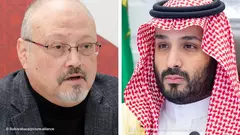 Jamal Khashoggi's murder and U.S. intelligence
Mohammed bin Salman – from darling to international pariah?
U.S. President Biden has announced he will be excluding Saudi Crown Prince Mohammed bin Salman from future talks between Washington and Saudi Arabia. Is this just lip service that will soon be subsumed by Saudi Arabia’s powerful bargaining position? Analysis for Qantara.de by Karim El-Gawhary
-
 The legacy of the Arab Spring
"The Syrian revolution is resumable today and tomorrow"
On the 10th anniversary of the Arab Spring we can’t quite escape that substance called remembrance. Yet, eschewing facile modes of nostalgic remembrance and/or tragic lamentation, we opt for asking questions. Yassin Al-Hajj Saleh reflects
-
 "An Imaginary Racism: Islamophobia and Guilt"
Deeply ignorant – Pascal Bruckner's hateful verbal crusade
In his controversial book published in 2020, French author Pascal Bruckner describes anti-Muslim sentiment as a fiction, claiming that the term "Islamophobia" is being used to silence criticism of the religion. Alexandra Senfft responds by highlighting the contradictions in a popular view of Islam and Muslims that leaves little room for nuance
-
 Germany and the discussion surrounding "Political Islam"
Berlin 2021 is not Tehran 1979
Several media reports in recent weeks have focused on the potential threat presented by Islamist groups in Germany. The discourse is fraught with generalisations, both sides accusing the other of their inability to differentiate, writes Tayfun Guttstadt
-
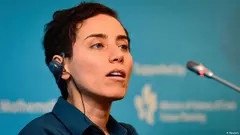 The Persian poetry of mathematics
From Omar Khayyam to Mirzakhani – Iran’s beautiful minds
Presenting a more nuanced vision of their common homeland, Iran, to Western imaginations, kindred spirits Omar Khayyam and Maryam Mirzakhani stand out against the twenty-first century backdrop of anti-Iranian sentiment and Islamophobia. By Hamid Dabashi
-
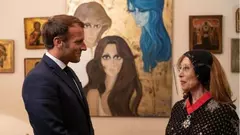 Culture and innovation in the Arab world
Where are the new Arab icons?
As the photo of Fairouz talking to French President Emmanuel Macron spread around the world, many asked if Arabs today had any contemporary stars of Fairouz's standing. In this essay for Qantara.de, Khaled Al-Khamissi answers this question and asks whether there is a place for up-and-coming stars in a world that is so hostile to creativity and originality
-
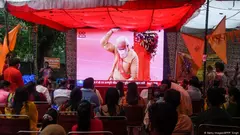 Dispute about the temple to Lord Ram in Ayodhya
The end of India's post-colonial consensus
With the construction of a controversial Hindu temple in the city of Ayodhya, Indian Prime Minister Narendra Modi is marginalising the Muslim community. With his rhetoric, he is intentionally breaking with the post-colonial legacy of the Indian independence movement that saw India as a secular, multi-faith state. By Dominik Müller
-
 Criticism of Islam versus Islamophobia in Europa
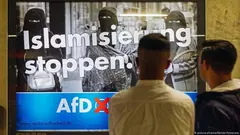
AfD's religious criticism is simply Muslim-bashing in disguise
Germany's AfD party claims its critical attitude towards Islam is religious criticism and hence falls under the right to freedom of expression. Yet the party fails to back its claim with convincing arguments, writes social scientist Ulrich Paffrath from the Frankfurt-based Academy for Islam in Research and Society in this feature for Qantara.de
-
 France, terrorism and identity politics
Emmanuel Macron's determination to pick the wrong battle
Emmanuel Macron appears to want to rekindle the old conflicts between Occident and Orient. He blusters on about a "crisis of Islam", as if oblivious to the more acute crises society is facing these days, says Stefan Buchen in his essay
-
 COVID-19 and terrorism
9/11, coronavirus – epochal events that force a re-think
This 11 September marked the nineteenth anniversary of the terrorist attacks in New York and Washington. The wide-ranging repercussions of those attacks in the years since 2001 are only just emerging. Throughout the coronavirus crisis, political patterns born of the era of terrorism continue to prevail. An essay by Stefan Weidner