Politics
Topics
-
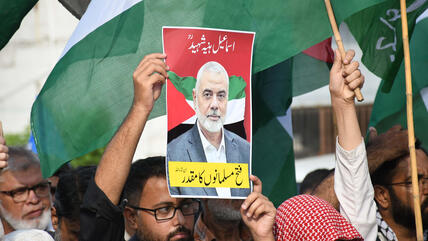 Pakistan and the war on Gaza
Commitment to pan-Islamic solidarity
With a population of 235 million, Pakistan is one of the most populous Islamic countries. There is great solidarity with Palestine among the population. The government views the war on Gaza primarily against the backdrop of the Kashmir conflict.
-
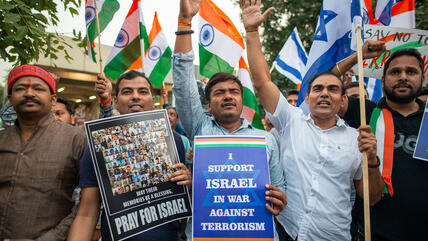 India and the Middle East conflict
India’s arm sales to Israel are a political statement
The ammunition supplies to Israel may bring more support for India within Western capitals. However, the Arab-Israeli crisis continues to shape the future balance of power in the Middle East, mainly against the Western countries and their Gulf allies, states the Indian Middle-East expert Omair Anas.
-
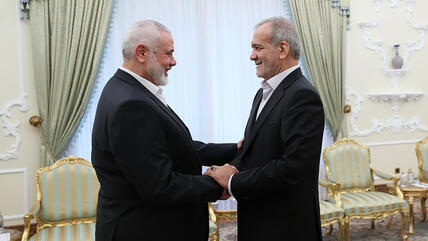 Iran and Israel
The spiral of violence escalates
The assassination of Hamas leader Ismail Haniyah is a drastic event. The Islamic Republic seems determined to take revenge, and a new armed conflict against Israel cannot be ruled out. In addition, everything the new president had promised is obsolete for the time being.
-
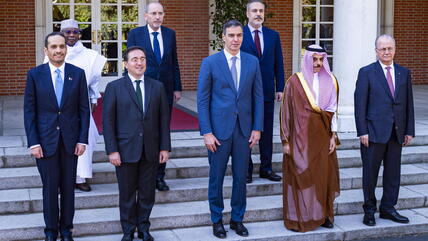 EU-Arab cooperation for Peace
From word to deeds
While all eyes continue to be turned towards the US for decisive action, a potential regional contribution should not be ignored. In this regard, tightening cooperation between European and Arab states could produce tangible progress to support Israeli-Palestinian peace making.
-
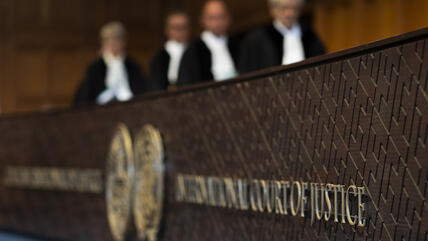 South Africa's lawsuit at the International Court of Justice
In the centre of an international legal maelstrom
Amidst rising geopolitical competition, South Africa has sought to position itself as a leading voice of the global south. The country sits outside the complex geopolitics that plague the Middle East but taking Israel to the International Court of Justice underlines the countries intentions, to play a new global role.
-
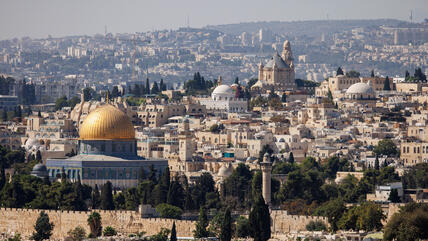 Post war order for Israel and Palestine
Robust resurrection of the peace process
Formulating a common strategy for peace and stability, optimizing cooperation with Arab countries, and implementing effective dialogue formats and cultural and economic policies. Just a few practical measures how the EU can provide positive impetus for a post-war order.
-
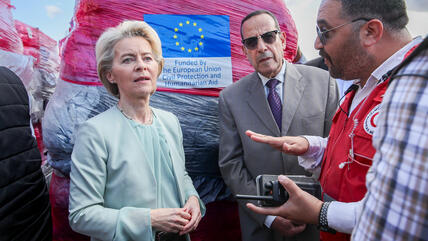 Europe and the Middle East
“Context is crucial”
Up to now, the EU has not assumed a significant mediation role in the Middle East. How can the EU foster trust and effectively contribute to a lasting peace solution following the Gaza conflict? What approach should it take towards authoritarian regimes in the region? Middle East historian Lorenzo Kamel offers insights.
-
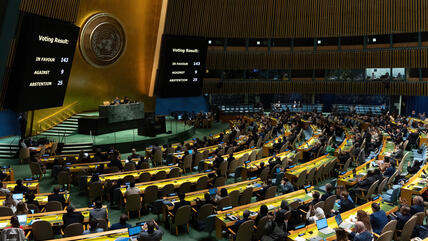 Recognition of the Palestinian State
Reducing the power gap
The mere recognition of Palestine as a state will not be the panacea, but it will be the essential, decisive turning point on the road to a just and sustainable solution to one of the most protracted and volatile conflicts in modern history.
-
 Europe and the Middle East conflict
“Strict observance of international law”
Recently, Norway, followed by the EU countries Ireland and Spain, has recognized a Palestinian state. How should the European Union respond and establish a unified stance? Can Europe provide positive impetus and ideas for a post-war order? How could these be realized?
-
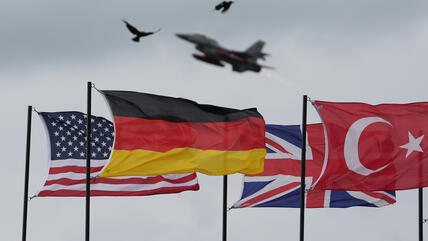 Turkey in NATO
Relationship status difficult
A more active role for Turkey in NATO, as demanded by the Turkish government, would be appropriate in view of the geopolitical challenges, but is meeting resistance within the alliance. How can the defence alliance achieve greater unity?
-
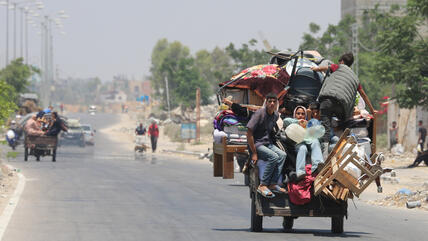 A new phase in the Middle East conflict
History and the war on Gaza
According to historian Rashid Khalidi, the Middle East conflict and the war in Gaza are in many ways a consequence of imperial interventions. “Resolution can only be based on dismantling entrenched structures of supremacy and discrimination”, he asserts. Only in this way a two-state solution can be realised.
-
 Relations with the Middle East
Europe can still make a difference
The European Union is faced with the challenge of finding a common line towards the Middle East that both takes into account the different national positions and promotes a coherent foreign policy. How can this be realized?
Most read articles
-
Women in Saudi Arabia
Caught in a System of Gender Apartheid
-
Sex tourism in Egypt
A bride for the summer
-
Sex education in the Arab world
Let's talk about sex, habibi!
-
New Faculty of Islamic Theology in Münster
"Theology is opening up and engaging with society"
-
Prostitution in Tunisia
The big reveal
-
"Postmuslim" by Youssef Rakha
One author, multiple selves