The era of the female protagonist
Topics
"Novels have the ability to probe the soul of a people," the Moroccan writer Tahar Ben Jelloun once said in an interview. And that is precisely what the three novels that were awarded the 2026 Katara Prize in October do. Drawing on the experiences of women, they seek to understand social change in their respective countries.
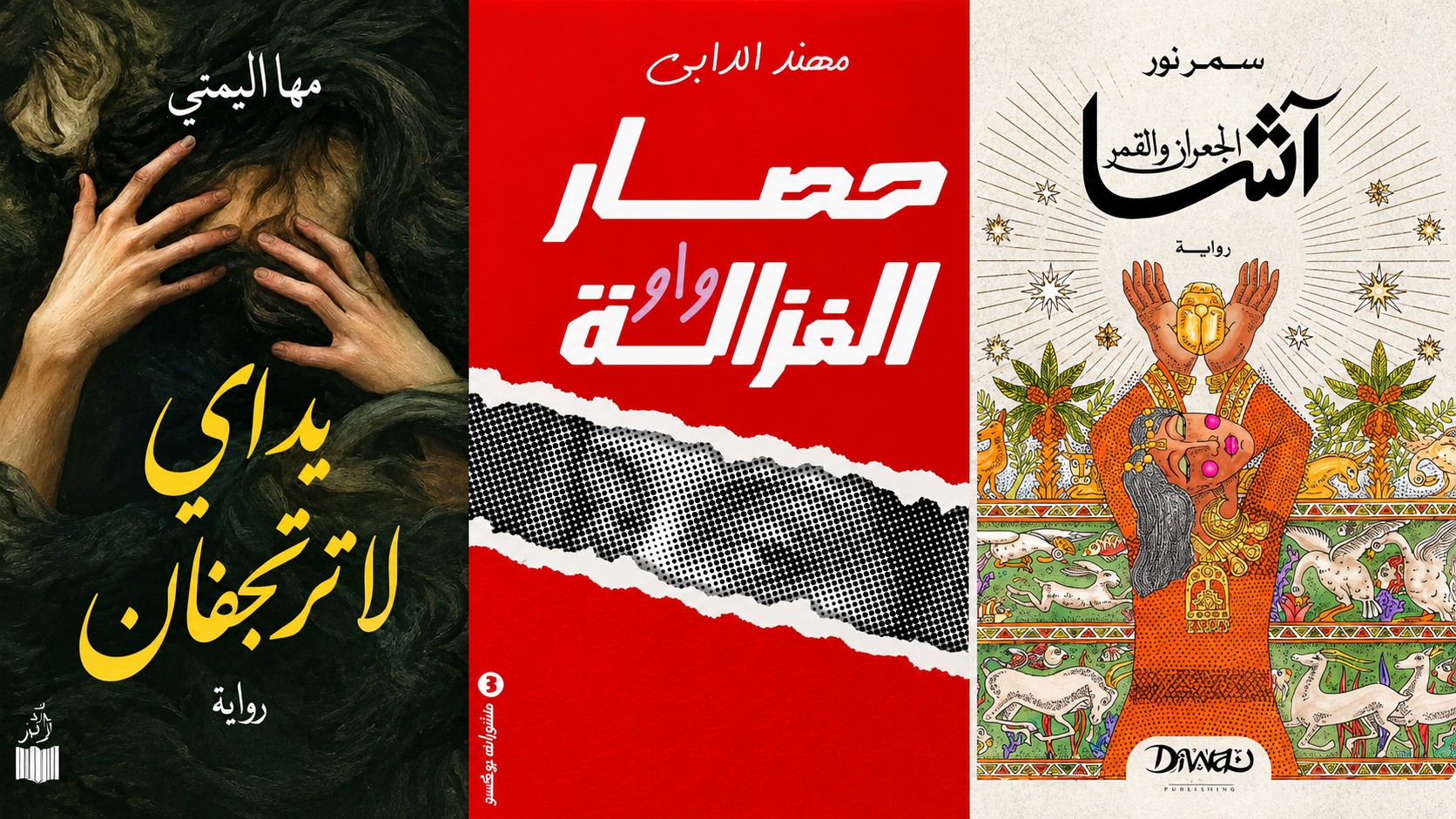
The prize, awarded by the Katara Foundation in Qatar, comes with a cash award of $30,000. In addition, the winning novels are translated into English. The award-winning works in the "Published Arabic Novels" category are:
آشا الجعران والقمر (Asha, the Scarab and the Moon)
Samar Nour (Egypt)
120 Seiten, published by Diwan
January 2025
حصار الغزالة واو (The Siege of the Gazelle Wau)
Mohannad Ragab al-Dabi (Sudan)
202 Seiten, published by Booktino
December 2025
يداي لا ترتجفان (My Hands Do Not Tremble)
Maha Abdulaziz al-Yamani (Saudi Arabia)
232 Seiten, published by Athar
December 2025
Asha and the memory of Nubia
In "Asha, the Scarab and the Moon", Egyptian author Samar Nour brings to life the history and cultural heritage of Nubia in southern Egypt, and the people's deep connection to the Nile and the land. She draws on a family story from her childhood—the story of her Bosnian grandfather and his marriage to her Nubian grandmother.
The story is set in the 19th century. Asha, the village sage's daughter, grows up in the "Cave of the Scarabs", high on a mountain above the Nubian village of al-Shabbak, and is deeply influenced by her mother, a gifted storyteller.
The novel blends history and fiction, bringing Nubian rituals, songs and beliefs vividly to life. Words from the Nubian dialect are woven in throughout, their meanings left to be gleaned from context alone.
Through the story of Asha's family, the novel chronicles the historical upheavals in the region, from the flight to Nubia of the surviving Mamluk princes following the Ottoman massacre at the Cairo Citadel in 1811, to the British occupation in 1882 and the family's resistance against it.
Women are at the heart of the narrative: not mere witnesses to historical events, but active participants and bearers of responsibility. They resist and struggle against the loss of their homeland, war, famine and social constraints, and they play a crucial role in preserving and passing on collective memory. The novel also recalls Amanirenas, the ruler of the Kingdom of Kush, who stood up to the Romans, led her warriors, and lost an eye in the process.
Samar Nour does not simply document history as it has been handed down. Rather, she examines how the narrative itself changes over generations. In doing so, she reveals how collective memory shapes a community's understanding of its own past and identity.
The gazelle as symbol of a woman in the midst of war
From Egyptian Nubia, Mohannad Ragab al-Dabi's work "The Siege of the Gazelle Wau" takes us further south to Sudan. The war raging there serves as the backdrop for the story of a family whose world suddenly comes crashing down.
After living abroad for 20 years, Wisal al-Dardiri returns from Dublin to the Sudanese city of Wau, accompanied by her husband and their two daughters, just a few days before the war breaks out. She hopes that the journey will help her reconnect with her father and her roots.
But what was supposed to be a one-month family visit turns into hell on earth. Armed groups begin fighting for territory and influence, while the civilian population pays the price for a conflict it did not choose.
The narrative follows the fate of the al-Dardiri family and their daily lives during the war. Their own home becomes a place of terror; food, water, and medicine become scarce commodities, while interpersonal relationships are put to the test in the face of murder, hunger, rape and displacement.
Al-Dabi refrains from repeating the narratives of the warring parties or their political and military justifications. Instead, he focuses on the civilian population and the impact of the war on their lives. It is primarily women who "bear the burden of survival in a war unleashed by men, but which destroys everyone equally," al-Dabi writes.
Wisal's attempt to protect her two daughters becomes a test of the little humanity and compassion that remain amid the brutality. "Their only dream became to leave this country—a country where men's wars are won on women's bodies; a country where people experience their nightmares while awake rather than asleep," the novel states. The characters' fate thus hangs in the balance, their end as impossible to foresee as that of the war itself.
The moral dilemma of euthanasia
In her work "My Hands Do Not Tremble", Saudi author Maha Abdulaziz al-Yamani explores the subject of euthanasia and the ethical conflicts that come with with it.
The nurse Hasna is under heavy family and financial pressure. In her work, she cares for patients who are suffering excruciating pain in the final stages of their lives. Out of compassion, she ends the lives of some patients for whom she sees no chance of recovery. Yet this plunges her into a moral conflict that extends far beyond her medical practice, touching on the human right to self-determination as well as the limits of compassion and responsibility.
The novel's title has a double meaning. On one hand, it conveys steadiness and the ability to act in critical situations, but in light of the protagonist's dilemma it takes on another more complex meaning. Steady hands may underline her capacity to act with confidence and resolve, yet what inner conflict lies behind this apparent calm?
The novel is deeply rooted in psychological and philosophical approaches; it explores the characters' motives and inner struggles. In doing so, it challenges readers to question their own notions of justice and compassion, without offering any definitive answers.
Women and the limits of their freedom
The female characters in all three novels step beyond the boundaries of their traditional roles, exposing the contradictions of their respective societies.
From reclaiming Nubian memory and resisting the erasure of history, to protecting family in the face of war, to ethical dilemmas between life and death, the novels raise fundamental questions: about women's capacity to make decisions, the limits of their freedom and the price they pay when they take on responsibility for life.
This text is an edited translation of the original Arabic. Translated from Arabic to German by Jana Treffler and to English by Max Graef Lakin, with the support of AI-assisted tools.
© Qantara