"Revolution has become more conceivable today"
Topics
Last week, German Chancellor Friedrich Merz said "we are now witnessing the final days and weeks" of Iran's regime. Do you agree?
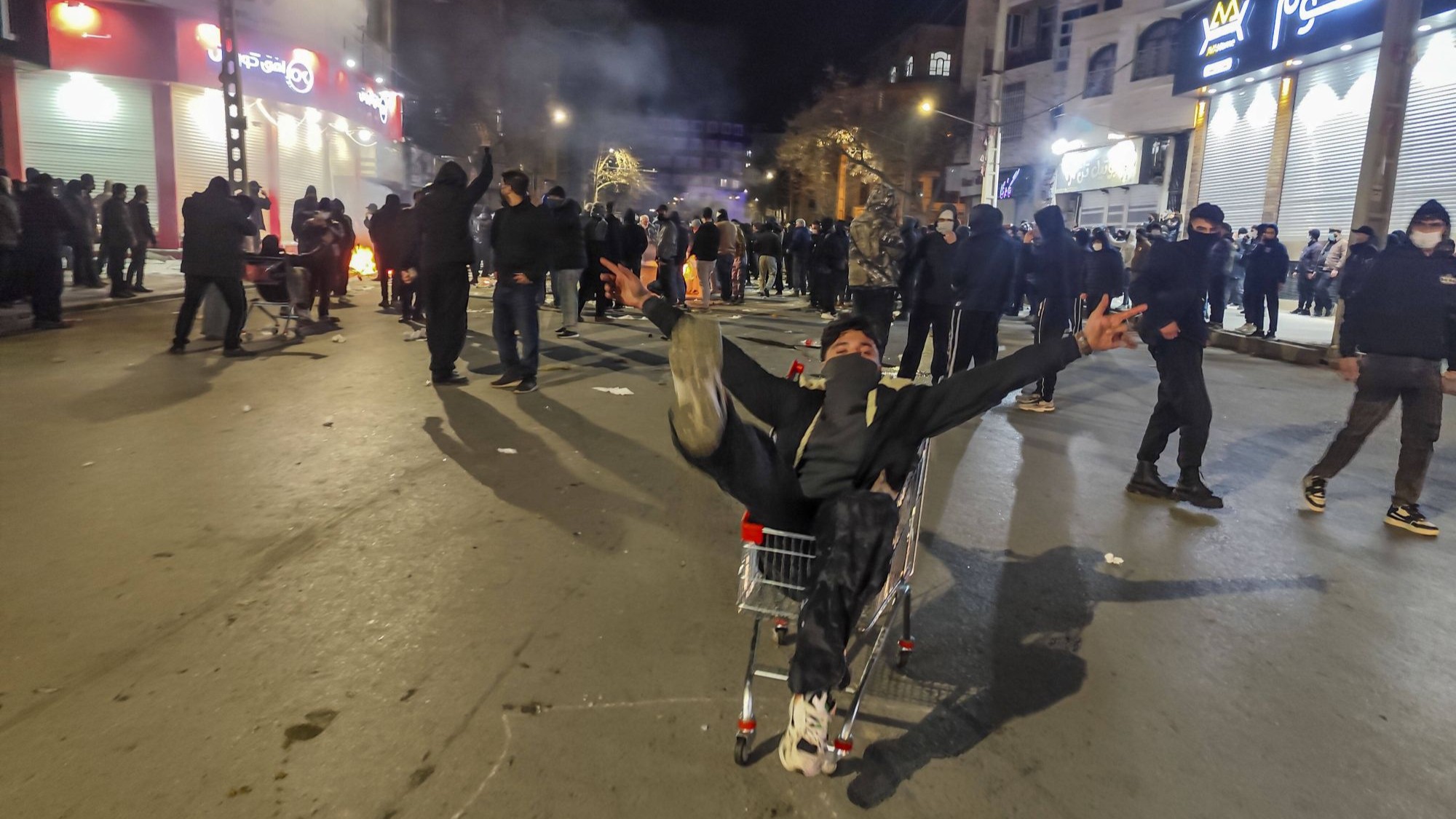
The Islamic Republic is in a very vulnerable place. The feeling, both inside and outside the country, is that this is the last battle, which is in fact one of the chants heard on the streets: "in akharin nabarde", sometimes followed, by royalists, with "Pahlavi barmigarde" ("Pahlavi will return").
Iran has experienced extreme sanctions for decades, as well as a corrupt, inept government that's filling the pockets of its own while depleting those of ordinary Iranians. Iranians have risen up several times in nationwide protests to demand more rights and freedom. The current state—a devastated economy, the rial plunging to record lows and extreme inflation—cannot continue. But whether the Islamic Republic will fall is another question.

In 2023, you told Life and Letters that for a revolution to happen, enough people have to believe that it can happen and argued—drawing on the sociologist Charles Kurzman—that revolutions become possible only once they are widely conceivable. Is that the case today?
Yes. Even during the "Woman, Life, Freedom" uprising of 2022/2023, the revolution had become conceivable. But that uprising wasn't perceived to be as inclusive as what we're seeing now.
Revolution has become more conceivable today because it's based on many layers of demands and uprisings—student uprisings, union uprisings and women's rights uprisings. Now this economic disaster has hit the country, and all these different factors are converging.
Human rights groups report thousands of deaths and arrests amid a widespread internet blackout, which has now been only partially eased. How does the level of repression compare to previous protest waves?
Because of the complete communication shutdown after 8 January, we still don't know the extent of the killing of protesters that has taken place. Some reports have trickled out, but there is still a blackout on the internet and most communications abroad, so we don't have a complete picture.
However, we do already know that the brutality of the repression has been much greater than it was during the "Woman, Life, Freedom" uprising, when more than 500 people were killed. Some not very reliable sources, such as the Iran International TV channel, have the number of dead as 12,000, which is an incredible number to fathom. Others have kept their estimations around 2000. All Iranians are waiting to understand the full extent of what's happened.
We have heard that this time, security forces were given license to shoot protesters with live ammunition. They've killed many more people directly and intentionally than in previous protests. An image surfaced from the Kahrizak prison in the south of Tehran showing dozens of black body bags. This was actually something that was broadcast on Iranian state television itself, with the rationale, I assume, that it would act as a warning to people.
It's been very difficult to obtain accurate news. The only information or footage that we're getting is from people who have filmed on the streets and then left the country, or had a Starlink connection before those too were shut down.
President Masoud Pezeshkian initially called the protests "legitimate". Supreme Leader Khamenei later called protesters "saboteurs". What do these contrasting messages reveal?
The president's conciliatory language came early, when the state still believed it could contain the protests. But once the protests spread beyond the bazaar, quickly engulfing all 31 provinces in Iran, the Supreme Leader spoke and has not changed his stance since. He continues to refer to the protests the way he has in all uprisings, as foreign-instigated.
To what extent does open US and Israeli support for the protests impact the movement?
We've seen the impact of Western interventions in Iraq and Libya. When the war broke out in June, with Israeli and then US attacks on Iran, Iranians came together to oppose the war. In fact, the notion of Western intervention is what the regime and others are using to discredit these protests. They claim these protests are instigated by Mossad [Israel's intelligence agency] on the ground and are not authentic. Mossad forces may very well be on the ground, but that does not mean that the core of these protests is not authentic. These are the legitimate demands of the Iranian people.
We can't deny that people who have repeatedly risen up to improve their political situation without success are at an impasse, with some in Iran saying, "Can't Trump just come and take out Khamenei? Can't he do what he did with Maduro?"
How central is the current economic crisis to the expansion of the protests, compared to broader political demands?
Obviously, the economic crisis is central to these protests. Even though the economic situation was not great a few years ago, Iranians were still able to afford to live and, if they really couldn't put up with the Islamic Republic and its restrictions, to leave the country, as many have. Now, because of the devaluation of the rial and extreme inflation, even leaving has become impossible for most.
At the heart of the scene are bazaar merchants who played a pivotal role in the 1979 Islamic Revolution and have maintained ties to the regime ever since. They now seem to be reconsidering their loyalty. Do you sense a significant shift?
Iranians know that during the 1979 revolution, the moment that the revolution really gained ground was the oil strikes and the bazaar merchant strikes. That is when things became inevitable. For that reason, seeing the bazaar merchants and other unions on strike has been so important for Iranians this time.
Bazaar merchants are at an impasse; they've said they won't end their protest until the government does something drastic. The currency crash is existential for them. They can't import goods or run viable businesses.
Who are the political figures leading the protests in the streets?
There aren't any prominent political leaders on the ground, which makes this uprising even more remarkable. The "Women, Life, Freedom" movement was also famously leaderless.
Grassroots figureheads do exist, like Narges Mohammadi, the Nobel laureate who is currently in solitary confinement, or other prominent labour, student and women's rights activists.
There are also some political organisations among minorities, such as the Baluch and the Kurds. But you can't point to any single unifying organisation or figure. In the absence of political leaders who can function on the ground, people are holding up these young people, who are losing their lives on the streets, as their political champions. They're pledging their blood to the blood of the martyrs.
[Internationally,] there is also the Mujahedin-e-Khalq organisation of Maryam Rajavi, more a cult than a political organisation, well organised but totally discredited with Iranians. At this point, the most prominent opposition figure is the son of the former Shah of Iran, Reza Pahlavi. He has issued near-daily statements and encouraged Iranians to go out on the streets and protest.
How enthusiastic are Iranians about the exiled Pahlavi?
For four decades, the Islamic Republic has systematically repressed internal opposition: targeting civil, labour and women's rights activists through imprisonment, exile and violence, leaving Iran without a structured political alternative.
In this vacuum, Reza Pahlavi, despite having no governing experience and having left Iran as a child, is increasingly being framed as the last hope for Iran.
A lot of Israeli-, Saudi- and US-supported media channels, such as Iran International, probably the most widely watched news network in Iran right now, are pushing the narrative that Reza Pahavi is Iran's last saviour.
Yet with a near-total communications shutdown and no reliable polling, it remains impossible to assess public support. Given the fact that Iranians got rid of his dad 47 years ago, it's unlikely that a majority of Iranians want a future with Pahlavi.
What are the most likely scenarios ahead?
The worst-case scenario: the U.S. attacks and Israel gets involved, dismantling the Iranian state and infrastructure and leaving Iran a balkanised landscape. Iran is an extremely diverse national patchwork. Those who would like to see a fractured and weakened Iran could take advantage of that diversity to break the country up into Baluchistan, Kurdistan and so on.
Second scenario: the regime survives but makes concessions; negotiates with the US, gives up its nuclear programme and changes course. That's what the US really wants.
Third: Trump might make a deal with regime insiders, as he did with Maduro's vice president, to remove the current leader and install someone who will acquiesce to US demands on its nuclear programme in return for the US withdrawing some sanctions and allowing Iran to survive to some extent. Trump could also bring Reza Pahlavi in, and then God knows where it will go from there. Either Pahlavi will stand by his word and allow for elections, or we revert to a monarchy.
Fourth: the regime survives and becomes much more repressive, and kills many more people. The US might attempt to intervene on behalf of the Iranians, but only symbolically. It might destroy some military infrastructure and ballistic missiles, but that's about it.
The most hopeful scenario: the regime crumbles because of a devastated economy and sustained protests, without foreign intervention. Iranians, who have many incredible leaders among them, many of whom are in prison, organise elections and build a bright future based on democratic foundations.
© Qantara.de