Mass anger in a political void
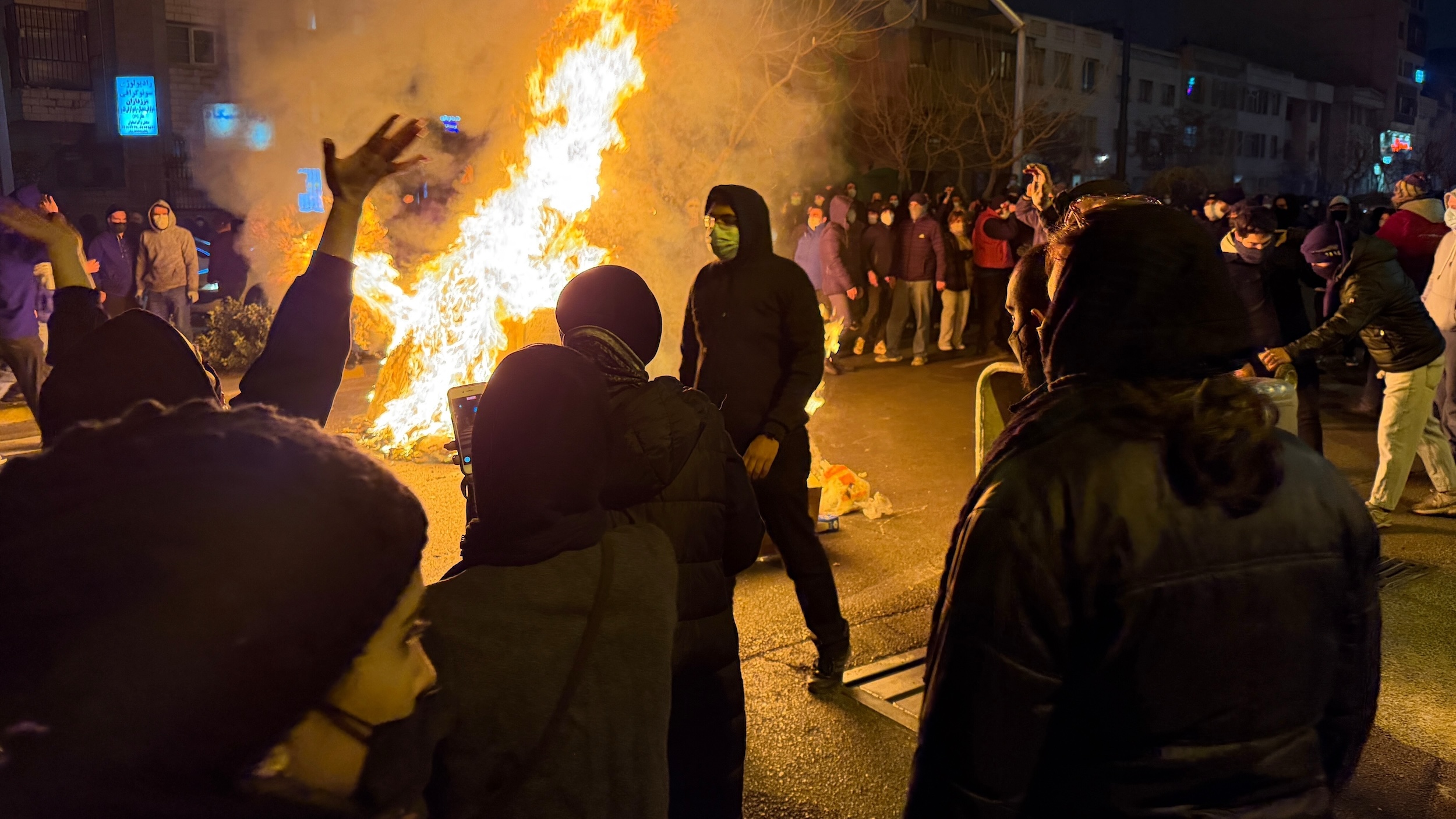
Not since the 1980s, marked by post-revolutionary armed conflict and the Iran-Iraq war, has the Islamic Republic been shaken to this extent.
While the 2022-2023 "Women, Life, Freedom" movement primarily mobilised urban youth and minorities on the peripheries, the current wave has achieved what no other had: uniting social, geographic and generational strata that, in recent years, had mobilised separately.
Since 8 January, when authorities imposed a total internet blackout, the few images reaching the outside world point to sustained nocturnal protests and exceptionally violent repression. Estimates suggest at least 2400 protesters have been killed.
This article retraces the uprising so far, highlighting its key moments, slogans and socio-spatial evolution.
The bazaar strike
At the end of 2025, Iran's currency, the rial, collapsed. On 28 December, electronics merchants in Tehran's Grand Bazaar, particularly sensitive to hyperinflation and the rising cost of imported goods, closed their shops and took to the streets.
While sanctions play a role, Iran's economic crisis is primarily the result of structural corruption and the allocation of subsidised foreign currency to actors close to the Supreme Leader. Officially, these funds are for the import or production of essential goods, over which these actors hold monopolies.
In reality, a large portion of these dollars are resold at market rates or simply leave the country. According to economist Saïd Laylaz, between 40 and 50 billion dollars are "stolen" annually, accelerating inflation and the loss of value of the rial, which hits the poorest households hardest. In October, Iranian economic daily, Donya-e-Eqtesad, estimated that 36% of the population lived below the poverty line. Since then, the situation has worsened.
The political identity of the protesters is significant. Historically conservative and often religious, Iran's merchant class, the bazaaris, were a driving force of the 1979 revolution and maintained ties to the state ever since. Their mobilisation signals that the state is no longer fulfilling its minimal function: keeping the economy afloat.
By directly confronting the government—"Pezeshkian, shame on you, resign!"—the bazaaris' grievances resonated widely, touching on wealth distribution, state inefficiency and elite corruption. From the heart of the traditional economy, the strike quickly spread to other social groups nationwide, igniting a national revolt.
Unprecedented expansion
From day two, the uprising spread to Tehran's working-class neighborhoods and major provincial bazaars. The first to join were the impoverished working and middle classes, for whom life has become materially impossible. With the minimum wage at $90 per month and food prices rising rapidly, households have reached breaking point.
The movement quickly diversified socially. Residents of working-class neighborhoods and industrial areas were joined by students, small business owners and agricultural workers. Unprecedentedly, the mobilisation is not limited to the youth but includes people in their 50s and 60s, a generation that witnessed the 1979 revolution.
There is novelty also in the geography of the protests. Small and medium-sized towns (10,000-100,000 inhabitants) in Khorasan and the Zagros mountain range, running from central-southern to western Iran, have become central hubs. These regions, typically conservative and religious, stayed on the sidelines during the 2022–2023 protests. This is the strata from which the state traditionally drew part of its social base and recruited its security forces.
But major social vulnerabilities are now concentrated in these regions: high structural unemployment, few opportunities for youth and exhausted working-class families. According to the Iranian Statistics Center, the average unemployment rate reached 12% in 2023, four of the seven hardest-hit regions are in the Zagros range—a likely underestimation, especially among young graduates.
Initially, some regions—Kurdistan, Kurdish areas in West Azerbaijan and Baluchistan—remained cautious. Still suffering the collective trauma of 2022–2023, these regions bore a disproportionate share of the repression, accounting for nearly half of the over 551 deaths recorded. Interviewed sources and social media analysis suggests that the prevalence of monarchist slogans among movements in central Iran also acts as a deterrent for many minorities (the Azerbaijan region, for example, has been notably quiet during this period), due to the Perso-centric nature of contemporary monarchist discourse and the memory of repression under the Shah.
7-9 January marked a turning point. Seven Kurdish parties in exile called for a general strike, strongly followed in the Kurdish regions, and Baluchi religious dignitaries declared their support, bringing protesters out after Friday prayers. Reza Pahlavi, exiled son of the last Shah, also released a statement urging the protesters on. In major cities, the mobilisation became massive, and protests took place in almost all regions of the country.
Slogans are revealing
These protests mirror the geographic breadth of the "Woman, Life, Freedom" movement, the urban and rural working-class participation of the 2017–2019 uprisings and the massive urban mobilisation of the 2009 Green Movement.
According to analysis of the protests by Radio Zamaneh and the Tel Aviv-based INSS, 53-60% of slogans directly targeted Ali Khamenei and the regime ("Death to Khamenei", etc.) Slogans pointing to a clear political program, however, were deeply absent. These slogans reflect not only a total rejection of the existing order but also ideological stagnation.
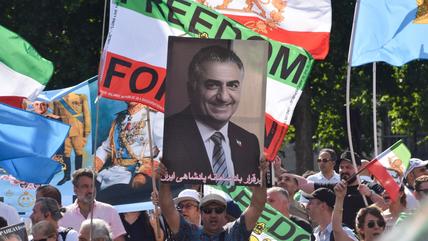
Iran's political void partly explains the prevalence of monarchist slogans, representing about 20-27% of those recorded. The monarchist current is reinforced by diaspora satellite channels that heavily promote Pahlavi. Framing the movement as monarchist, as these channels do, has a self-fulfilling effect: protesters begin to identify with and amplify the message, not out of support for restoration, but due to a lack of alternatives.
Producing nostalgia, courting war
Through satellite TV, viral content, and alliances with Netanyahu and Trump, Iran's monarchist elites are staging a comeback. From exile they are attempting to co-opt Iran's opposition by recasting the Pahlavi dynasty as a golden age of freedom.
For many, Pahlavi does not embody a political program but a negative symbol: rupture with the Islamic Republic. In this regard, his role is less that of a leader than that played by Khomeini in 1979. Pahlavi is a crystallising figure invested with contradictory expectations, made central both by the regime's repression and the void it has produced.
Total repression
From 8 January, the country was plunged into an almost total information blackout, cutting internet access and deploying military jammers to neutralise satellite connections like Starlink. This strategy aims to prevent coordination among the protesters and suppress evidence of repression.
The few reports coming from inside Iran indicate a simultaneous intensification of protest in major cities until January 11 and a brutal escalation of repression, resulting in several thousand deaths. Images show the mobilisation of militiamen, police, military personnel and Revolutionary Guards across numerous cities and neighborhoods, with military trucks equipped with heavy machine guns, while testimonies describe overcrowded morgues, particularly in Tehran.
So far, Khamenei's response has been an escalation of terror, spreading death on a scale comparable to other besieged regimes such as Bashar al-Assad's. The regime, facing a political deadlock and confronted with its own contradictions, has decided to eliminate protesters, who have been labeled as "demonstrators", then "rioters" and now "terrorists", allegedly guided by external forces.
The regime's forces, despite being socio-culturally similiar to many of the protesters, commit brutal acts of repression. Under the internet blackout they have been radicalised by monopoly-holding state media that emphasises the threat of intervention by the US and Israel and the deaths of security personnel.
Caught between a state willing to do anything to survive, radicalised security forces and external political agendas, the Iranian people—in all their diversity—remain absent from strategic calculations, while paying with their lives.
Yet today, more than ever, they alone hold the legitimacy to drive a democratic transition, which is the only way out of violence, authoritarianism, and political deadlock.
© Qantara.de