The singing revolutionary
Topics
"I am Sahrawi. We choose to live as free people. We do not accept humiliation, we do not forget our homeland, and we will not trade our land for gold."
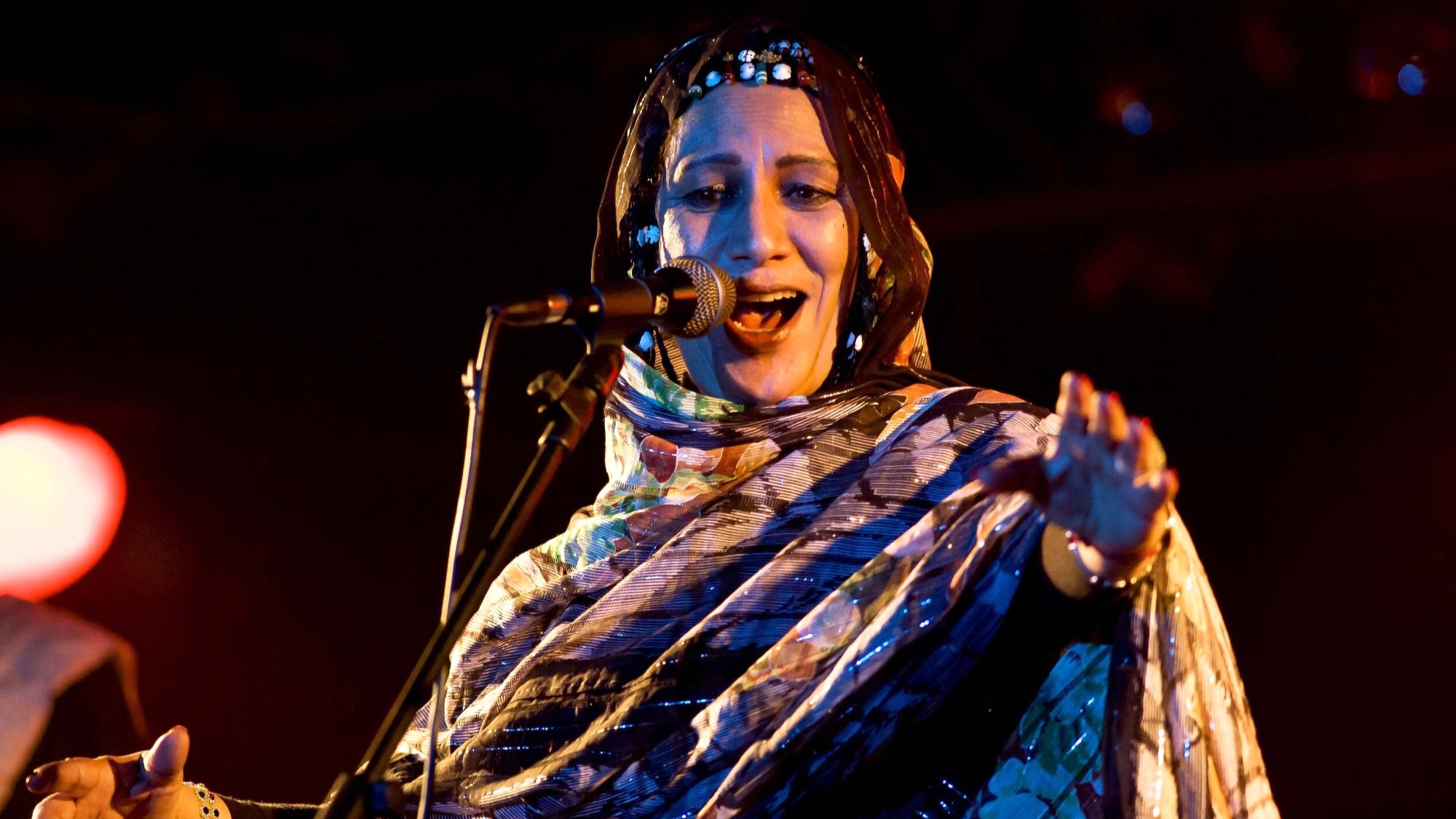
With these words – sung during one of her final recording sessions in a Madrid studio in 2012 – the artist Mariem Hassan makes clear just how closely her life and work were bound up with the struggle for Western Saharan independence, a conflict that is among the longest-running in Africa.
The 90-minute documentary "Haiyu – Rebel Singer Mariem Hassan and the Struggle for a Free Western Sahara" explores the life of the Sahrawi singer, who was born in 1958 in the Saguia el-Hamra region. The film traces her journey – from her early years under Spanish colonial rule and the departure of the last Spanish soldier in 1976, through years of war and displacement, to her death in 2015.
Produced as a collaboration between "Saharawi Voice", a film collective based in the Sahrawi refugee camps, and the Swedish group RåFILM, "Haiyu" (2024) was most recently screened as part of the "Western Sahara Action Weeks" in Berlin and other German cities.
The film uses Mariem's music as a lens through which to explore the history and collective memory of Western Sahara. Drawing on an archive spanning several decades, it brings together field and radio recordings, concert footage from performances both inside and outside the refugee camps, as well as interviews with members of her family, friends and fellow musicians from the band "El Uali", which she joined in 1976.
From the camp to the international stage
"She was still young, but she sang as if she carried the weight of an entire nation on her shoulders," said the poet Bachir Ali, who would go on to write several songs for the singer, remembering their first encounter. "We called her 'Mariem the Revolutionary,' because for her there was no distinction between political struggle and the stage."
The two met in 1976 at a refugee camp in Algeria. Like tens of thousands of others, they had fled the Moroccan military offensive against the Popular Front for the Liberation of Saguia el-Hamra and Río de Oro (known as the Polisario Front).
Hassan's fame soon extended beyond the refugee camps. In the late 1980s, she gave her first concerts in Europe, and before long was performing in numerous countries. She appeared at international festivals, and her revolutionary songs reached an ever-growing audience.
Songs such as "Haiyu," which gives the film its title, have become part of the collective memory of the Sahrawi people: "Long live the revolutionaries, long live! We are all revolutionaries. Oh, revolutionary people of the Sahara, we are the revolutionaries, and the land of the Sahara is free for the Sahrawis," she sings.
Alongside Hassan's life story, the documentary provides background on the conflict that shaped the singer's life. "After the Spanish withdrew, we were attacked by Morocco from the north and Mauritania from the south," recalls former Polisario commander Mohamed Ylidia in the film. In 1976, with Algeria's support, the Polisario Front proclaimed the Sahrawi Arab Democratic Republic, which failed to gain widespread international recognition.
In 1978, the Polisario declared a ceasefire with Mauritania. Following the fall of the Mauritanian government, the movement wanted to give the new leadership in Nouakchott an opportunity to reconsider its predecessor's policy on Western Sahara. "We therefore turned to guerrilla warfare (against Morocco) and managed to regain around 80 percent of our territory by 1980," Ylidia explains.
With the support of the United States, France and Israel, Morocco began building a defensive wall fortified with landmines in 1980 to secure the so-called "useful triangle". This area encompasses Laayoune, Smara and the phosphate mines of Bou Craa.
Meanwhile, the Polisario Front continued its war of attrition against Morocco until it agreed to a ceasefire in 1991 as part of a UN peace plan. The plan also provided for a referendum through which the people of Western Sahara would be able to determine their own future.
Ylidia describes this peace process as a "referendum conspiracy," alluding to the fact that the referendum has yet to take place. In early November 2026, the Security Council even announced that the mandate of the UN Mission for the Referendum in Western Sahara (MINURSO), whose remit included organising the referendum, would not be renewed.
Women's struggle for liberation
Hassan's story also offers a way of telling the story of Sahrawi women's involvement in the liberation struggle. During the war, they did not only support the fighters; they also took over the administration of the refugee camps and organised everyday life in the men's absence.
"Women played a vital role; they made sacrifices, fought and persevered – as teachers, writers and directors," Hassan says in an archival recording. "Colonialism had stripped women of their role – and all this was for freedom and the homeland."
Together with her band El Wali, Hassan sought to support the Sahrawi people. "We organised concerts in the middle of the war to raise morale, travelling from one place to another at night," recalls band member Atiya Oubeyda. During one performance, Hassan was told that her brother had died. Yet she carried on singing. "Stopping wouldn't bring him back," she is said to have told the audience.
Over time, the Western Sahara issue faded from international attention. It was not until the Gdeim Izik protest camp in October 2010 that it made international headlines again. Moroccan security forces forcibly dismantled the camp – an operation that drew widespread criticism at the time.
In the film, Hassan's voice can be heard over these scenes: "The enemy controls the media, but the camp exposed him. The occupier can find no peace; he fears hell. While revolutions are usually led by leaders, here it is the camp that leads the revolution."
In her music, Hassan also draws a connection between the Gdeim Izik protests and the beginnings of the Arab Spring. She sees the spark of resistance spreading from Western Sahara to Tunisia and from there to other countries across the region.
Hassan's fight against cancer
Alongside her life as an artist and activist, Hassan was also a mother. Her youngest daughter, Aqila Mohammed, born in 1993, describes in the film how the family moved from one refugee camp to another before finally settling in Spain in 2002.
A few years later, Hassan was diagnosed with breast cancer, but she did not stop singing. In one scene in the film, she offers a prayer to God: "Oh Lord, heal me of my suffering. My song still lives in my heart – and my daughters, my husband: do not be afraid, freedom is coming, it is surely coming." Despite her advanced illness, the singer gave one final concert in the Tindouf refugee camps in 2014.
Hassan died in August 2015, aged 57, in Smara camp and was buried in Tindouf. Her friend and fellow band member Tarba Babou looks back on the singer's final moments in "Haiyu": "She wanted to pass the baton to a new generation that would continue the struggle." But Western Sahara had still not achieved independence. That pain stayed with her until the very end.
This text is an edited translation of the Arabic original; translated by Jess Smee with the support of AI-assisted translation tools.
© Qantara.de