Can English replace French in Algeria?
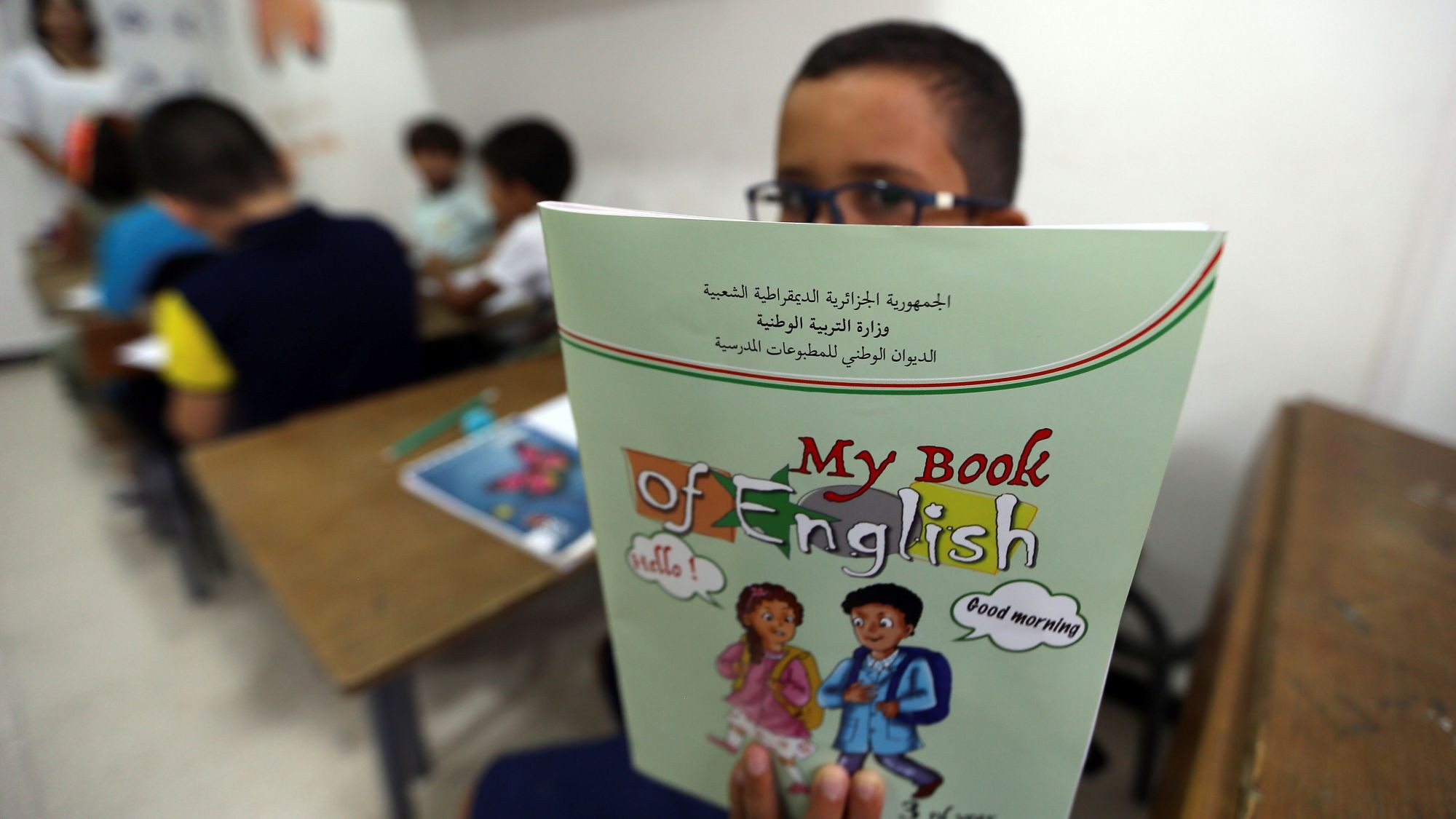
For decades, Arabic and French have maintained a fragile and often tense linguistic balance in Algeria. In recent years, however, a new player has entered the game: English. Once largely confined to academic research and social media, it is now gaining ground in education and the wider economy, and is increasingly shaping the everyday language of younger generations.
Since the 2025-2026 academic year, faculties of medicine and science have started switching their first-year curricula from French to English, as part of a government push to make English the language of instruction in universities.
This turning point had already been set in motion in 2022, when President Abdelmadjid Tebboune announced that English would be introduced from the third year of primary school, alongside a gradual scaling back of French. This shift has extended beyond the classroom reaching to state institutions: Air Algérie has dropped French from its tickets, while Algérie Télécom now issues its bills in English.
A political choice
This linguistic shift is about more than simply replacing one language with another. It is a sign of a deeper renegotiation of identity and memory, and cannot be understood in isolation from its political context.
While the adoption of English is officially presented as a pragmatic, forward-looking choice, tied to labour market demands and greater engagement with scientific global research, it also intersects with rising political tensions in Algerian-French relations. In this context, language is brought back to the fore as both an instrument of influence and a lingering symbol of an unresolved colonial legacy.
Across West Africa, from Niger to Burkina Faso and Mali, as well as in Tunisia, similar shifts are underway, as French gradually gives way to local languages and English in education and administration, as a part of broader effort to redefine its post-colonial narrative.
"This shift cannot be seen simply as a move towards openness, but must also be understood as a project shaped by ideological and political considerations", argues Aomar Abdellaoui, a professor of sociolinguistics in the French department at the University if Bejaia, in an interview with Qantara.
Since independence in 1962, language in Algeria has been closely bound up with questions of sovereignty and liberation from colonial legacy. Arabic lay at the heart of the national Arabisation project, intended to rebuild a collective identity after more than a century of French colonial rule, which left a cultural and linguistic imprint that is visible to this day.
But Arabisation ran up against a complex linguistic reality. While Tamazight retained its deep roots in society, French continued to dominate in administration, higher education and knowledge production. In this context, the recent rise of English in Algeria's educational system has emerged as a new force, quietly reshaping the linguistic landscape.
In schools, Arabic is the main language of instruction, with French taught as the first foreign language. English was introduced as a second foreign language in 1993 at lower secondary level. At university level, French has long remained the primary language of instruction in faculties of medicine and science, while the humanities remain anchored in Arabic, with French still used to varying degrees in academic sources and partial instruction. Against this backdrop, the current shift appears as an attempt to reposition English within Algeria's educational system.
English remains a foreign language
According to Abdellaoui, the way English is being integrated into public policy reflects a top-down approach that risks reproducing past imbalances rather than addressing them. He points to the failure of Arabisation to fully replace French, which remains dominant in Algeria's administration and among the cultural elite.
He adds that, at the pedagogical level, the Ministry of Education has rolled out teacher training programmes for English instruction at pace, even though most teachers were themselves educated in French or Arabic. In practice, these programmes remain limited, often amounting to little more than procedural formality rather than meaningful educational reform.
In this context, Abdellaoui argues that the shift towards English is likely to face significant constraints, and that these efforts may ultimately replicate the outcomes of Arabisation. The risks may be even greater at primary school level, where a new foreign language is being introduced into a system that is already struggling with multilingualism.
English still has a limited presence in everyday life , which raises questions about how firmly it can take hold socially. Outside certain digital and professional settings, it remains largely unfamiliar to most Algerians, making it harder for it to establish itself as a stable language of education and knowledge. There are no reliable figures on the number of English speakers in Algeria, but according to a 2022 report by the International Organisation of the Francophonie, around 15 million Algerians, roughly a third of the population, speak French alongside Arabic or Tamazight.
Nevertheless, a field study conducted by Ibn khaldoun University in Tiaret points to strong support among both students and teachers for replacing French with English, driven largely by social and economic factors. English has also gained momentum from the backing of some political leaders who see it as the country's future primary foreign language.
This reflects a broader shift in the labour market, where proficiency in English is becoming increasingly important for employment and career progression. Its rise therefore, is not simply the result of political decisions, but also of growing social and economic pressures, not least because it does not carry the same colonial weight as French in the collective memory.
Academics are sceptical
This policy has stirred concern in academic circles. Abderrezak Dourari, a linguist at the University of Algiers, warns that a forced shift in language could unsettle both the structure of intellectual elites and the way knowledge is produced.
In an interview with Qantara, he says "scholars who have built their careers in Arabic or French risk falling into a form of intellectual silence for at least a generation, as they lose the linguistic tools their work relies on."

He adds that the language of teaching and research is far more complex than that of learning, shaped as it is by concepts rooted in a particular linguistic system. Moving too quickly to English would mean asking academics to rebuild their "linguistic habitus" from scratch, a process that takes time and could affect both the quality and continuity of knowledge production.
Yet the experience of countries such as Rwanda, which switched from French to English as the main language of instruction in 2008 as part of a broader political and economic realignment towards East Africa and the Anglo-American world, shows that such a transition is possible. However, it comes with significant early challenges, particularly in teacher training and language proficiency.
This text is an edited translation of the Arabic original. Translated by Rand Abou-Fakher.
© Qantara.de