The last bastion of beauty

After more than a decade of war, artists in Yemen continue to be productive. Following the collapse of state institutions and the discontinuation of official cultural events, many intellectuals fled the country. Yet some isolated initiatives have endured, becoming symbols of cultural resistance.
One notable example is the Almaqah literary club, whose members include writers, journalists, poets and other artists both within the country and in exile. Through partly virtual workshops and online forums, they connect with a new generation of cultural creators whose artistic profiles have been shaped in the shadow of war.
"Writing is a way of immortalising life and resisting death," Ibrahim Abu Talib, professor of literature and criticism at King Khaled University in neighbouring Saudi Arabia, tells Qantara. "Authors continue to publish works to preserve memory and identity in wartime."
Wednesdays are for literature
The club was founded in 1990 at the Faculty of Philosophy of the University of Sanaa by a group of Yemeni authors, who chose the name Almaqah. In the Kingdom of Sheba in pre-Islamic times, Almaqah was the name of the most important god. As he was considered the god of the moon, the club also chose a coloured half-moon as their logo, explains writer Muhammad al-Gharbi Omran, president of the club.
Almaqah quickly became a meeting place for writers, convening weekly in cafés, bookshops or at events. It organised the Short Story and Novel Festival, then still supported by the Yemeni Ministry of Culture, which attracted writers and critics from all the country's provinces and across the Arabic-speaking world.
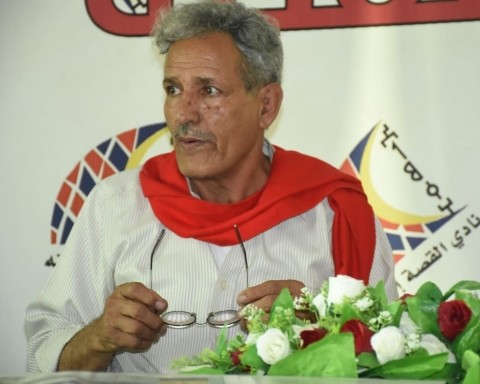
Since Iran-backed Houthi rebels seized power in 2014, triggering a civil war between the Houthis and government forces, all cultural and literary events have been suspended. Almaqah, however, remained active and continued to operate out of a small office in the building of the Association of Former Parliamentarians in Sanaa.
According to al-Gharbi Omran, the club currently continues to meet every Wednesday. Some of the meetings also take place via Zoom. New publications and, above all, literary debuts are celebrated and discussed. The meetings are intended to be a tribute and honour to those who enrich and promote Yemeni literature.
One of the most recently discussed works is "Modern Literature of Yemen" (2025) by Amina Youssef. In it, the Yemeni author provides a critical reading and analysis of five Yemeni novels published during the war, showing how the experience of pain and alienation is reflected psychologically and socially in Yemeni wartime fictional characters.
Club members document their activities on their private Facebook pages, creating a virtual literary scene where experiences are shared, serving as a platform for young authors to present their works. In November, the club organised a short story reading by unpublished authors as part of this year's tribute to the celebrated Yemeni writer Ahmad Qasim Al-Ariqi.
Strict censorship in Houthi-controlled areas
Ibrahim Abu Talib describes Almaqah as "the last bastion of beauty in Yemen." The club offers writers a platform to express their pain, despite a lack of support from the state or civil society.
Zain al-Abidin al-Dhabibi, a Yemeni poet who has been living in Cairo for four years, notes that the state of culture and the political situation in Yemen are intertwined; both are in decline. "Freedom has been virtually wiped out, especially in the areas controlled by the Houthis," he tells Qantara. "There, every activity is subject to strict censorship."
Cultural resistance, he emphasises, is limited to small initiatives such as the literature club. One event per week or per month is "in no way comparable to Yemeni culture as we knew it before the war," he says.
The taboo of abortion
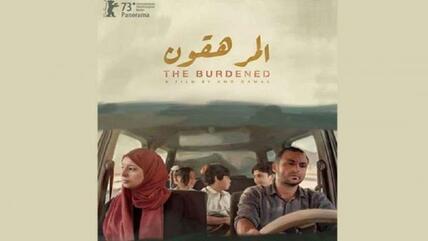
"Al Murhaqoon" ("The Burdened") is the first Yemeni feature film ever to be shown at the Berlinale. Ahmed Shawky spoke to director Amr Gamal about the difficulties of making a film in Yemen and the taboo of abortion
"There are dozens of figures from the Yemeni literary scene who lack the income and opportunities to earn a living," he adds. "This has forced many to stop writing for literary newspapers and magazines." These publications have suffered as a result.
Many Yemeni cultural figures who decided to flee have published their works in exile, with Lebanese or Egyptian publishers, for example. Some have received prestigious literary awards, like the journalist and novelist Hamid al-Raqimi, who was awarded the Katara Prize for Arabic Fiction in October for his novel "The Blindness of Memory" (عمى الذاكرة).
The club is not exclusively reserved for Yemeni writers. Authors from other Arab countries are also invited to talk about their works. One example is the Egyptian poet Fatima Wahidi, the first non-Yemeni member of the club, who regularly participates via Zoom from Cairo.
Wahidi, author of the poetry collection "A Moment Before Love Dawns" (قبل مشرق الحب بنبضة), reflects: "The discussions give me a sense of the value of my writing, despite all the obstacles that stand in the way of my presence."
"Writing is an act of resistance," she continues. "Despite all the adversity, creative people in Yemen are holding on to literature and keeping the fire of art burning."
This is an edited and shortened translation of the Arabic original. Translated from German by Max Graef Lakin.
© Qantara.de