A reality that calls for the surreal
In "Aisha Can't Fly Away", director Morad Mostafa follows a Sudanese nurse who works as a caregiver in the Ain Shams district of Cairo. In quiet moments, especially at night, an ostrich appears to Aisha. It stands before her, motionless and imposing, disturbing and poetic. It's a striking image, particularly for Egyptian cinema, but it's not an isolated case.
For a long time, Arab cinema was devoted to social realism and the everyday lives of ordinary people: struggles for survival, women rebelling against the patriarchal order, and the consequences of corruption, Islamism and poverty-driven migration. Recently, however, surreal images have begun to proliferate within these real stories—an expression of a form of fantasy often described, drawing on Latin American literature, as "magical realism".
Fantasy seems to have become a new wave sweeping across the Arab world. In the Tunisian film "Agora" by Ala Eddine Slim, awarded the Green Leopard at the Locarno Film Festival in 2024, people long presumed lost suddenly emerge from the sea after a sandstorm, attempting to slip seamlessly back into their former lives.
Muhammad Hamdy's "Perfumed with Mint", an Egyptian production that premiered at the Venice Film Festival in 2024, features a young man who visits a doctor because mint is sprouting from his body. And in "Roqia", presented by the Algerian director Yanis Koussim in Venice in 2025, an elderly imam and respected exorcist begins to forget the incantations meant to free the possessed.
Fantasy and body horror
The rise of the fantastic in Arab auteur cinema runs parallel to the success of body horror in Western arthouse film, populated by mutating bodies and displaced minds. Julia Ducournau’s "Titane" (2021) is one prominent example, as are "Poor Things" (2023) and "The Substance" (2024).
The fantastic in Arab cinema demonstrates how filmmakers from the region are not only responding to international currents but actively shaping them. Their visions contributes to what is often described as "world cinema", visions realised with striking visual force through comparatively inexpensive digital technology and international co-production funding. Streaming platforms have also played a part, enabling more open participation and cross-pollination of global cultures of storytelling.
At the same time, this global participation is still shaped by regional controls, a tension reflected in the films mentioned above. Their images grapple with what has long remained unspoken: experiences that resist articulation in the "normal" language of film because they resist clarity. Unspoken, too, in the face of censorship in repressive autocracies, which ensures that certain taboo subjects remain untouched.
In "Perfumed with Mint", the mint stops growing from the body when hashish is smoked, which has a numbing, repressive effect. As a result, smoking features prominently throughout the film. The sprouting mint can thus be read as a symbol for critical thoughts, unwelcome memories, suppressed desires and hopes that have no place in Egypt under the Sisi regime.
"Trauma will hit you in the face"
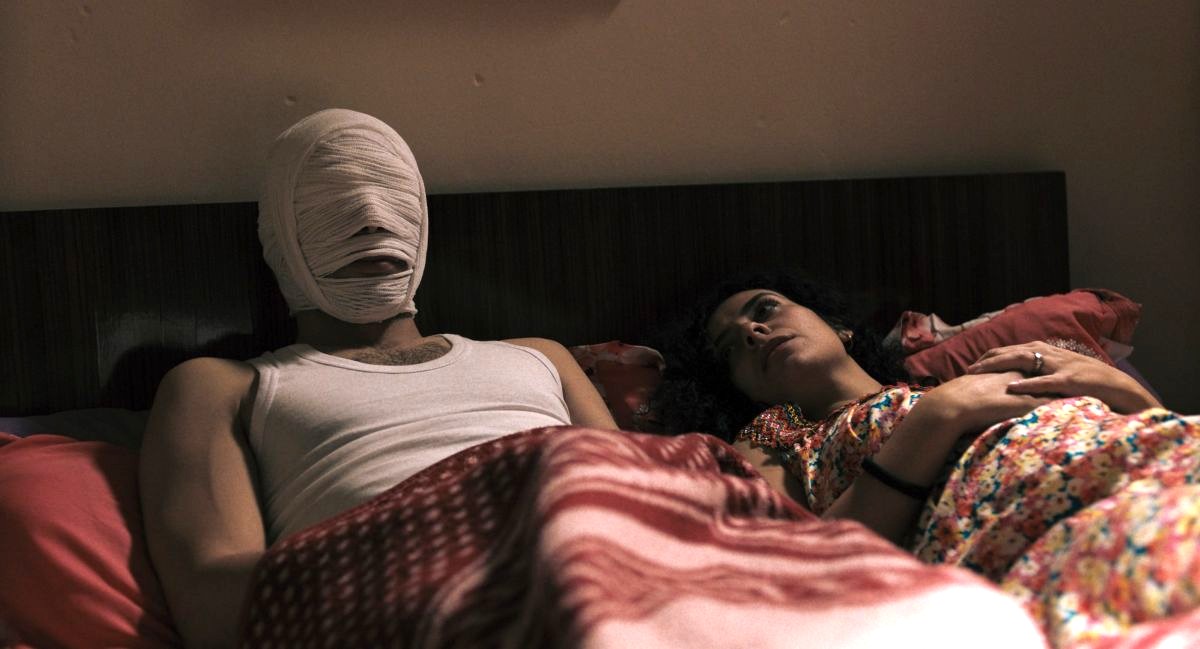
In "Roqia", Yanis Koussim broadens the scope to encompass several decades of Algerian history. In 1993, family man Ahmed returns home with his head bandaged after an accident. With his face now effectively "faceless", he cannot remember anything, and at night strange figures appear to him, uttering incomprehensible sounds.
On a second narrative level, set in the present, the elderly imam and respected exorcist enters the story. Suffering from dementia, he can no longer perform exorcisms, with devastating consequences that lead to horrific crimes.
Themes of remembering and forgetting, obsession and exorcism, resonate with Algeria’s violent past: in the 1990s, the country endured a brutal civil war that claimed tens of thousands of lives. Its unresolved traumas continue to lie dormant in the collective unconscious today.
"If you don't deal with trauma, it won't go away. Over time, it will resurface and hit you in the face," says Koussim. Repressed memories break through in the present. Film and art can help articulate them.
The fact that the ghosts and demons of the past and present are connected is also evident in "Roqia" in that both men—the father who had an accident and the exorcist—are missing a finger.
But Koussim goes back even further than the civil war, seeing connections to Algeria's colonial history: "If you superimpose a map of French colonial crimes on a map of the massacres of the 1990s, the locations coincide. It's incredible."
Political deadlock, individual paralysis
In "Aisha Can't Fly Away", the Egyptian film featuring an ostrich, concrete social realities are intertwined with mythological elements and a form of "body horror"—the alienation from one's own body. When Aisha pops an unsightly swelling on her stomach, something feather-like emerges.
As a Black woman and refugee, Aisha experiences exploitation, racism and involvement in drug crime, portrayed with the same intensity as her unwavering will to survive. Various energies and emotions—constraints, frustrations, anger—build within her and demand expression.
This may be reflected in the image of the ostrich: a mute bird unable to articulate itself, a creature that cannot fly. Aisha's personal paralysis mirrors the political stalemate in Egypt.
Omar El Zohairy's "Feathers" (2021) similarly tells the story of a man who transforms into a chicken and vanishes within the machinery of Egyptian bureaucracy, highlighting how individuals can become as anonymous as the poultry in factory farms.
Surrealism from Israel and Palestine
The Israeli-Palestinian conflict, with its unresolved history and absurd policies of occupation, also produces surreal images. Muayad Alayan's "A House in Jerusalem" (2023) tells the story of a father and daughter who have emigrated from London to Jerusalem. In the old house they move into, the daughter encounters a Palestinian girl named Rasha.
The references to the Nakba are obvious; director Alayan and his brother Rami Musa, who co-wrote the screenplay, have incorporated the story of their family's expulsion from the Jerusalem neighbourhood of Emek Refaim in 1948, whose name can be translated as "Valley of Ghosts".
Similarly haunting, Rakan Mayasi's short film "The Key" (2023) tells the story of an Israeli family who hear strange noises after moving into a new home: the ghosts of the previous Palestinian owners.
Three major taboos have long been formulated in Arab cinema: sex, religion and politics. A fourth could be added: memory, the reappraisal of history and recent history. This taboo is now being tackled by independent filmmakers, who are finding their own forms of expression, blending traditional elements with universal symbols—a thrilling development!
Translated from German by Max Graef Lakin.
© Qantara.de