A politically engaged alternative
Topics
Last Thursday, as the Berlin International Film Festival opened its latest edition with Shahrbanoo Sadat's Kabul-set comedy-drama "No Good Men", another film festival four miles away was making a statement of its own: the Palinale.
Now in its second year, the Palinale positions itself as an independent platform for Palestinian cinema and other marginalised perspectives. Organised by a Berlin-based collective, it responds to what its members describe as the ongoing repression of Palestinian voices and pro-Palestinian cultural workers within the German film industry and beyond.
The collective first came together at the end of 2024, and in February 2025, managed to put together a programme, mostly with the help of volunteers: filmmakers, curators, media workers, activists and political organisers. It was impressive to see a festival announce itself on such short notice and pull it off with confidence, all while the capital's biggest annual cinema event was taking place around it.
This year is no different. Palinale has expanded its programme considerably, broadening its scope of screenings, exhibitions and panel discussions. Their press officer told Qantara that the Palinale is "independent from state, corporate or militarised funding". It relies largely on donations, "understanding cultural work as a form of collective care and actively seeking to remove economic barriers to participation."
Foundational Palestinian cinema
The contrast with the Berlinale is immediately visible in the choice of venues. While Berlinale unfolds in the city's premier cinemas, the Palinale takes place in smaller, intimate community spaces.
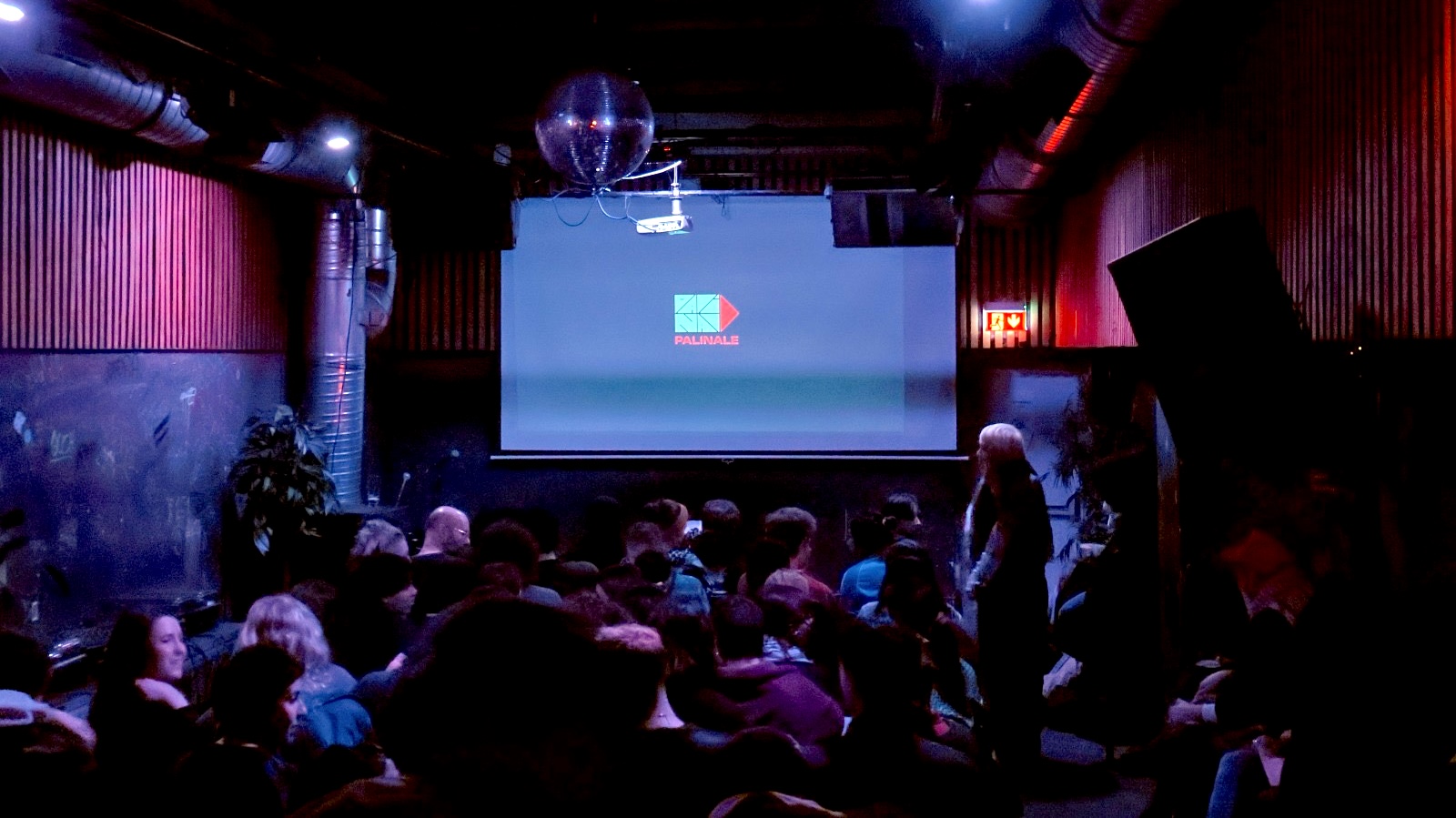
Its opening night kicked off at Arkaoda in Berlin's Neukölln district, with a screening of Michel Khleifi's 1981 documentary "Fertile Memory". The film follows two Palestinian women from different generations, both navigating questions of statehood and womanhood.
More than four decades after its release, it was a fitting choice for an opening night film, resonating with the engaged audience in Arkaoda's fully-packed basement. By revisiting a foundational work of Palestinian cinema, the Palinale drew a line between past and present struggles over land, identity and political agency.
Yet the festival insists that it is not only concerned with Palestinian suffering and struggle. In an introduction to "Fertile Memory", a team member emphasised that the Palinale was also interested in giving room to Palestinian joy.
The programme reflects this through another of Khleifi's films, the seminal 1987 feature "A Wedding in Galilee", which centres on a marriage ceremony in a Palestinian village, depicting everyday Palestinian life in a way that was rarely seen on international screens at the time of its release.
Another highlight is the 2025 documentary "One More Show". Co-directed by Ahmed Al Danaf and Mai Saad, who communicated through phone calls between Gaza and Egypt, the film follows the efforts of the Free Gaza Circus to bring moments of relief and laughter to Gazan children.
A counterweight to the Berlinale
The Palinale was founded from a desire to amplify Palestinian voices within Germany's cultural landscape and show solidarity with their struggle. And the Berlinale, however unintentionally, couldn't have provided a more perfect illustration of Palinale's raison d’être. On the opening day of this year's Berlinale, when asked about "selective empathy"—showing solidarity for Iran or Ukraine more readily than for Gaza—jury president Wim Wenders stated that filmmakers should "stay out of politics" and be "the counterweight to politics."
The remark underscored the urgency of projects like the Palinale. Yet the relationship between the two festivals is more complex than just a simple case of opposing views.
This year, the Berlinale has, as it did in its last two editions, featured Palestinian films or films about Palestine, such as "Chronicles from the Siege" or "Who Killed Alex Odeh?" While the festival has not taken an explicit stance on Germany's political position on Gaza during its last three editions, it has never actively excluded Palestinian filmmakers from its screens.
For critics, the issue lies less in the selection of films than in what they see as a reluctance to openly engage with the political context in which these works are screened, something the festival routinely does with films from Iran or Ukraine. Wenders' comments reinforce this critique, giving Palinale's organisers an opportunity to show Berlinale-goers that theirs is the festival providing space for such engagement.
Whether the Palinale will become a permanent fixture remains to be seen over the next few years, but it's a welcome addition to Berlin's cultural calendar, which already features a wide range of specialised film festivals.
One strength of Palinale is a scope that extends well beyond Palestine. This year, the programme includes documentaries on Sudan and Iraq, a panel on DR Congo, films on neo-colonial labour struggles in Brazil and Lebanon, a look at the situation for Gazan journalists in Egypt, and much more. In that sense, the Palinale isn't just competing with the Berlinale—the latter would not necessarily engage with these topics.
The Berlinale might well still be the center of the film world in February, but Palinale shows that the margins are political, and just as deserving of an audience.
© Qantara.de