An international coming of age
Topics
The world premiere of "No Good Men", the third feature film by Afghan director Shahrbanoo Sadat, at the Berlinale Palast is a minor sensation. Major festivals like Cannes and Venice have also included works by young Afghan filmmakers in their programs, but not at a festival opening, until now.
The 36-year-old screenwriter Sadat has been living in Hamburg since her evacuation from Afghanistan in August 2021. Many other Afghan filmmakers and screenwriters have also ended up in Germany and other NATO countries, partly due to existing relationships with cultural institutions such as the Goethe-Institut or human rights organisations.
Many of these filmmakers fled the Taliban in the wake of the military failure of the US-led NATO intervention. Many arrived after the extensive withdrawal of Western troops in 2014/15, and others followed after August 2021, when the Taliban regained power in Afghanistan.
But not everyone can make themselves heard like Shahrbanoo Sadat. Among the cultural figures from Afghanistan living in Germany today are members of the former film collective Jump Cut, whose films were shown at Documenta 13 in Kassel in 2012.
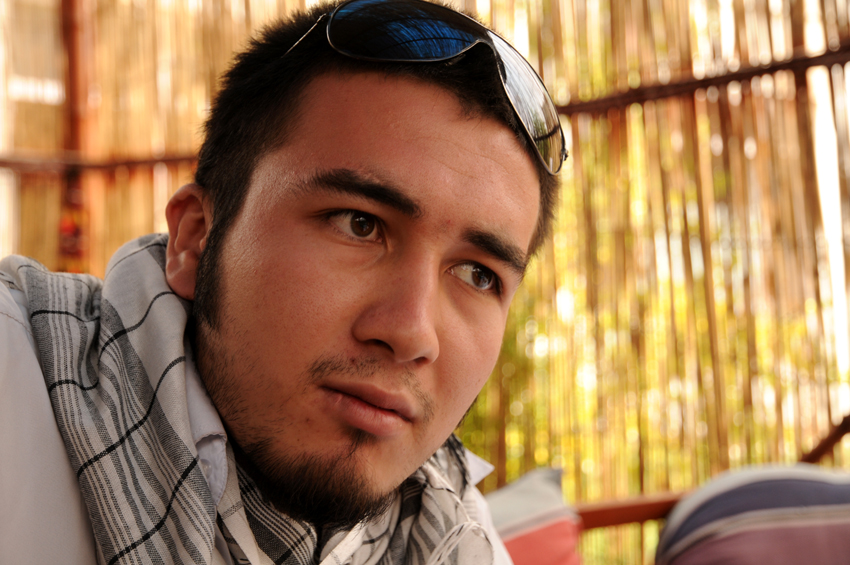
Ali Husseini, who was part of the film collective at that time, has been living in Germany for four years but is dependent on state support. He dreams of working for a German film production company and would also like to take a C1 German course, but he says the job centre won't pay for it.
"I worked as a filmmaker in Afghanistan. My short films have won awards. I was the cameraman for the documentary 'Generation Kunduz'," says Husseini. "I can continue my film work here. But first, I want to and should learn to speak German fluently." He is currently looking for training in media, IT or electronics.
Stories from elsewhere
The war in Sudan has made displacement a fact of life for millions. Two new films, with Sudanese women at their core, reflect this reality through very different lenses. A review of "Aisha Can't Fly Away" and "Cotton Queen".
Husseini lives in Cologne, in a housing estate on the outskirts of the city, together with 40 other families. Most of them come from Afghanistan and arrived in 2021. Little German is spoken in the estate. Husseini say's he is conscious of the "ghetto" effect, but finding a more central apartment is difficult.
Film production in Afghanistan
Unlike Iranian filmmakers in Germany, Afghan directors have no lobby among German critics. The film press is generally familiar with authors and films from Iran, but little is known about Afghan cinema and its linguistic and cultural ties to Iran, where many Afghan filmmakers studied in exile.
Afghanistan did not produce a sustainable domestic film industry during the years of NATO intervention. Except for the last few months before the Taliban's return in 2021, there was no systematic funding from the state film authority, Afghan Film. In Iran, on the other hand, there are numerous prestigious state and private film schools.
During the NATO intervention, several private television stations emerged in Afghanistan, financed by international aid, and an environment developed in which film equipment was available and film productions could flourish. However, the return of the Taliban destroyed this ecosystem. Film studio owners often had to leave their equipment when they fled the country. Only a very small number of film productions managed to resurrect themselves in exile.
Even before 2021, by international standards, there was no real film industry in Afghanistan, as Sharhrbanoo Sadat noted in an interview in 2019. "But there are young directors who make short and feature-length films, both fiction and documentaries," she pointed out. In principle, it was at least possible to film in Afghanistan, even if there was no guarantee that filming would be incident-free.
Afghan-German filmmakers
Jamil Jalla and Jalal Hussaini, who work on films and screenplays together as part of the Jump Cut collective, have also been living in Germany for several years. "I studied here for four years at the University of Fine Arts Hamburg", says Jalla, "and found that it was very difficult to make friends and build networks."
Jalla, who has also appeared in front of the camera as an actor in international productions, now earns a living as a cameraman, with assignments from trade unions, among others.
Hussaini continues to write screenplays and make short films. He has some familiarity with regional film funding, but has yet to receive any substantial grants. Since 2020, he has been earning money as an editor in the Dari/Farsi department of Amal, an online platform for exiled journalists.
If all goes well, many Afghan filmmakers in Germany could obtain German citizenship in the coming years and become part of the country’s film history. German audiences would see their stories on screen; their work could shape understandings of immigration and exclusion, successes and failures.
In retrospect, the humiliating military withdrawal of the West from Afghanistan in 2021 paradoxically became a decisive factor in the emergence of a generation of Afghan filmmakers in Germany.
"Art and culture during the Western intervention were primarily a bubble created by Western aid money. Without it, many opportunities would not have existed. When the West withdrew, they promptly disappeared," notes Aman Mojadidi, a US-Afghan artist based in Paris who co-curated the Afghan program at Documenta 13 in 2012.
This bubble was unsustainable, as donor countries did nothing decisive to ensure the film funding agency was given funds for local directors. Under the Taliban, Afghan Film was finally closed down last summer after around 60 years. The fate of the archive, which contains thousands of film reels documenting decades of life in Afghanistan, is still uncertain.
With Shahrbanoo Sadat's opening film at the Berlinale, Afghan cinema now appears to have come of age abroad. When Germany's largest documentary film festival, DOK Leipzig, first presented a special programme of 15 Afghan films in 2008, the festival management stated that one could not really speak of "Afghan film" as a distinct form of cultural expression. That now seems to be a thing of the past.
For the future, however, Aman Mojadidi hopes that Afghan films will be judged less on national or ethnic grounds: "Afghan art is often exhibited simply because it is Afghan; as part of an agenda, but not because of its quality," he says. He, who has not yet seen Sadat's "No Good Men", hopes for success at the Berlinale: "If it's a good film, it will be very significant."
Translated from German by Max Graef Lakin.
© Qantara.de