Damage control
When asked about how to rehabilitate Israel's international image, Yair Lapid, the current leader of the parliamentary opposition, told the D.C. think tank Atlantic Council: "The first step is obvious: send into retirement Benjamin Netanyahu and his group of extremists who are tearing us apart at home and abroad, tell the world this was a crazy period, but it is over."
Lapid's analysis reflects the widespread belief, shared by the party leaders of Israel's Zionist opposition bloc, that the country's growing unpopularity is because of the government's "negligence, arrogance, and amateurism" rather than violence toward Palestinians – which in the Gaza Strip has been plausibly deemed a genocide.
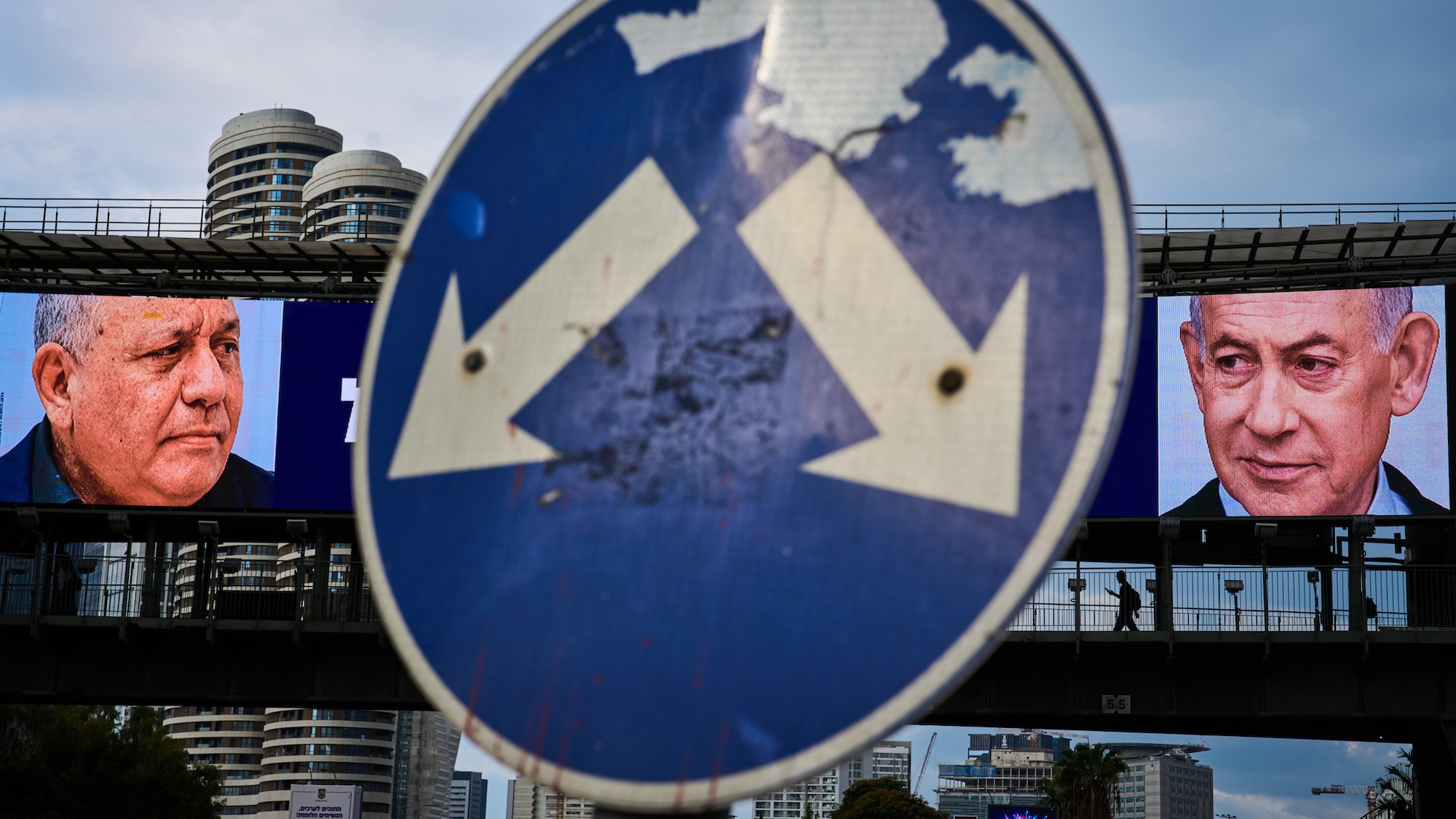
Gadi Eisenkot, Lapid's ally and the frontrunner to lead an alternative government in next week's election, has laid most of the blame at the feet of far-right ministers Itamar Ben-Gvir and Bezalel Smotrich: "The activities of these two ministers, together with the incidents of settler violence against Palestinians, are causing Israel to lose international legitimacy," and, revealing his priorities, "endangering the entire settlement enterprise."
When Israel goes to the polls on 27 October, the Zionist opposition bloc – made up of Eisenkot's Yashar, Naftali Bennett and Lapid's Beyachad, the liberal Zionist HaDemokratim party and the hard-right Yisrael Beiteinu – will seek to replace Netanyahu's far-right coalition. But this bloc offers no real alternative when it comes to the Palestinians.
As almost a prerequisite to participate in a public conversation that has shifted to the right, opposition parties have queued up to pronounce their rejection of Palestinian statehood. With the exception of HaDemokratim, they openly back continued settlement expansion and different visions of annexation of the occupied West Bank.

How to talk about Zionism
Criticism of the ideology underpinning Israel's foundation remains contentious in Germany. In the US, however, a significant shift is taking place. The Zionist consensus within the Jewish community is fracturing and debate is opening up.
So deep does anti-Palestinian racism run that, though the bloc may struggle to form a majority without the support of at least one of the two Arab Palestinian slates, it has rejected cooperation with them and petitioned for their disqualification. This means pushing Palestinian citizens of Israel, roughly a fifth of the country's population, beyond the pale (though this stance could be softening given the electoral arithmetic).
On regional policy, the opposition does show more pragmatism toward Arab allies like Egypt, and a defanged Palestinian Authority, and seeks a return to conflict management. This contrasts with the accelerationism of coalition parties that back the "voluntary migration" of Palestinians from Gaza and are trying to provoke a conflagration in the West Bank so that a similar project can follow there. But on the broader Middle East, the opposition is no less maximalist, pushing fantasies of regime change in Iran and insisting on Israel's freedom of military action across Lebanon.
What the opposition offers, then, ranges from more polished efforts at public diplomacy to, at best, tinkering around the edges of Israeli policy with the express purpose of preserving the impunity that has enabled a regime of destruction and domination.
Media distortion and PR failures
The opposition's platform speaks to and sustains the Israeli public's deep investment in ignoring Palestinian suffering. Since 7 October 2023, a compliant Israeli media has relitigated the trauma of the Hamas-led attack on a near-daily basis and opted to uplift "national morale" in dereliction of their basic duty to broadcast, let alone question, the consequences of the army's actions in Gaza.
That such a dissonance even exists received rare airtime in the only mainstream Israeli interview with Yuval Abraham, director of the award-winning documentary "NAZA" about Israel's mass killings of civilians in Gaza. Abraham pointed out that across all the Israeli investigative reporting in the last three years, "there was not even a single item about the army's open fire policy in Gaza, the collateral damage policy, that investigates in depth the harm to the lives of innocent Palestinians."
This media diet has helped to shape a parallel and inverted reality for the Israeli public. In this reality, a documentary with testimonies from 24 Israeli military officers about the mass killing of Palestinians can be described by Eisenkot as "smearing our good soldiers' names", as "blood libel" by the current army chief, or as comparable to "dozens of ballistic missiles" by Netanyahu. Meanwhile, the fictional drama series "Fauda", based on the attack of 7 October, is praised for having "the courage to tell the truth in a world full of lies, antisemitism, and ignorance."
When irrefutable proof and international pressure emerge, like when Israeli soldiers gunned down 15 Palestinian paramedics in Rafah in March 2025, the media frames actual executions as "damage to Israel’s image." Fact turns into fiction, fiction turns to fact, criticism becomes warfare, genocidal acts become a PR failure.
Israel is failing to control the narrative
Contrary to the opposition's diagnosis, Israel’s conduct has already shown that the problem is not messaging but exposure. Israel has gone to unprecedented lengths to control the flow of information from Gaza, barring international journalists and, after damning testimonies from other international observers like doctors and aid workers, imposing further draconian bans on access. Palestinians had no choice but to take it upon themselves to livestream the genocide at great personal risk, with Israel defaming journalists in order to justify their killing. Israel has killed more journalists than any other country since 7 October 2023.

"Our actions are the result of fear"
Two years after the Hamas attack, Israel remains in shock, says Ami Ayalon. In this interview, the former intelligence chief explains why Israeli society has failed to learn the lessons of 7 October, why the Gaza war must end, and why he rejects allegations of genocide.
These efforts to control the narrative have emphatically failed, as demonstrated by skyrocketing disapproval ratings among Western publics, if not yet their political classes. In turn, Israel and its lobbies in the US and Europe have turned to increasingly anti-democratic pressure to salvage what support remains.
Netanyahu said that Israel "must invest heavily in ... media and social media influence operations," and that is exactly what he did, with a record spend of $1 billion on public diplomacy since 7 October 2023. These efforts have included a reported $46.5 million contract to PR firm Clock Tower X to shape how AI chatbots talk about Israel, lobbying social media giants to police pro-Palestine content, and pro-Israel billionaires buying up social media platforms and news outlets.
But so long as the public and expert opinion does fully translate into Western government policy, hard-won breakthroughs on accountability risk being reversed. As Abdaljawad Omar astutely argues, Palestinians have won the argument in almost every forum, yet almost nothing has changed. The issue is not a shortage of facts or even empathy but "a special form of disavowal," because, "to truly accept what is happening in Palestine requires acknowledging that the international order is a fiction, and that Western prosperity remains tethered to a brutal, selective inhumanity."
Returning to a status-quo of impunity?
If the opposition wins on 27 October, its potential willingness to tone down some of the worst excesses of open incitement and cruelty will be rooted more in a desire to polish Israel's image, rather than sympathy for Palestinians. Still, a victory could alleviate the very worst conditions for Palestinians in the West Bank and Gaza. Departing from the intransigence of Netanyahu's messianic coalition, the opposition's concern for its image could at least offer Western governments some leverage.
But whether Western governments choose to wield it is another matter. For all the opposition's misdiagnoses, much of its outlook is based on the signals sent by Western governments. It was not mass killing and destruction in Gaza that forced Western government action, but the open self-incrimination and sadism of ministers like Ben-Gvir, a lightning rod in the PR battle.
It was Ben-Gvir's broadcast of abuse of European flotilla activists that prompted France to impose a travel ban, and his open calls for a higher death toll in Gaza that drew rebuke from German Chancellor Merz. Through these largely symbolic measures, it is this illusion of normalcy, a pretext to look away, that Western politicians are most interested in saving. More consequential measures, such as the UK-led ban on trading with Israeli settlements, could mark a genuine break, but only if they are entrenched and expanded.
While Netanyahu faces an ICC arrest warrant over crimes against humanity and remains a persona non grata in much of Europe, Eisenkot – who joined Israel's war cabinet for the first and most brutal months of the onslaught on Gaza – receives sympathetic portraits from Western media. Lapid can take the stage at a liberal D.C. think tank, defend Israeli military conduct, and receive a warm reception. In place of a vengeful genocide, the polite liberal apartheid offered by Israel's opposition may still be marketable.
© Qantara.de