A new era of automated violence
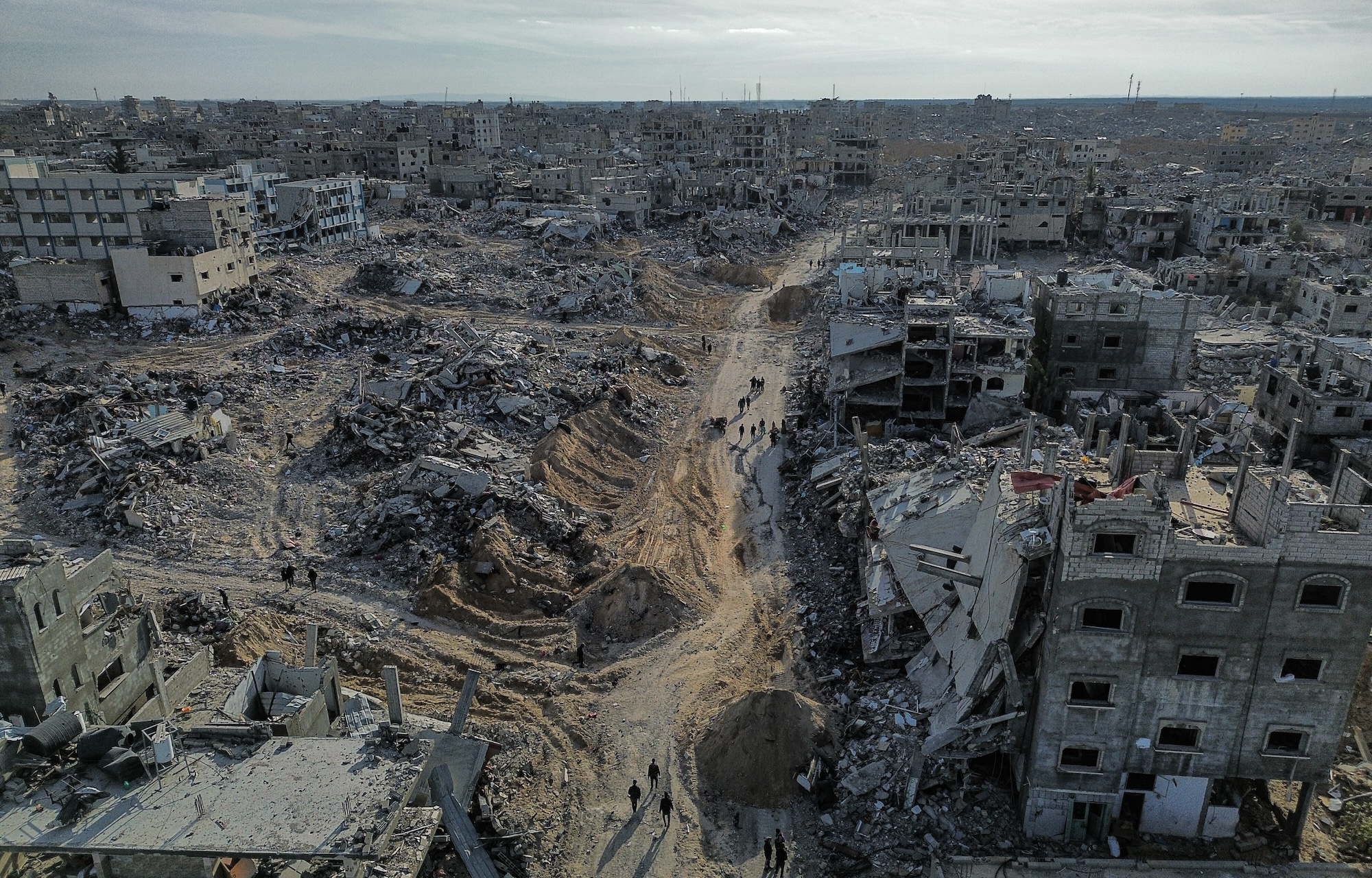
"Congratulations on those beautiful flowers you placed today by your kitchen window," the Israeli intelligence officer said in a calm, almost casual tone, before giving the man on the other end of the line 30 minutes to evacuate.
The call was received by a political analyst living in Gaza City in late October 2023. In an interview, he told me that the Israeli officer made comments that revealed detailed real-time knowledge of the analyst's private life—the flowers on his windowsill, the whereabouts of his wife and children, and the location of his car. The officer also listed specific neighbours by name and directed the analyst to go door to door warning them.
That call was more than a routine military warning; it was a chilling declaration that privacy had ceased to exist. The flowers served as a calculated demonstration of the invisible architecture of surveillance that envelops every inch of Gaza: drones that slip through open windows and film apartment interiors, satellites that watch from above and mobile phones whose signals and metadata are intercepted in real time and fed into intelligence databases that have been quietly building portraits of families, faces and daily habits since long before the first bomb fell.
In Gaza, intimate knowledge has become a brutal weapon in the arsenal of algorithmic warfare. Before taking a life, the Israeli army strips the victim of the feeling of safety in their most private moments.
These experiences are documented in the study "High-tech Warfare in Gaza: Documenting Life under Surveillance and (Targeted) Strikes", for which I conducted in-person interviews in Egypt in September 2025 with Gazans who had fled, alongside remote interviews with informants in Gaza between October 2025 and January 2026.
Gaza's silent children
Two years of war have left deep scars in Gaza. Some children have lost the ability to speak as a result of trauma. A team of psychologists is using new technology to help them find their voices again.
Through these interviews, I discovered that for Gazans displaced by the war that began after the Hamas attacks on 7 October 2023, mobile phones and communication platforms like WhatsApp function not as stable infrastructures but as precarious lifelines. Phones are essential for reaching family, finding shelter and resources, and tracking danger, while simultaneously exposing users to surveillance and military targeting.
One interviewee captured this torment precisely:
"On those nights when the bombardment shook the ground beneath us, the phone was our only window to know who was still alive to check on a mother stranded in the north, or a child sheltering in a tent in the south. Yet at the same time, we felt as though we were carrying a spy in our pockets, one that never sleeps and never blinks. We live like an open book, its pages read under a microscope by an army with the world’s most advanced surveillance technologies. We know we are completely exposed, and yet we could not afford the luxury of turning the device off. Switching it off meant stepping into an unknown far more terrifying than the one we already faced."
Trapped in coerced complicity
This reality gives rise to a central concept of the study: coerced complicity. To survive, Palestinians must remain digitally visible to the very system that threatens their existence. To locate constantly shifting "safe zones", to receive food aid, to access information through QR codes, one generates a chain of digital footprints. Those footprints become the fuel that powers the killing machine.
Since the attacks of 7 October 2023—which killed 1,139 people in Israel and unleashed the military campaign that brought these dynamics into their most devastating form—Palestinians have been handing the system the precise data it needs to track them in exchange for a fragile chance at survival. It is a closed, hellish loop in which surveillance infrastructures directly feed killing infrastructures, transforming technology from a tool of empowerment into an instrument of erasure.
Israeli intelligence intercepts and stores enormous volumes of Palestinian phone calls—millions of them, according to a 2024 investigation by +972 Magazine, Local Call and The Guardian, which found the recordings stored on Microsoft's cloud servers. WhatsApp messages and information on WhatsApp group memberships is also collected—though the exact route by which this data reaches Israeli intelligence remains undisclosed and unconfirmed by Meta.

How to talk about Zionism
Criticism of the ideology underpinning Israel's foundation remains contentious in Germany. In the US, however, a significant shift is taking place. The Zionist consensus within the Jewish community is fracturing and debate is opening up.
This data feeds an AI system called Lavender, which scores almost every adult in Gaza from 1 to 100 based on their likelihood of being a militant. At the beginning of the war, once an individual was flagged as a target, intelligence officers reportedly spent as little as 20 seconds reviewing the data before authorising a bombing.
Once a name is on the list, a tool nicknamed "Where's Daddy?" tracks the person's phone signal and triggers a strike when they have arrived home—often at night, when they're most likely to be asleep with family nearby.
Other systems like The Gospel and Blue Wolf complete the siege. Described as "Facebook for Palestinians," Blue Wolf turns the faces of Palestinians at checkpoints into instant biometric verdicts: green for passage, red for detention. These algorithmic systems have turned Gaza into an automated target factory, where human intuition and ethical judgment have been replaced by the cold, hollow logic of machines.
The colonial logic of surveillance
Just as in all wars before, Palestinians have been forced to craft strategies of endurance and evasion. A doctoral student interviewed in Cairo described how people in Gaza practice what I call "self-body policing." The moment a drone's hum is heard, behaviour shifts instantly: groups dissolve, people walk alone at calculated distances. Some suppress even the smallest movements inside their tents, fearing acoustic or thermal sensors might flag them as threats.
The terror has reached surreal levels—displaced people warn one another against carrying tree branches, to be burned for warmth, in case one of the Israeli ground robots deployed across Gaza interprets it as a weapon and opens fire on the spot.
This is not paranoia: the system does not "think" about what is being carried, it matches the elongated geometric form of any held object, its length-to-width ratio, the angle at which it is gripped and its thermal density, against a model trained on weapons, issuing its verdict within fractions of a second, long before any human eye has the chance to intervene. For the algorithmic eye, a weapon and a dry branch are data points that may overlap.
Israel's use of surveillance technologies does not represent a break from history—it is a continuation of deeply rooted colonial practices. The pattern begins with Britain's own colonial rule over Palestine after the First World War, when the Mandate authorities administered the population, mapped the land and gathered the demographic knowledge that any colonial power needs to govern a territory.

"There's room for everyone between the river and the sea"
What does it take to make anti-militarist cinema in a country where, as Netalie Braun puts it, the army "resides in the DNA of society"? In this interview, she discusses navigating censorship, boycotts and the challenges of imagining peace amid violence.
The Zionist movement inherited this same logic. This is the origin of the 1940s "village files": classified intelligence dossiers compiled by Zionist military organisations before 1948, which recorded in meticulous detail the topography of every Palestinian village, its family structures, land ownership and the political leanings of its inhabitants. These files were assembled as an operational blueprint for what followed, the forced depopulation of over 400 villages during the Nakba.
The colonial mindset has not changed: identifying the population is the gateway to controlling or displacing them. The only difference is that this knowledge is now algorithmic, transcontinental and operated from air-conditioned rooms far from the smell of death.
Gaza has been transformed into a global laboratory where systems are tested on the living bodies of civilians to refine their lethal efficiency. The victims become data that improve algorithmic performance. Israeli companies showcase these technologies at international security expos as "field‑tested" products. We are confronting a cross‑border economy of killing that converts human tragedy into a profitable technological commodity.
The story of the "flowers on the windowsill" is a moral warning to a world rushing towards the unchecked automation of violence. Behind every algorithm and every probability score is a human life—with dreams, loved ones and memories—erased in an instant. Palestinians are forced to draw on every remaining fragment of strength to preserve their humanity in a system that reduces them to data.
© Qantara.de