"White secular women do not have a monopoly on feminism"
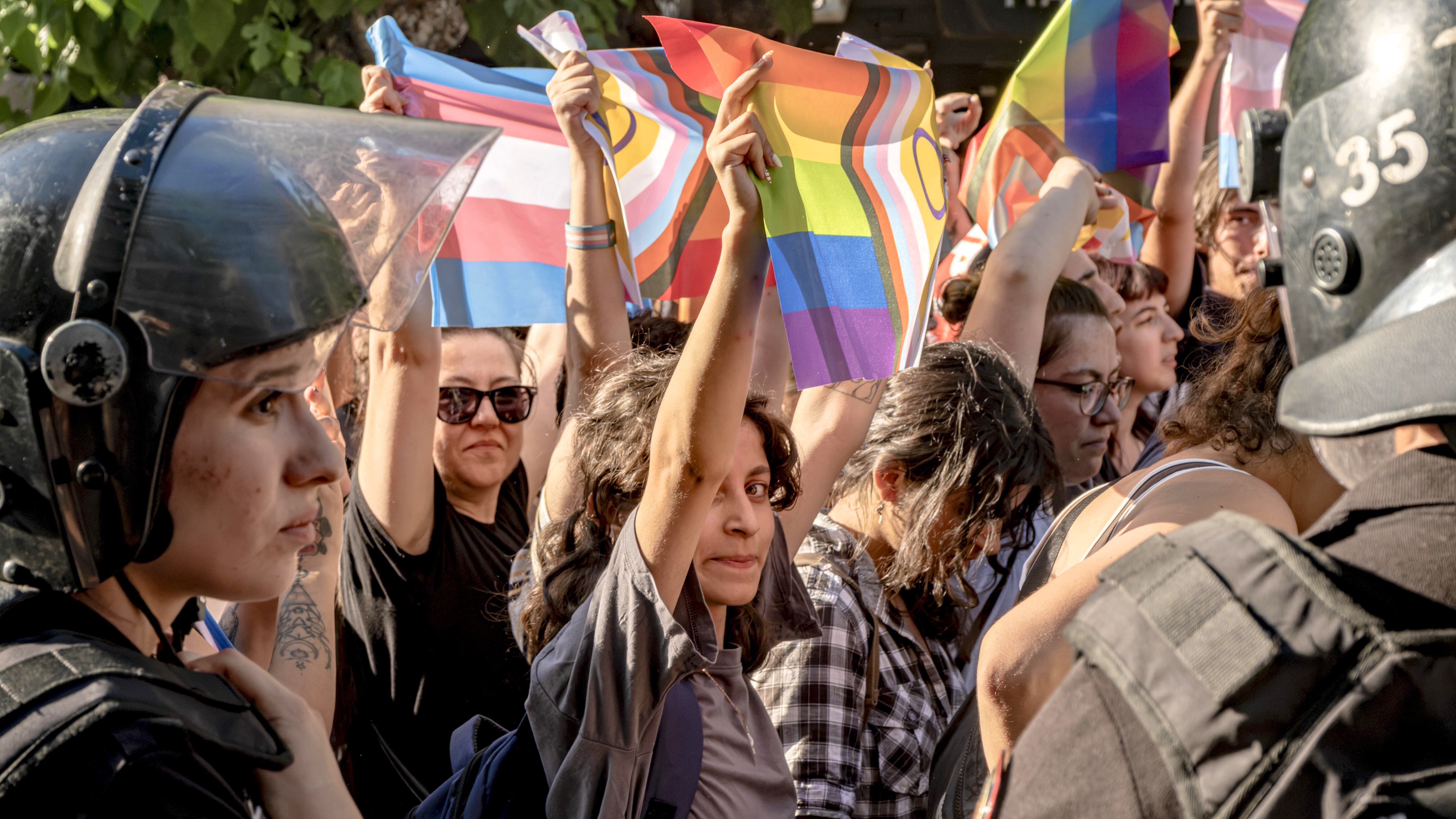
This week, Turkey saw nationwide raids and a wave of arrests targeting the LGBTQ community. In 15 provinces, authorities raided LGBTQ organisations, venues and offices, temporarily detaining more than 100 people. As part of the operation, codenamed "My Family Is Safe" (ailem güvende), websites and social media accounts were also blocked. Critics responded online with the hashtag #AilemGüvendeDeğil ("My family is not safe").
For Qantara, Ceyda Nurtsch spoke to Kübra and Enis from Havle, an affected association. For security reasons, only their first names are given.
Qantara: Members of Havle were arrested during the recent raids and demonstrations. You are a Muslim-feminist women's association that stands in solidarity with the LGBTQ community. What is your view on the government's "My Family is Safe" initiative?
Kübra: This operation only pretends to protect families. In reality, it protects no one. The government's aim is to bring the family and society into line. If it really wanted to protect families, it would first have to meet the minimum conditions needed to guarantee the protection of children. The aim the government is pursuing through the "My Family is Safe" campaign is to demonise the LGBTQ movement and thereby tighten its repressive, authoritarian regime. For us at Havle, our primary concern is the protection of women and children.
Havle, Turkey's first Muslim feminist association, was founded in 2018. How did the idea come about?
Kübra: For many women who identify as Muslim feminists, myself included, the Gezi protests in 2013 were a turning point. I could not accept the disproportionate use of force by the police, which left people with permanent injuries or even cost them their lives. Then came the 2017 referendum on constitutional reform, following which Turkey transitioned from a parliamentary to a presidential system. It became clear to me then that we would gradually lose everything we had in the way of democracy.
So was it your disappointment with the policies of the AKP, which has now been in power for over twenty years, that led you to become politically active?
Kübra: Yes, it led to an awakening. I come from a family with close ties to the Milli Görüş movement and the Refah Party. For decades, we women had been harassed because of our headscarves. Then Erdoğan came to power and said he was on our side. At first, nothing happened for years. And when things did finally start to change, he and his people took a course of action that I, and many others, could no longer support. So I looked for like-minded people.
What sets Havle apart from other women's organisations?
Kübra: I was active in other women's organisations, but although I learnt a great deal in the secular ones, I never really felt I belonged there. At gatherings of religious women, on the other hand, the conversations revolve solely around God and the Prophet and are completely detached from the realities and problems of this country. That isn’t for me either.
Havle sits between these two extremes. We meet here to chat, eat, pray and celebrate religious holidays. Many of the members have difficult family situations; often their families have cut them off, perhaps because they interpret Islam in a progressive way, have a partner without being married, or are queer. Someone who has grown up in a Muslim environment often feels more at home here than in a secular organisation, even if they aren't particularly religious.
Enis: This is how it was for me: my family comes from the Nurcu movement. The secular women's organisations I was involved with couldn't understand why someone could feel the need to be accepted by their own community. Here at Havle, I find a sense of belonging that I haven't experienced anywhere else. At first, I was worried that the women might take off their headscarves in front of me—after all, I’m a trans woman—but that wasn't a problem for them at all.
Many people argue that "Muslim" and "feminist" are mutually exclusive. How do you respond to these people?
Enis: They absolutely can go together! My favourite slogan from Havle is: "Act with respect for your memories and in faith in the Day of Judgement." This means that we live in this world, but there is also a spiritual dimension to our lives.
Kübra: On the one hand, there are militant atheists and Islamophobes who equate Islam with IS and Salafism. They paint a picture of a religion that does not allow women to leave the house and beheads people. On the other hand, there are those who impose their interpretation on others and use it as a means of exerting pressure. We are not against other interpretations, but we are against the exploitation of these interpretations, which leads to oppression and violence.
Enis: People keep saying that progressive Islam, the Muslim left and Muslim feminists are pursuing alternative interpretations of Islam. That's not true; we're not reinterpreting the religion, we're going back to the fundamentals of Islam.
Kübra: It is the Sufism of the 13th and 14th centuries, embodied by the mystic Mevlana, who said: "Come, whoever you are, come yet again." At Havle, we open that same kind of door.
Enis: In the surah Ar-Rum, it says: "And one of His signs is the creation of the heavens and the earth, and the diversity of your languages and colours. Surely in this are signs for those of sound knowledge." These are verses that were revealed in the seventh century.
A century of Arab feminism
For over a century, Arab women from Tunisia to Saudi Arabia have fought for their rights, against violence, and for autonomy over their lives and bodies. In her new book, Claudia Mende amplifies their voices.
What work does Havle do?
Kübra: A major problem in Turkey is child marriage. Time and again, politicians and leaders of religious groups claim that our religion rewards the marriage of minors. We wanted to find out whether people actually believe this, so we carried out a survey. We asked whether, and if so under what circumstances, people would marry off their children under the age of 18. The answer was always the same: economic reasons, a particular understanding of honour and the fear of pregnancies outside marriage. Religion played no part.
Furthermore, sex education is an important part of our work. We train our members to become "feminist facilitators" who lead discussion sessions, and we have developed a mother-daughter sex education kit that takes religious sensitivities into account.
Even before our organisation was founded, we had joined forces to form the initiatives Muslim Women Against Violence and Women in the Mosques. Our aim was to make mosques more accessible and appealing to women as public spaces. These places are often dominated by men. For women, designated areas are often neglected and, in some cases, difficult to access. Trans women then face a whole different set of problems.
You place great importance on the "localisation of feminism". What does that mean?
Enis: Alongside intersectionality, this point is very important to us. White, secular women do not have a monopoly on feminism. It can just as easily emerge from a village in Anatolia. People who say that Islam and feminism are incompatible have a particular view not only of Islam, but also of feminism. Yet feminism can take different forms, depending on social realities. The dynamics in Konya in Anatolia, for example, are different from those in Brussels. Demonstrating naked in the street can be a form of resistance, but so can a solidarity network of women who share their sorrows with one another.
What changes have taken place in Turkey in recent years and decades with regard to women's rights?
Enis: We are seeing a rise in fascism, homophobia and transphobia worldwide. In Turkey, too, we are facing many problems: many of the rights we have won, such as those relating to child maintenance, are hanging in the balance. Turkey has withdrawn from the Istanbul Convention (2021, ed.), and hormones for gender-affirming treatment are difficult to access. But no matter how repressive the system is at present, time and society cannot be turned back. The new generations and the flow of information cannot be stopped.
So you’re feeling optimistic about the future?
Enis: Absolutely! Just a few days ago, two elderly women from Erzurum—one of the most conservative places in Turkey—came up to me and told me how beautiful I was. Things like that fill me with hope.
Kübra: Recently, we cooked aşure, a traditional Alevi dish, here together with some Alevi women. Just a few years ago, Sunnis and Alevis would never have come together. My hope is that, perhaps in 20 or 30 years, we'll be living in a country where we listen to one another more closely and have put aside our hatred of "the others".
Enis: We mustn't just look at what the President or some AKP politicians are saying, but at us—society. We are the state. And we are the change we want to see.
This is an edited translation of the German original. Translated by Max Graef Lakin.
© Qantara.de