Slave drama sparks debate on national identity
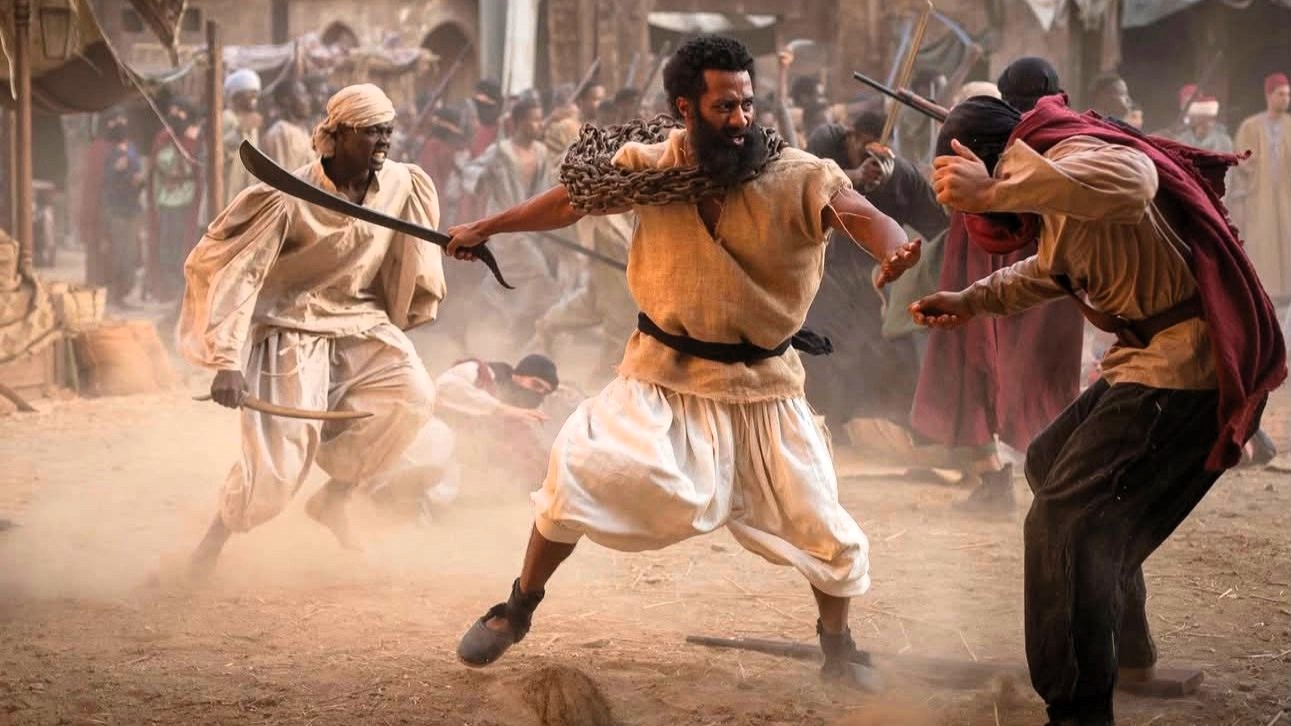
A Black boy is abducted from an unnamed African country. Ripped from his happy life, he is brought to Egypt as a slave. After the traders decide he's "rebellious", he is named Asad (Lion), a name he lives up to when he rises to become a leader who inspires other slaves to fight for freedom.
That's a short summary of "Asad", a film set in 19th-century Egypt, when slavery was still widespread on the banks of the Nile. Even before its theatrical release, the film, which was written by siblings Khaled, Sherine and Mohamed Diab (who also directed), sparked fierce controversy in Egypt.
That "Asad" has touched a nerve is hardly surprising given that the film's central theme is freedom. In Egypt's current restrictive political climate and against the backdrop of ongoing tensions in the region, some view any discussion of freedom as misplaced, even when it deals with historical subject matter.
"My wife asked me, 'Does the film want us to start a revolution?'" remarked journalist Maher Farghali in a video he posted after seeing the film.
The Afrocentrism debate
Yet more controversial than the discussion of freedom is the accusation that the film supports Afrocentrism, an international movement that emerged in the 20th century in response to racism against Black people.
Among those levelling such a critique, Magdi Shaker, chief archaeologist at the Ministry of Culture in Cairo, is one of the fiercest. In a TV broadcast, he suggested that symbols featured in the film as well as its overall visual design, could be interpreted as spreading Afrocentric ideas, which, he argued, came at the expense of the historical identity of the Arab region.
Afrocentrism is an intellectual movement which pushes for a re-examination of history and culture so that African people are central rather than marginal, creators of civilisations rather than merely slaves or subjugated.
Which is where Egypt comes in. Afrocentrism's leading thinkers, most notably American scholar Molefi Asante, hold the view that the ancient Egyptian civilisation of the pharaohs was the work of Black Africans.
In modern-day Egypt, this perspective has sparked repeated debates about the country's Arab cultural identity. The heart of the matter is the question of who can lay claim to the legacy of ancient Egypt.
In the case of "Asad", which stars the southern Egyptian actor Mohamed Ramadan, just the depiction of a Black slave on the movie poster was enough to raise fears that the film was promoting Afrocentric ideas.
These fears were likely fueled by recent film productions, in particular the Netflix documentary "Queen Cleopatra" (2023), which sparked debate in its portrayal of Cleopatra as Black.
Kemet movement mobilises against the film
As "Asad" is set in the 19th century—many centuries after the Pharaonic era on which Afrocentrism's claims are based—the filmmakers may not have anticipated facing accusations of Afrocentrism.
Author and director Mohamed Diab vehemently rejected the accusation on Facebook: "Afrocentrism means claiming that today's Egyptians are invaders and that Egyptian civilisation is of African origin and was built by Africans," he says, dismissing such ideas as "empty talk."
"Anyone who has seen 'Asad' knows that in the very first scene, slaves are abducted from Africa by English pirates and only subsequently sold in Egypt. The slaves in the film are therefore not of Egyptian origin—which refutes this baseless accusation." He emphasised, for the record, that he and the other filmmakers are Egyptian patriots.
Further fuel was added to the controversy by the Kemet movement, which has been gaining strength in recent years. "Kemet" is the ancient Egyptian name for Egypt. This nationalist group views Egypt through the lens of its ancient past and holds that the country fell victim to an Arab conquest. Only by returning to its roots, they argue, can it rediscover its true self.
Supporters of the government aligned with the Kemet movement, and adopted a strongly nationalist stance as regards "Asad." The administrator of one Kemetist Facebook group asked why the film did not pursue a "national idea" instead of one that would inevitably spark controversy.
Accusations of historical distortion
The controversy surrounding "Asad" is not limited to the debate over Afrocentrism; the film is also accused of distorting historical facts. The film-makers uprooted the Zanj slave revolt against Abbasid rule, which took place in 9th-century Mesopotamia, and placed it in 19th-century Egypt. No uprising of that nature took place there.
Director Diab addressed this criticism in an interview, emphasising that the film is merely "inspired by true events" which allowed them the freedom to blend truth and fiction in the service of the plot.
Speaking to Qantara, film critic Alia Talaat agreed in principle that a filmmaker' has the right to use history for an artistic work, provided it is not presented as a strictly historical account. Yet in explicitly giving both the year, 1840, and location, Cairo, she argued that the creators of Asad had made themselves unnecessarily vulnerable to criticism. The precise date could have been avoided.
"Asad" main storyline starts later in the nineteenth century with the adult Asad shown clearing the path in front of his masters’ carriage. For a slave, Asad is relatively privileged; he supervises newly arrived slaves who are locked in cages, distributes food and water, and feels compassion for a little boy who refuses to eat. The film shows him opening the boy's cage to try and feed him.
This depiction of slavery in Egypt has also drawn criticism. Archivist Issam Fawzi, who owns an extensive collection of old newspapers, magazines, and documents, rejects what he calls a "falsification of history" born of a plot borrowed from other works.
"In Egypt, slaves were not humiliated in this way," Fawzi points out, adding that most were not Black. "The majority were brought in primarily for military purposes. It was from their ranks that the Mamluks emerged, who ruled Egypt for years. There was never a rebellion or strike by Black slaves."
Fawzi draws a distinction between the legitimate use of history and the invention of historical events that never took place. He cites the work of the writer Naguib Mahfouz as a positive example: "He adhered to historical events in his novels. Only the characters are fictional, although they too are inspired by reality."
For film critic Alia Talaat, "Asad" is "at best a mediocre film." "It doesn't deserve all the hype. Despite its Hollywood-style visuals, it suffers from numerous weaknesses in the screenplay and the acting."
This text is an edited translation of the Arabic original. Translated from German by Louise East with the support of AI-assisted translation tools.
© Qantara.de