The weaponisation of Pakistan's blasphemy laws
In December, a court in Pakistan's Punjab region sentenced Mubarak Sani, a member of the Ahmadiyya religious minority, to life imprisonment under Pakistan's blasphemy laws. Comprising less than 0.5% of the population, Ahmadis identify as Muslims but, in Pakistan, are not legally allowed to call themselves as such or freely practice their faith.
Pakistan's Ahmadiyya community has faced legal persecution for decades. What makes this case especially notable is that, after reaching the Supreme Court, tensions between extremist religious political parties and the judiciary exploded.
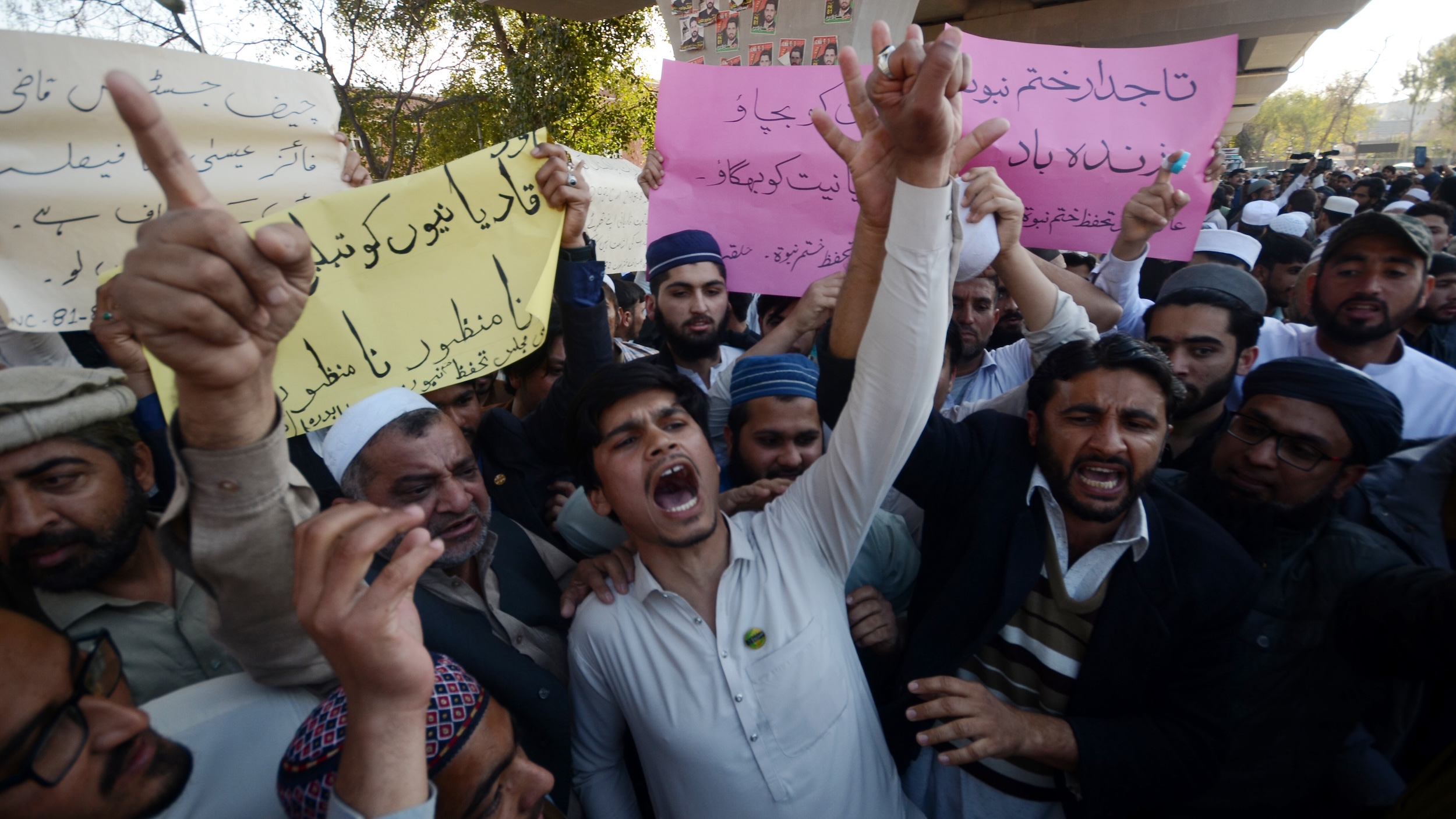
Sani was first arrested in January 2023 for "printing, altering, distributing and teaching the Quran as part of his religious activities". In February 2024, Pakistan's Supreme Court granted him post-arrest bail, a decision that ignited fierce protests from a range of religious political groups—including the far-right Tehreek-e-Labbaik Pakistan (TLP).
The TLP led a campaign against the Chief Justice of Pakistan, Qazi Faez Issa, taking to the streets to chant death threats and accuse him of blasphemy, too. Under pressure, the Supreme Court reversed their decision.
The escalation brought international attention to the complex relationship between law, religion and politics in Pakistan, and the precarious position of the Ahmadiyya community at its centre.
Religion and law
"The persecution of Ahmadis in Pakistan cannot be understood without looking at the political use of religion in the country's history. Pakistan was created on an ideological basis," says Farnood Alam, an Islamabad-based political analyst and journalist. "From early on, sections of the ruling elite began using religion as a political tool rather than keeping it a matter of personal faith."
Over decades, state intervention turned theological questions into legal and constitutional ones. Some regard the Ahmadi position as blasphemous, creating a theological divide between Ahmadis and Sunni Muslims. The Ahmadiyya community was founded in British India in 1889 by Mirza Ghulam Ahmad, who claimed to be the Promised Messiah and Mahdi of Islam.
In 1974, constitutional amendments introduced by Prime Minister Zulfikar Ali Bhutto (in office 1973–1977) declared the Ahmadiyya community non-Muslim. In 1984, President Muhammad Zia-ul-Haq (in office 1978–1988) introduced Sections 298-B and 298-C to the Pakistan Penal Code, making it a criminal offence for Ahmadis to call themselves Muslims, employ Muslim practices in worship, or propagate their faith.
Why blasphemy is a capital offence in some Muslim countries
The Prophet Muhammad never executed anyone for apostasy, nor encouraged his followers to do so. Nor is criminalising sacrilege based on Islam’s main sacred text, the Koran. In this essay, Ahmet Kuru exposes the political motivations for criminalising blasphemy and apostasy
"Religious legislation and narratives were introduced to delegitimise political opponents", Alam explains. "This trend became much stronger during General Zia-ul-Haq's regime. His Islamisation policies were used to suppress political opposition, control dissent and create fear. Laws related to blasphemy and the status of Ahmadis were strengthened, laying the foundation for long-term persecution."
The rise of the TLP
Since Zia-ul-Haq's reforms, Ahmadis have faced severe marginalisation, incidents of mob violence and widespread social exclusion, as highlighted by data from the National Commission for Human Rights (NCHR). Since 1984, 1,294 Ahmadis have been charged with religious offenses, including 765 for merely displaying the Kalima (i.e. the Shahada, the Islamic declaration of faith) and 861 for preaching. Around 280 have been killed.
During the presidency of General Pervez Musharraf (2001-2008) and the years following his exit, Pakistan's government sought to project a more moderate tone.
The balance shifted again after 2017, with the rise of the TLP party. At the time, the Pakistan Muslim League-Nawaz (PML-N) was in power but locked in a tense standoff with the military, long regarded as the country's primary powerbroker.
During anti-government protests that year, the army was widely seen to have covertly backed the TLP, effectively empowering extremist religious forces to put pressure on the civilian government and engineer a new political arrangement.
Alam, who himself has been targeted by blasphemy campaigns, says, "the emergence and empowerment of the TLP played a key role in this phase of hatred and violence. The very justification for this group's politics rested on blasphemy laws and hostility toward Ahmadis. Its street power and violent rhetoric was used to intimidate political opponents and to exert pressure through religious sentiment."
A civil rights paradox
Yasser Latif Hamdani, who co-founded the Jinnah Fund, a non-profit fighting to advance religious freedom in Pakistan, highlights that the use of Pakistan's blasphemy laws against the Ahmadiyya community rests on a constitutional contradiction.
"The idea that you can punish people for possessing, reading or teaching the Quran is an egregious violation of Article 20 of the Pakistani constitution. The constitutional position is that while the Constitution of Pakistan has designated Ahmadis as non-Muslims, it cannot ask them to consider themselves non-Muslims. That goes against whatever we know of the right of freedom of conscience," he told Qantara.
"What Pakistan is doing to Ahmadis is not just a violation of its own constitution but also the International Covenant on Civil and Political Rights, which it signed and ratified in 2010." He added.
Pakistan's current military leadership and civilian government have launched a crackdown on religious extremists, declaring TLP a proscribed organisation under the Anti-Terrorism Act. Alam acknowledges this as a positive step but remains skeptical about the outcome. "This action also seems to be driven by political calculations, political and military engineering for the current regime, rather than a genuine ideological shift."
"It gives the impression that when a particular weapon is no longer needed, it is simply put aside. The extremist mindset behind this weapon has not been seriously challenged or dismantled. There is little evidence of a sustained effort to counter the thinking, narratives and social conditioning that produce religious extremism."
"Until this mindset is confronted honestly and consistently, the cycle of persecution and political manipulation through religion is likely to continue."
© Qantara.de