Ceuta was a referendum
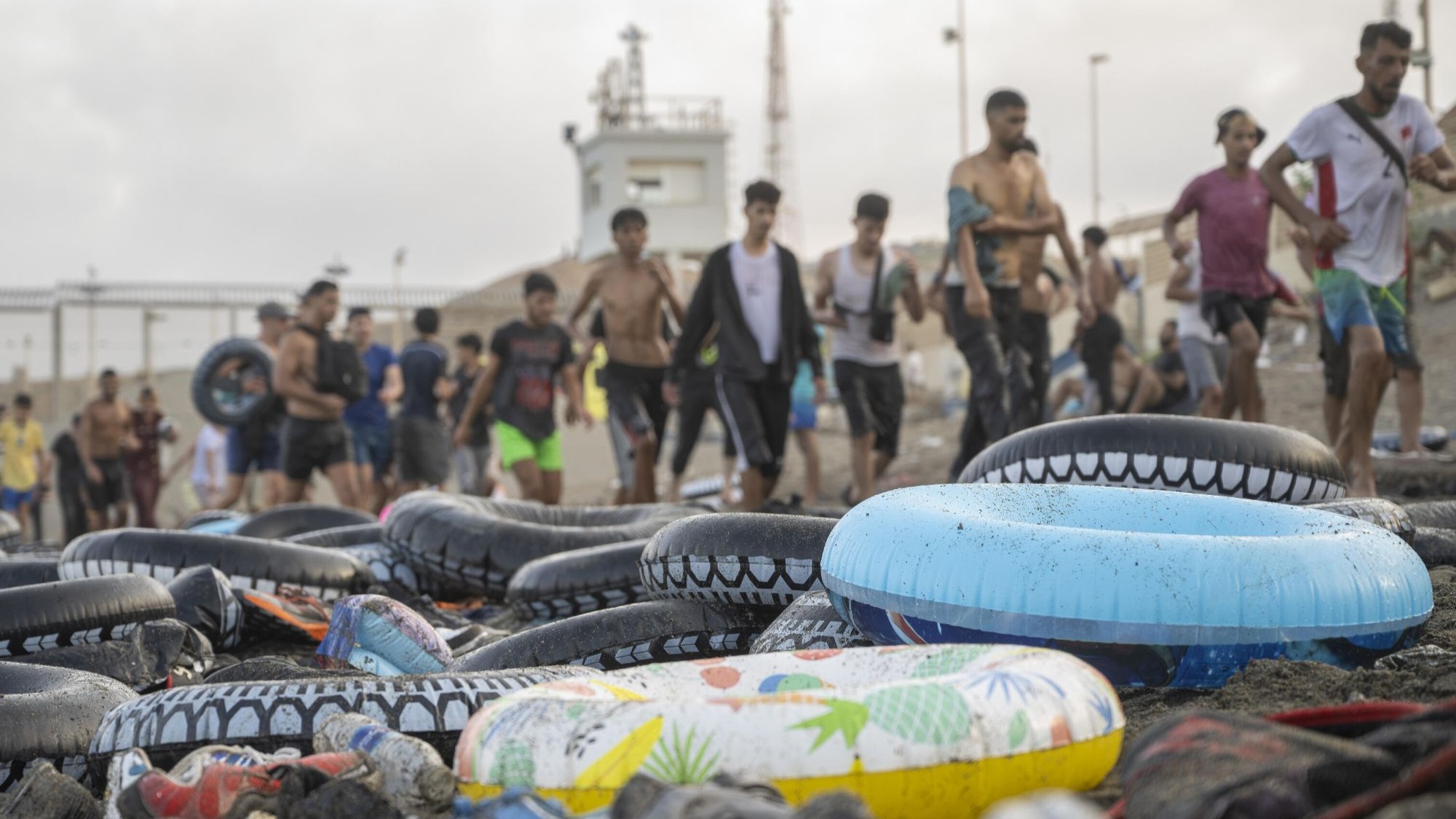
It's telling that, while the events in Ceuta were being widely discussed around the world from the end of July, the Moroccan government took several days to break its silence. It was only four days later that a spokesperson for the Interior Ministry made a statement.
The events, he said, had been a mass exodus attributable to "several interlinked factors", "foremost among them the misuse of the digital space, the spread of misleading information and the activities of people-smuggling gangs".
Yet he gave no direct answer to a key question that was on the minds of people in Morocco: why are thousands of citizens fleeing from a liberated country to an enclave regarded as occupied and seeking refuge there? Tens of thousands of Moroccan and non-Moroccan migrants had made their way into Ceuta, which has been under Spanish rule for centuries—an event that will remain in Morocco's collective memory for a long time to come.
At the same time as the crisis on the border with Ceuta, the nation was celebrating the 27th anniversary of King Mohammed VI's accession to the throne, just a few kilometres away. On the Spanish side, events were already unfolding at a rapid pace, and the US and Israel lent the whole affair a remarkable international dimension when they entered into a war of words with Spain's Prime Minister Sánchez over his humanitarian stance towards Israel's war on Gaza.
Morocco's official silence was all the more puzzling given that, from the outset, the events had become a means of exerting geopolitical pressure, with multiple actors seeking to exploit the crisis to advance their own interests. Rabat's silence stood in stark contrast to the country's image as an influential and emerging regional power.
Many explanations, few answers
As people sought answers as to how the mass border crossing had come about, explanations for the events quickly multiplied. Some linked them to tensions between Spain and Morocco—highlighting factors such as Sánchez's visit to Algeria in July, a bill debated in the Spanish Parliament that would grant Spanish citizenship to descendants of Sahrawis born during the colonial era, and difficulties surrounding the reopening of the customs checkpoints with Ceuta and Melilla.
Others linked the event to changes in Spain's migration policy, in particular the ruling by the Spanish Supreme Court on 8 July, which deemed the immediate return of irregular migrants to be unlawful. Added to this was the Spanish government's decision earlier this year to regularise the residence status of around 500,000 irregular migrants.
For its part, the Spanish Government stated that a misleading interpretation of the aforementioned court ruling from July had been deliberately circulated by human trafficking networks and had triggered the mass influx into Ceuta.
Nevertheless, it is difficult to imagine that tens of thousands of people would actually have made their way towards Ceuta without having been directly instructed or organised to do so. The question of whether people were deliberately guided towards the border in order to convey a political message, however, remains unanswered.
The reality of life in Morocco
Whatever exactly happened: none of these narratives can explain the painful reality in Morocco, where fleeing has long since gone from being an individual gamble to a collective dream. A dream born of despair.
The government is part of the problem, not least because, over the years, it has cultivated the image of an "emerging Morocco", which has become a kind of symbolic capital. The reality of citizens' lives is becoming increasingly detached from this image, raising urgent questions:
Firstly: The Ministry of the Interior's claim that the "misuse of the digital space" and the "dissemination of misleading information" were to blame for the tragedy leaves much to be explained. Whilst rumours may well mobilise people, it would be hardly possible to persuade thousands to set off into the unknown unless there was already an underlying willingness to do so.
The argument put forward by the Ministry of the Interior—without its proponents realising it—fundamentally undermines the reputation of the Moroccan security apparatus. This apparatus has made a name for itself worldwide in the fight against terrorism and extremism. How could the "watchful eyes" that never sleep have failed to detect movements on such a scale—whether in the virtual or the real world?
Secondly: economic figures and macroeconomic indicators that occasionally portray Morocco as a top-performing economy by no means mean that the country is thriving. Among its approximately 36.8 million inhabitants, there are around 7,500 millionaires, including 423 individuals with extremely large fortunes. They live side by side with 2.5 million people suffering from multidimensional poverty (6.8 per cent of the population in 2024). The problem, therefore, does not lie in the economy's ability to generate wealth, but in the question of how fairly it is distributed.
Thirdly: the Ceuta crisis sends an unmistakable message to Morocco's political elite in the run-up to the parliamentary elections at the end of September. When more than 40,000 Moroccans of all ages choose to brave the dangers of the sea rather than place their trust in institutions, political parties and the state administration, the question arises: how can these people be reconciled with a country from which it has become more bearable for them to flee than to remain?

The cost of redevelopment
As Morocco’s Atlas Lions take the field in the 2026 World Cup, bulldozers in Casablanca and Rabat are already clearing the way for 2030, when Morocco will co-host the tournament. Local residents are paying the price.
The tragedy on the border with the occupied city of Ceuta was therefore far more than a temporary migration crisis. It has exposed the fact that, in order to maintain its own image, Morocco would rather gloss over reality than change it.
The statistics paint Morocco as an "emerging power", whilst social inequality is suffocating the aspirations of the country's young people. This is becoming far too obvious to be glossed over by isolated government statements.
The state stands at a crossroads: either it recognises the mass exodus as a referendum against its current policies, or it must stand by and watch as its own citizens are exploited to fuel the geopolitical conflicts of others.
The time for stopgap measures is over. Unless the situation is reassessed with courage and determination, the question tomorrow will no longer be who is trying to leave the country, but what remains of their homeland for those who decide to stay.
This text is an edited and abridged version of the original Arabic text. Edited and translated into German by Abdulrahman Afif and Jannis Hagmann. Translated from German by Max Graef Lakin.
© Qantara.de