The artist behind a Palestinian icon
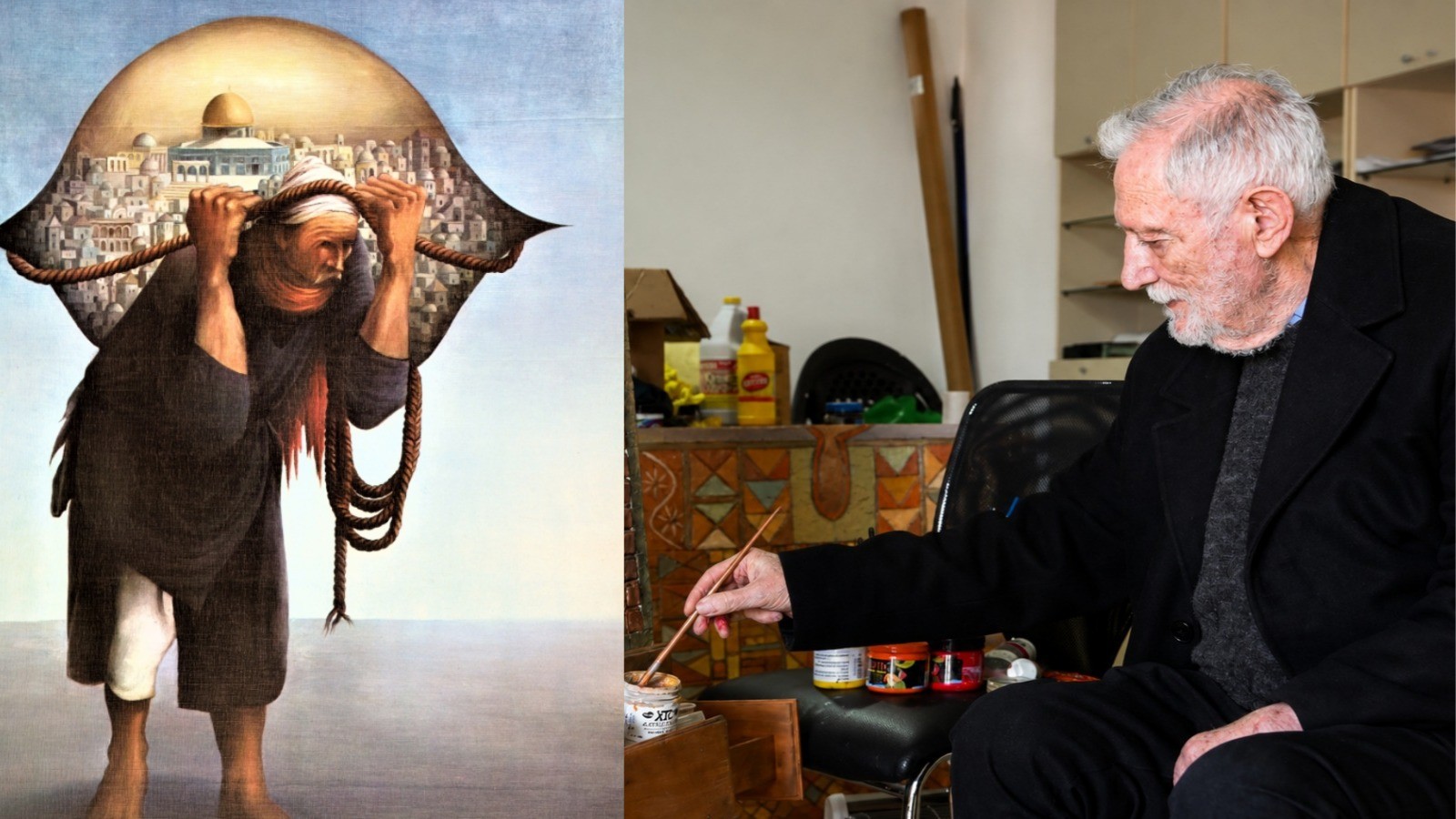
When Sliman Mansour passed away a few days ago, it felt as though a part of our childhood memories had passed away with him. His famous painting, "Jamal Al Mahamel" ("Camel of Hardship"), was among the first artworks we encountered as children in the refugee camp. Without realising it at the time, it became a part of our early artistic consciousness.
I remember seeing it hanging in the corner of my grandfather's guest room at his home in the Rafah refugee camp, above a large fish tank. Throughout the 1980s and 1990s, the painting could be seen on the walls of countless Palestinian homes, in refugee camps and cities alike. No one seemed to know, back then, how its printed reproductions had become so widespread, but the image became almost a talisman. Generations of Palestinians grew up with the painting on their walls. After Mansour's death, many shared the image on social media, bringing back memories of the painting and the childhoods they associate with it.
At first glance, the painting appears Expressionist: the rough lines of the porter's tattered clothes, the curve of his body beneath the weight he carries and the veins bulging from his arms, all conveying a sense of physical strain. But once you look at what he is carrying, you realise that you have left Expressionism behind and entered the realm of Surrealism, something reminiscent of Salvador Dalí's melting clocks.
The painting embodies a form of magical realism, becoming an enduring image that brings together the realities of occupation and questions of identity. Mansour said in one of his interviews, "It is impossible for an artist to live in a situation like that of Palestine under occupation and not be a political artist." In a more recent one, he added: "The conflict is over identity. I started my work searching for identity, and now my life is ending and I am still searching for identity."
The painting became more famous than its creator, standing out among his work over a five-decade career, which Mansour devoted to portraying the many concerns and struggles of the Palestinian people.
The artist, who died on 24 August at the age of 79, painted the original version of the work in 1973. He produced a second version in 1976, followed by a final version in 2005. Mansour explained that the final version differed slightly from the earlier ones: he made it larger, replaced the twisted rope holding the load with something resembling a strip of cloth, and added a small church.
Mansour passed away in a hospital in East Jerusalem. His funeral was held on 26 August at a packed church in Birzeit, the town where he was born in 1947.
He studied art and design at the Bezalel Academy of Arts in Jerusalem, graduating in 1970. He was a founding member of the Palestinian Artists Association. He co-authored books on Palestinian traditional dress and embroidery and received numerous awards throughout his career, including first prize at the first Palestinian Spring exhibition in 1985.
His list of honours continued to grow, most notably with the UNESCO-Sharjah Prize for Arab Culture in 2019 and the Nile Award for Arab Creators in 2025. In 2016, Palestinian Authority President Mahmoud Abbas awarded Mansour the "Medal of Culture, Science and Arts, Level of Excellence" in recognition of his artistic contributions to Palestinian national identity.
The porters of Jerusalem
In a 2021 interview with the Khazain blog, Mansour revealed that Palestinian writer Emile Habibi gave the painting its title, "The Camel of Hardship". The owners of a publishing house on Salah al-Din Street in Jerusalem had decided to turn the painting into a poster after its first exhibition at the YMCA in 1975. Habibi happened to be present when they were discussing a suitable title and suggested the name, which everyone agreed on.
The title draws on a familiar expression used to describe someone who patiently carries heavy burdens, hardships and responsibilities without complaint or collapse.
Mansour explained in the same interview that the idea for the painting came from a scene commonly witnessed in Jerusalem during the 1970s. Before small vehicles became widely used to transport goods through the Old City, porters would carry enormous loads on their backs, navigating the narrow alleyways with care and confidence. What struck Mansour most was their physical strength and their ability to carry weights that seemed far greater than their own size, despite their seemingly fragile bodies.
Punching through the glass
Packed with more than a hundred single-page political cartoons, this compilation of Mohammad Sabaaneh′s work, which draws on different periods of the artist′s life, offers a complex and often surrealist take on the daily struggles facing those in the West Bank and Gaza. By Marcia Lynx Qualey
Mansour tried to capture the figure of the porter, conducting several experiments in which he placed heavy objects on his own back, including a refrigerator and a cupboard. But the resulting painting was unremarkable.
The idea of the porter continued to preoccupy him as he searched for a more distinctive way to approach the subject. Eventually, he found it. "After deep thought, the idea of carrying Jerusalem flashed into my mind," he recalled. "At first, I placed the city inside a circle, but it seemed as though it could roll away at any moment. So I added a conical shape at both ends to give the load stability." The result resembled an eye, with the landmarks of Jerusalem inside it and the Dome of the Rock at its centre.
As for how the painting became so widely circulated, Mansour explained that it was printed and distributed by the Israeli Communist Party across Palestine, eventually finding its way into homes in cities, villages and refugee camps.
The painting that hung in my grandfather's house eventually disappeared. I do not know whether it was lost during the 2003 invasion of Rafah, when parts of the house were bulldozed, or during the 2014 war, when the house was completely destroyed. Many others, like me, do not know how it vanished from the walls of their childhood homes. But it continues to live on in memory.
This is an edited translation of the Arabic original. Translated by Maram Taylor with the support of AI-assisted translation tools.
© Qantara.de