Love without agreement

Topics
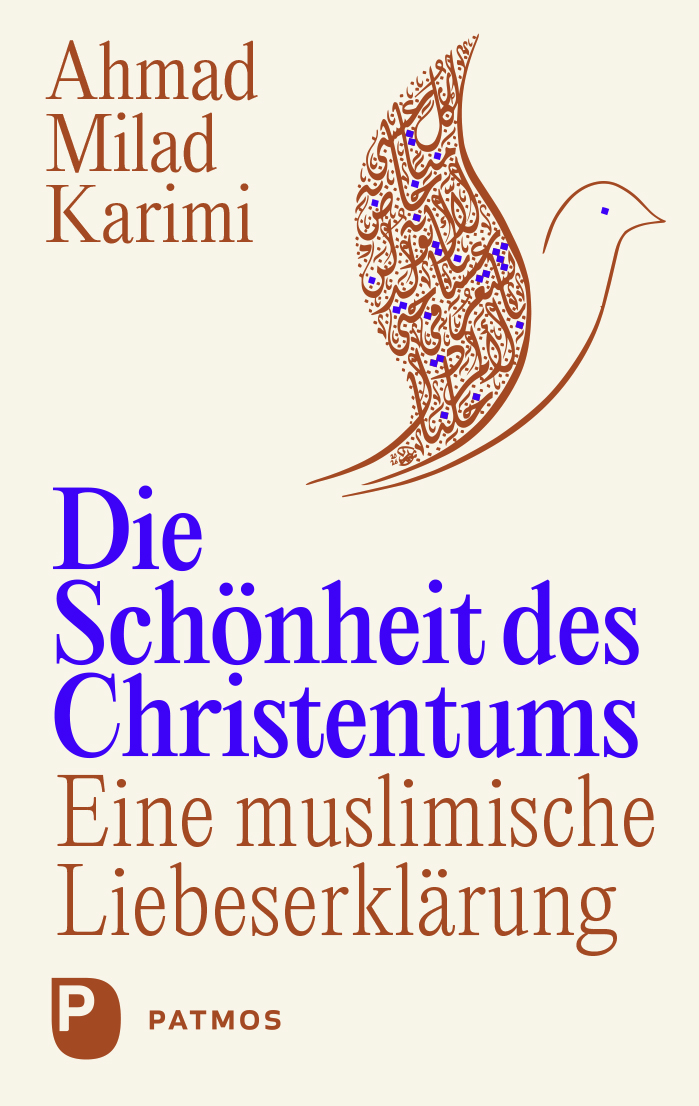
On the very first page of his new book, "Die Schönheit des Christentums", or "The beauty of Christianity", Ahmad Milad Karimi highlights a commonality, and a most significant one at that: neither his own religion, Islam, nor Christianity were formed in a vacuum. Both are embedded in a specific tradition, even when they break from it.
Judaism, Christianity and Islam "draw from one another, even where they differ", writes Karimi. Taking an interest in the "other" makes one’s own faith "more responsible", he argues: only by knowing the history from which one’s own religious tradition stems can one grasp the full depth of one’s own faith.
Karimi himself is more than just interested; "Die Schönheit des Christentums" is subtitled "A Muslim declaration of love." In just under 100 pages, deploying a tone at times poetic, at others, essayistic and incisive, Karimi explores how Christianity, from his perspective as a Muslim, moves, challenges and invites pause, pushing him towards self-reflection.
Yet love, as Karimi notes, does not mean agreement. "Love means to dwell with another, without possessing them." It's a clarification and perhaps also a justification. Karimi is a professor of Islamic philosophy at the University of Münster and is regarded as a prominent voice in the theological quest for a pluralistic Islam. Among conservative Muslims, the Münster faculty is frowned upon as a hub of overly liberal "German state Islam."
In a sense, Karimi’s book is a sequel. Earlier this year, he published a similarly titled volume—"The beauty of Judaism: a Muslim declaration of love"—in which he reflects on the common ground shared by the two religions with an eye to current conflicts.
Now, it is Christianity’s turn.
For me, the author of this review, the book is of particular interest given my own personal history. I converted from Christianity to Islam in order to marry my former partner, an Iranian citizen. It was a conversion on paper, compelled by the laws of her country; I did not embrace Islam out of conviction. And yet I could offer many declarations of love to this religion, sceptical vantage point notwithstanding.
As Karimi puts it: "I cannot believe what they believe. But neither can I pretend it is meaningless. I cannot agree, but I can allow myself to be moved. Perhaps that is precisely where a declaration of love begins."
Difference as a prerequisite for love
Anyone expecting this book to attempt to bridge the differences between the two religions will be disappointed. Karimi's focus is the points of divergence: the incarnation of God, the humiliation on the cross, the Trinity. These are positions that are often dismissed by Muslims as misguided, or benignly ignored in a spirit of 'don't we all, ultimately, believe in the same God?'
Karimi ventures down a different path, one he calls "a form of inner hospitality". He neither denies the otherness nor rejects it, but rather confronts the differences precisely because they challenge his own faith.
I am familiar with the bewilderment that the concept of the Trinity can evoke for Muslims. When I converted, the mullah in charge remarked: "Finally, a Christian who has grasped what utter nonsense this idea of three gods is." In Islam, the Trinity is rarely understood as an internal relationship within God, but rather condemned as a form of polytheism.
Karimi is far from making such an accusation, yet, he does not deny how bewildered he is by the concept. With unflinching honesty, he describes the profound challenge posed by the idea of the Incarnation—God becoming flesh. "This is alien to my faith. God is unique, incomparable. He remains beyond all anthropomorphism, all embodiment, all imagery, beyond any attempt to confine Him to the realm of the finite."
Something similar applies to the story of Jesus' crucifixion. For Muslims, it represents an inconceivable humiliation of a man they revere as a prophet. The Qur'an clearly states: "They did not kill him, nor did they crucify him." Karimi, too, asks himself, "How can this be God? How can divine truth descend so deeply into such humiliation?"
And yet, Karimi's resistance is mingled with a sense of wonder. He can't simply dismiss the image of God crucified as a mistake: "What this very image conveys is too significant: the complete surrender, the dignity of the wounded, the demands of a faith that does not relegate suffering to the margins."
The beauty of Christianity lies in its humanism
This is the point to which Karimi repeatedly returns—the common ground—and it is the great merit of this book. He does not deny the differences but rather recognises what connects us precisely within those differences. For even where Islam and Christianity diverge, they grapple with the same question: how far does God’s nearness extend?
“We are closer to man than his jugular vein,” says the Qur'an. Both religions strive for closeness to God. But while in Islam God remains great, transcendent, beyond human reach, Christianity is radical. God not only becomes human but, in that humanity, descends into the depths of suffering.
At this point, the Muslim author starts to wrestle with himself. Does the power of this unimaginable image reside exactly here: in its ability to seek God not only on high, but "also where humanity lies prostrate"?
The beauty that Karimi, as a Muslim, recognises in Christianity is the humanism he sees as inherent to the faith. Whether in the incarnation of God, the baby in the manger, the crucifixion, humanity in all its complexity is central.
It is surely no coincidence that the image of a suffering God resonates most deeply among secular, humanistic thinkers. Jesus’ lament on the cross—"My God, my God, why have you forsaken me?"—serves as the central symbol in Albert Camus’s novella The Fall, and the Greek author Nikos Kazantzakis describes the rejection of death on the cross—essentially the Muslim version of the story—as Jesus’ final, great temptation.
As a Muslim, Karimi can't subscribe to the theological implications of this narrative, but he subscribes to its humanistic values. The striking beauty of his book lies in the fact that although written by a devout Muslim, it has the potential to reveal to a Christian the beauty of their own faith.
Die Schönheit des Christentums – Eine muslimische Liebeserklärung
Ahmad Milad Karimi
August 2026
112 pages
This text is an edited translation of the German original; translated by Louise East with the support of AI-assisted translation tools.
© Qantara.de