Is "From the River to the Sea" illegal in Germany?
Topics
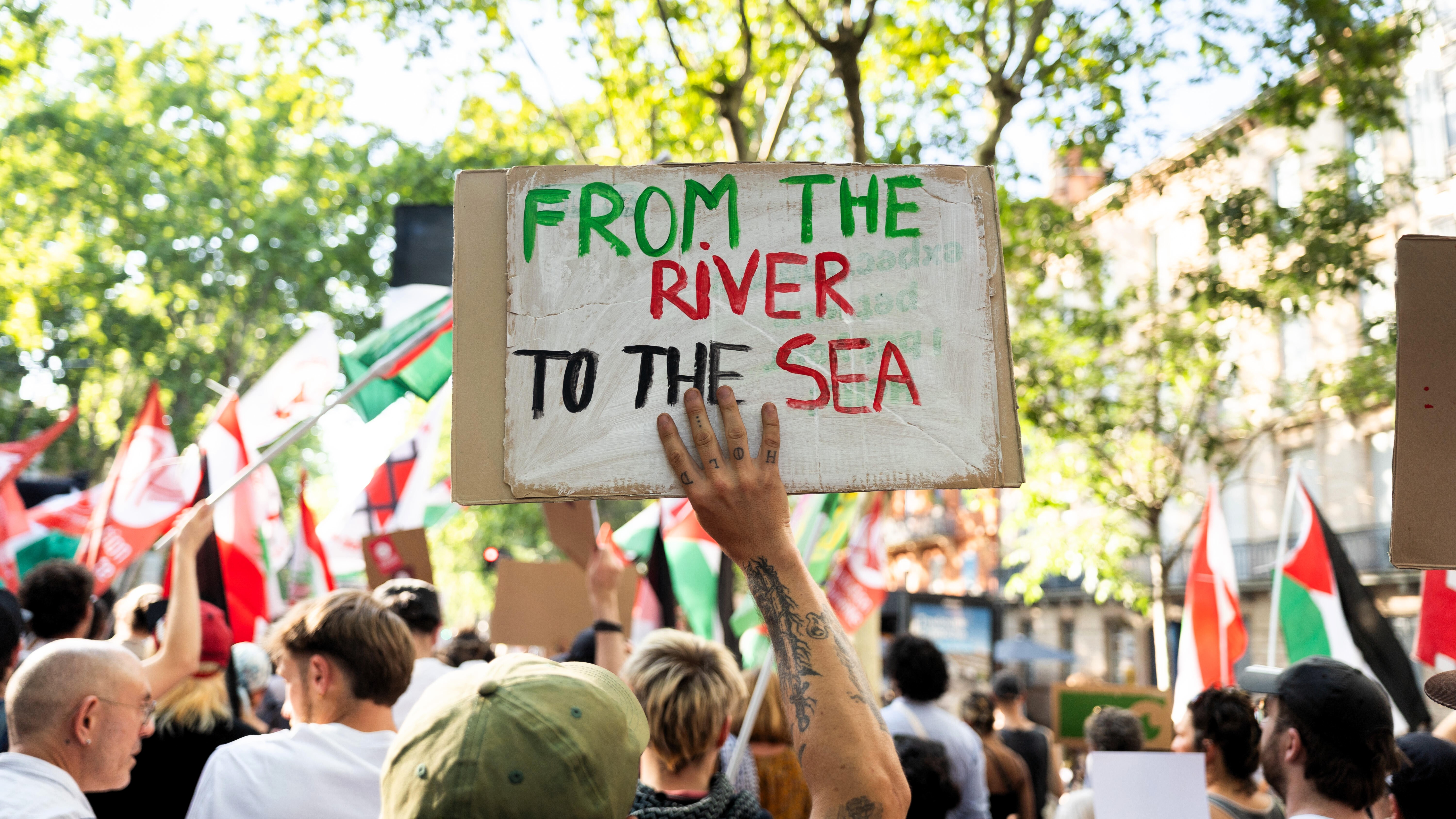
The slogan "From the River to the Sea, Palestine will Be Free" is controversial in Germany. For some, it is a legitimate call for a Palestine free from occupation and oppression; for others, it is an expression of antisemitism or a symbol of Hamas. At the same time, there is considerable uncertainty as to whether it is legal to use the slogan in Germany. Here is an overview of the key questions and answers.
What are the consequences of chanting the slogan in Germany?
Anyone who shouts the slogan at a demonstration or holds up a banner bearing it can expect to be reported to the police. However, whether the police actually intervene depends on the location, and on the stance taken by the local authority and the relevant public prosecutor's office. The latter decides whether to bring charges.
Is the slogan banned or not?
In November 2023, the Ministry of the Interior declared the first half of the phrase – that is, just "From the River to the Sea" – to be an "identifying symbol" (Kennzeichen) of Hamas. This phrase was banned alongside the usual symbols of Hamas and all activities carried out by the organisation.
However, the ban is merely an order, not a law that would provide clarity. When a case comes before the courts, judges must rely on existing legislation. The matter is further complicated by the fact that the Ministry has provided no evidence that "From the River to the Sea" is in fact a "Kennzeichen" of Hamas.
Have any penalties been imposed in connection with "From the River to the Sea"?
A number of defendants have been ordered to pay fines. The amounts usually range between 2,000 and 3,000 euros, payable in installments. There are no precise figures on how many cases have already been concluded and how many are still pending, but the lawyers involved estimate that there are several hundred cases in total.
Have there been any acquittals?
Yes, some cases ended in acquittal. According to observers, the fact that virtually identical cases are assessed differently by different courts is causing uncertainty. Among those convicted, it gives rise to a sense of injustice.
What is the legal basis?
Public prosecutors initially attempted to apply a section of the Criminal Code that criminalises incitement to hatred. However, according to the law, this offence must be directed against one or more population groups in Germany. As the chant relates to Israel/Palestine, this line of argument was rejected by the courts.
Furthermore, judges were unable to determine unequivocally what the defendants meant by various additions to the slogan, not even in the case of the most common variant, "Palestine will Be Free". Is this a call for freedom or a call for the destruction of Israel? Owing to this uncertainty and the need to protect freedom of expression, the judges initially opted for an acquittal in most cases.
The public prosecutors then sought an alternative in the Criminal Code and brought charges under a different section, which criminalises the use and dissemination of symbols of terrorist and unconstitutional organisations. The legal debate thus took a different turn.
Hamas symbol or not – what do the courts say?
As the Ministry of the Interior failed to provide any evidence to support this claim, it was contested in court from the outset. A number of arguments were put forward, some of which convinced the judges, whilst others did not.
In many cases, the defendants' defence team argued that the slogan did not originate from Hamas and was also used by other groups. For this reason, amongst others, it was not a "Kennzeichen" of Hamas. In this context, it was also pointed out that Israeli politicians likewise used the river/sea imagery to lay claim to the territory.
An expert witness from the Berlin State Criminal Police Office put forward a similar argument in court in 2025. She also pointed out that Hamas had used the phrase "From the River to the Sea" only a few times over the previous ten years – and then only as a geographical description and in various forms. The phrase could not therefore be regarded as a Hamas symbol.
On the basis of this expert report, several acquittals were handed down at first instance in Berlin in the summer of 2025. However, a judge in a higher court disagreed with this and commissioned the Islamic studies scholar Guido Steinberg to produce a further expert report.
In a relevant case in December 2025, Steinberg presented a series of examples of the use of river/sea imagery by Hamas, particularly by its leadership. On the basis of these, he claimed to be able to prove that "From the River to the Sea" was a Hamas "motto" (Leitspruch). For the judge, this was sufficient evidence to confirm the validity of the claim that the slogan was a symbol of Hamas.
Recently, however, a new shift has emerged in the courts. What has changed?
In March 2026, a trial took place in Munich in which a person was once again charged with using a symbol of a terrorist organisation. This time, the judge examined how the term "Kennzeichen" is understood in case law. The prerequisite, he noted, is that it must be used frequently by an organisation and always in the same form – and language.
With this in mind, he examined the examples that Steinberg, as an expert witness, had also presented at the trial in Munich. Out of a total of 21 examples, he was able to find the phrase "From the River to the Sea" in only one instance, namely in the English version of the 2017 Hamas programme. In the original Arabic, however, the wording is different: من نهرها إلى بحرها (from its river to its sea).
This difference alone, as well as the fact that the phrase in this English form appeared only here and nowhere else in the examples presented, suggested to the judge that it did not constitute a Kennzeichen according to German law. This interpretation was further supported by the fact that the phrase is in no way highlighted in the Hamas programme.
Is this a conflict between the judiciary and the executive?
Yes, because the judge not only ruled in favour of an acquittal, but went even further. He asked a Ministry of the Interior employee, who had been summoned as a witness, how the ban on the slogan had come about in November 2023.
It transpired that the Ministry had failed to document the investigative process, which led the judge to express doubts about the legality of the ministerial decision – a first.
A judge at an appeals court in Berlin was even more forthright in his criticism in June 2026, when he also acquitted the defendant. He even declared the ministerial ban to be legally irrelevant and without binding effect on the judiciary.
Although the public prosecutors' offices have lodged appeals against the recent judgements in Munich and Berlin, the legal debate surrounding the ban on "From the River to the Sea" is now regarded as obsolete in German legal circles.
What happens next following the recent acquittals?
Two high-level German courts, which have had appeals pending before them for months, could provide legal certainty: the Federal Constitutional Court and the Federal Court of Justice. However, it is not yet clear when they will rule on these cases.
This text is an edited translation of the German original. Translated by Max Graef Lakin with the support of AI translation tools.
© Qantara.de