"Palestine reveals the limits of international solidarity"
Topics
Qantara: Why does the Palestinian cause resonate so strongly with anti-colonial movements around the world?
Raouf Farrah: The Palestinian struggle demonstrates how territory can be seized and transformed through imperial power, and how settler colonialism can reshape geography and demography while destroying the structures of a society.
For this reason, Palestine has long occupied a central place in Arab, African, Latin American and Asian anti-colonial political imaginaries. But it also reveals the limits and contradictions of international solidarity.
Cameroon is a concrete example. Despite its anti-colonial history, Cameroon is today one of Israel’s closest allies in Africa, and the main security force protecting President Paul Biya has been trained and equipped with Israeli support.
This contradiction matters. Technologies and weapons developed within the context of the occupation and repression of Palestinians are subsequently exported to African states, including authoritarian regimes.

What distinguishes the Palestinian case from African experiences of anti-colonial struggle?
What distinguishes Palestine, first, is that it remains one of the clearest contemporary examples of an ongoing settler-colonial project. This is not simply a historical colonial experience whose formal structures have disappeared: the process of colonisation continues in the present.
Unlike most African countries, Palestinians are still struggling for the fundamental elements of decolonisation: sovereignty, freedom from occupation and the right of return.
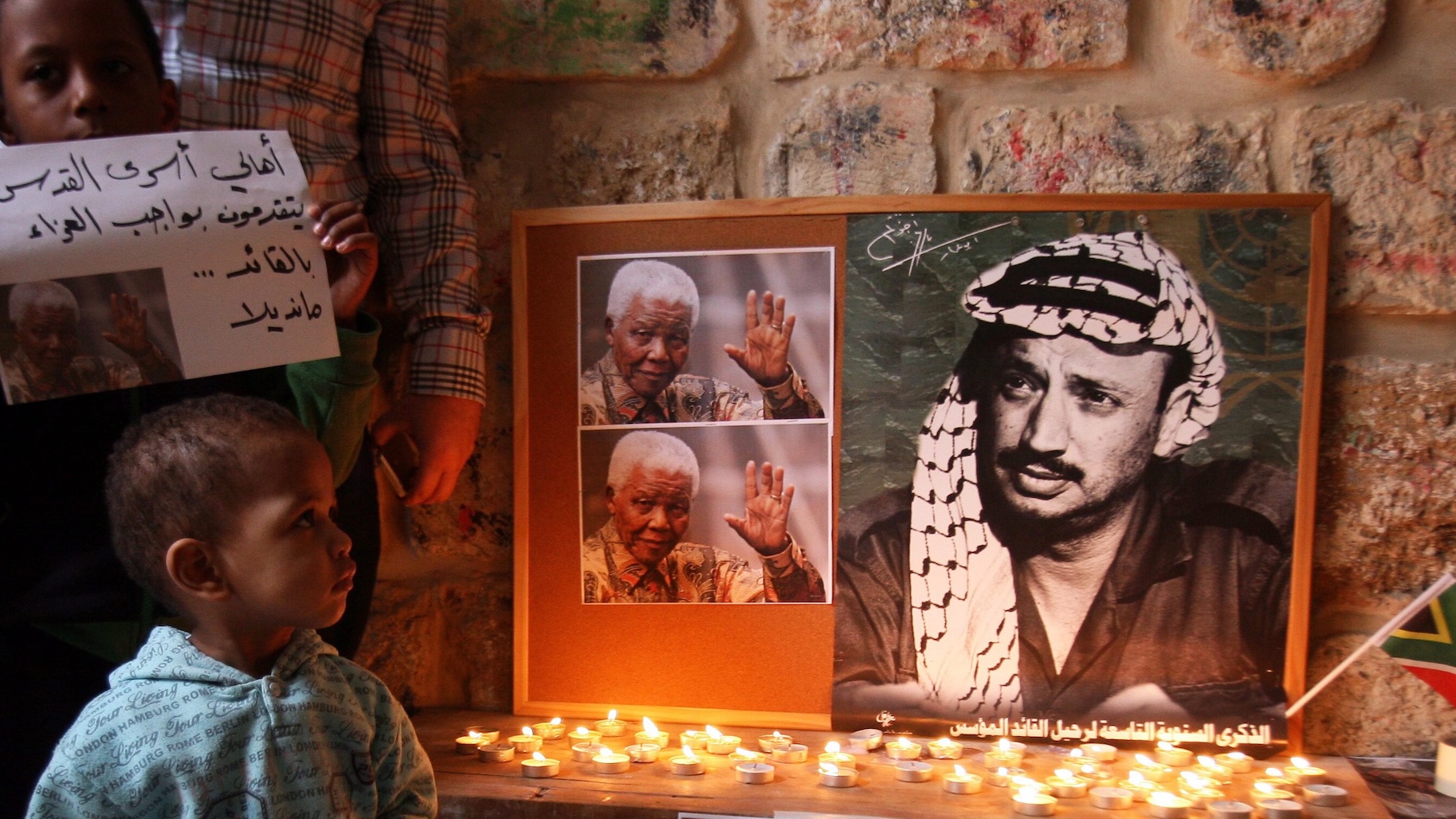
At the same time, the Palestinian struggle has historically learned from African liberation movements, just as African movements have drawn inspiration from Palestine. The Palestine Liberation Organization (PLO) and other Palestinian factions developed extensive relations with African liberation movements, including the African National Congress (ANC) and the Polisario Front.
Sociologist Eva Illouz argues that Zionism contains both colonial and anti-colonial dimensions, having emerged as a project of self-determination for a stateless Jewish people. Does the Israeli-Palestinian conflict therefore involve two competing claims to self-determination?
I would not characterise Zionism as an anti-colonial movement. It emerged in a Europe marked by centuries of antisemitism and the persecution of European Jews, culminating in the Holocaust. That historical reality must be acknowledged unequivocally, but it does not confer an anti-colonial character on the political project Zionism subsequently constructed in Palestine.
A persecuted people can legitimately seek safety, dignity and political protection without dispossessing another people. Political Zionism, however, developed around demographic transformation and the establishment of a Jewish state in a land already inhabited by other people.
This is fundamentally different from African national liberation movements, which sought to dismantle colonial domination over populations living in their own territories. Zionism, by contrast, sought imperial sponsorship for a new territorial and demographic order in Palestine. The absence of Palestinian consent is central to the colonial character of this process.
Claims to Palestinian self-determination are often grounded in indigeneity and dispossession, but Zionism also invokes Jewish historical and ancestral ties to the land. How should we evaluate these competing claims to self-determination?
For me, the central distinction is straightforward: historical or religious attachment to a territory cannot, on its own, establish a legitimate right to sovereignty. If such claims were sufficient, there would be no coherent limit to territorial claims anywhere in the world.
Palestine is fundamentally not a theological question, but one of colonisation, dispossession and decolonisation. Historical attachment may carry profound cultural significance, but it cannot justify sovereignty realised through colonisation, apartheid or forced displacement.
The relevant question is therefore how a historical connection is converted into claims to sovereignty and control over an existing population. Palestinians possessed continuous social, economic, political and territorial ties to the land; they were not an external population seeking sovereignty through the displacement of another people.
The issue is not whose historical claim reaches furthest into the past, but whose rights are being violated in the present.
South Africa has emerged as a leading advocate for Palestine, yet retains commercial relations with Israel. How do you explain this contradiction?
Many African states continue to support Palestinian self-determination diplomatically while maintaining economic, security and other bilateral relations with Israel. This reflects a broader tension between an inherited anti-colonial commitment to Palestine and increasingly pragmatic state interests.
How to talk about Zionism
Criticism of the ideology underpinning Israel's foundation remains contentious in Germany. In the US, however, a significant shift is taking place. The Zionist consensus within the Jewish community is fracturing and debate is opening up.
South Africa illustrates this contradiction particularly clearly. Its case against Israel before the International Court of Justice represents a major political and legal intervention in support of Palestine. Yet commercial relations continue.
This is where the distinction between symbolic and material solidarity becomes important. Recognising Palestinian rights, supporting international resolutions and issuing political statements matter. But solidarity becomes materially meaningful when political principles have consequences for economic, military and diplomatic relations. This is the logic behind boycott, divestment and sanctions (BDS).
The Moroccan Gen Z movement has brought the gap between governments and civil society into sharp focus: protesters carry Palestinian flags during demonstrations against the Akhannouch government, despite Morocco being a signatory to the Abraham Accords. What does this tell us about the divide between African governments' diplomatic choices and popular support for Palestine?
The Moroccan case exposes the growing distance between state diplomacy and popular political consciousness. Morocco has become one of Israel's closest allies on the African continent since the signing of the Abraham Accords.
That normalisation was also directly connected to Western Sahara: the agreement coincided with the United States' recognition of Moroccan sovereignty claims over the territory. In that sense, geopolitical bargaining took place at the expense of both Palestinian and Sahrawi self-determination.
At the same time, since the genocide in Gaza, Morocco has witnessed some of the largest and most sustained demonstrations in support of Palestine in the Arab world and Africa. Popular solidarity with Palestine in Morocco is particularly important because it also represents a form of resistance to the expanding Israeli political, security, technological and economic presence in Africa.
Morocco provides a revealing example of this Israeli presence: Pegasus, the spyware developed by the Israeli company NSO Group, has been documented in the targeting of human-rights defenders in Morocco and Western Sahara, including Sahrawi activist Aminatou Haidar.
The Moroccan case therefore points to a broader contradiction between the diplomatic choices of African governments and the political sentiments of their societies. The persistence of this solidarity, despite deepening relations between some African governments and Israel, is precisely what makes the state-society divide so politically significant.
© Qantara.de