"Rage can be very constructive"
Topics
Qantara: Your song "Dounana" ("without us") is going viral. In it, you rap: "You're wiping out our roots, destroying our homes, criminalising our very existence… But who would you be without us?" Who is this aimed at?
Siba: Those lines, like the whole song, are aimed at colonial and imperial powers. It's about general exploitation by Western colonial powers. That's why the message is deliberately kept quite broad.
In the music video, you seem to be confronting these power structures head-on, with palpable rage. Can rage be constructive?
Rage can be very constructive, but also destructive. It's first and foremost a signal that something is unfair. When I get angry, I know: something isn't right here. Rage is important. It can spur you into action and stop you from just standing by and watching something terrible happen.
Depending on how you deal with that feeling, it can consume you and turn destructive—or it can help you to make a statement, to show the other person, or the oppressor: this isn't acceptable. And then it's up to them what they do with that anger.
You sing in Arabic. Does the "other person" even understand you?
That's a good point, which is why the translation is displayed on screen. But the song isn't just directed at the "other person". It's also for the people who feel this anger themselves. When our rights are taken away or we experience injustice, anger can make us feel heard. We feel our existence again. It's not just about sending a signal to the outside world, but also about empowerment.

Doesn't that risk reinforcing an "us versus them" narrative?
That's an interpretation. Who is "us", who is "them"? I've never framed it that way. I would never, for example, say that every white person belongs to "them". Many white people worked on the song. If someone wants to see themselves as "the other", that's not my problem or the song's problem.
Still, your criticism is directed exclusively at Western colonialism and imperialism.
For me, that is whataboutism. We can't address everything at once in every statement. A work of art can't deal with all injustices in the world. Just because we talk about Western colonialism and exploitation doesn't mean we condone other forms of oppression.
The reason I speak so directly about Western colonialism is that we are still living in structures that emerged from it. White supremacy, the US prison system, or more broadly, the oppression of non-white people and other marginalised groups, are historically connected to it.
Western colonialism was global and long-lasting. It wasn't just about land seizure, but about restructuring entire political, economic and cultural systems so that these power structures could continue to exist. The slave trade, arbitrarily drawn borders, resource extraction—many of the inequalities and forms of poverty we see today directly stem from that.
You wrote and released "Dounana" almost two years ago. Was there a specific trigger?
Back then, we had been watching a genocide unfold on our screens for months, but weren't allowed to speak about it. There was a sense of helplessness [in Germany, ed.]. At the time, it was even more difficult to protest than it is today. The anger built up and eventually came out in that form.
I was also inspired by Bobby Sanchez's song "Quechua 101". It's in Quechua, a language spoken by Indigenous communities in the Andes that was suppressed by colonial powers and is now threatened with extinction. I realised just how global this pain is, which goes hand in hand with the destruction of entire populations and cultures.
Why do you think "Dounana" is striking a nerve right now?
When we released the song two years ago, we just uploaded a four-minute landscape-format video to Instagram. That wasn't algorithm-friendly at all. Then, about a month ago, I had a chat with the producer Monkyman. We both felt it was a shame that we hadn't really given the song a proper chance. When we switched to portrait format, it went viral.
The song is unfortunately still relevant. We continue to watch a genocide unfold, what Israel is doing in Lebanon, and how people are being oppressed worldwide—not only there, but also here, in Western countries, in the US, in Canada, everywhere. That's why it felt right to return to it and remind people of it again. Clearly, many people feel this pain.
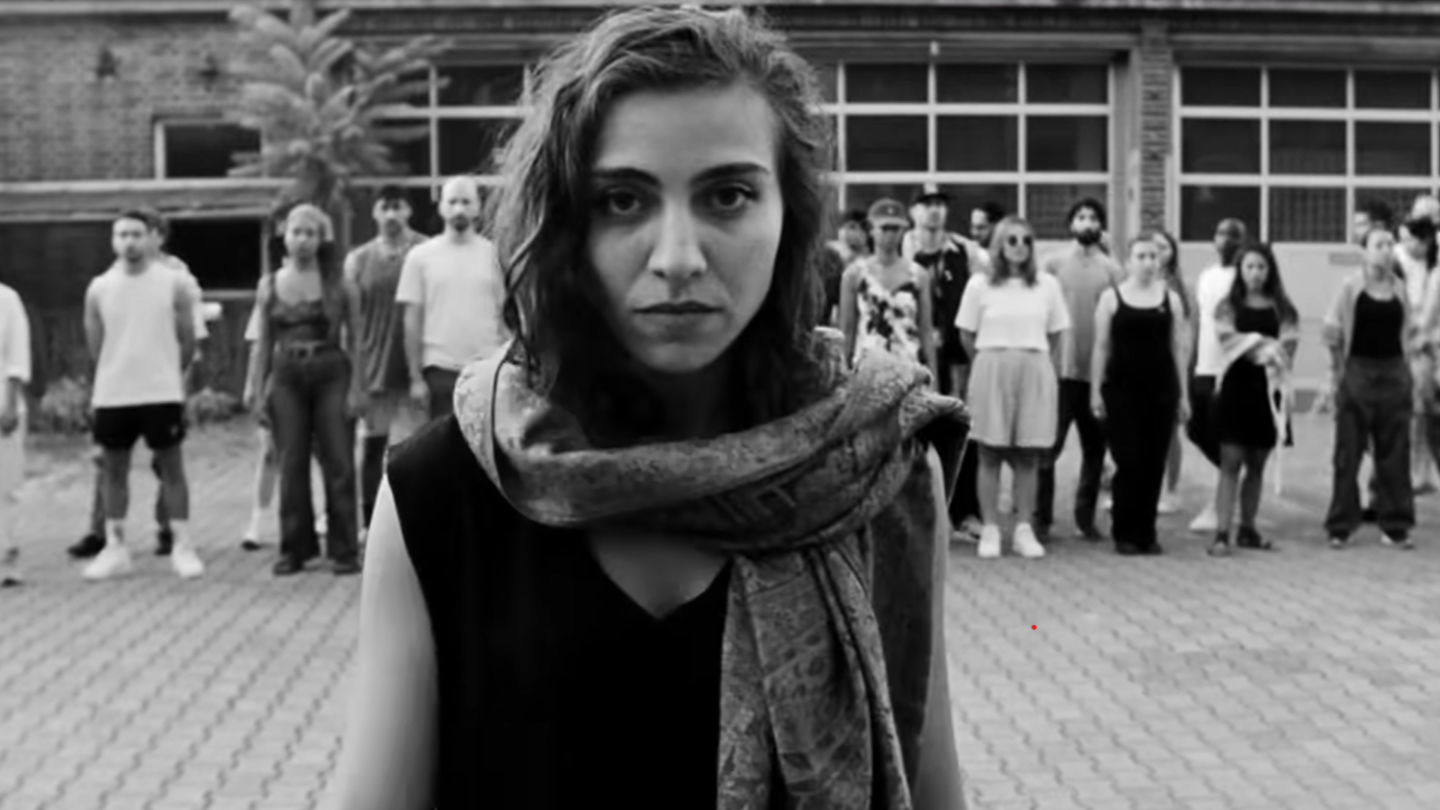
The music video is clearly located in Germany, and it features exclusively people with a so-called "Migrationshintergrund" (migration background). What led to this choice?
It wasn't easy to find a location that gave us space and also allowed us to shoot a video for a song like this. The values had to align. In the end, we did it at 90mil in Berlin.
The many people with a "migration background" represent a clear message of empowerment: we are many, we all feel this, and we will not be silent. As the song says at the end: سنبقى في مقامنا ويبقى فينا حبّنا ("We will remain steadfast in our place, and our love will remain within us.")
© Qantara.de