How to preserve what remains
Topics
During the Gaza War, most public libraries, private book collections and many bookshops were significantly damaged or almost completely destroyed, mostly because of Israeli air strikes. The list of the affected includes not only university and community libraries, but also numerous libraries in schools, mosques and charities.
The extent of the devastation suggests a systematic approach by the Israeli army. Palestinian and Israeli researchers such as Bilal Hamamra and Avi Shlaim, as well as the United Nations, speak of a "scholasticide", the deliberate targeting of educational institutions.
The largest book collection, containing around a quarter of a million Arabic volumes and some 60,000 English-language volumes, was housed at the Islamic University in Gaza, which Israel claimed to be a Hamas stronghold.
The university’s central library was attacked several times; during the final bombardment, the book collections on each of the building’s six floors were reportedly destroyed. Eyewitness accounts from internally displaced people who sought refuge in the ruined building suggest that remnants of the collection were used as emergency fuel. Some books, however, were salvaged from the rubble.
In early February, the head of the library, Mamduh Firwana, said on the university’s Facebook page that, during the initial reconstruction phase, only digital books would be available.
The libraries of al-Azhar and al-Aqsa Universities in Gaza City, which contained a total of several hundred thousand books, were systematically destroyed. In the latter, Israeli army personnel set fire to the book collections themselves, as evidenced by a video published online in May 2024, in which a soldier is seen sitting in front of a burning bookshelf, holding a book in his hand. Although the incident caused a stir, as far as is known, it had no consequences.
Making historical documents digital
The destruction also extended to cultural heritage sites. An Israeli air strike devastated large sections of the Great Omari Mosque, widely regarded as the oldest mosque in Gaza, while its library collection was almost completely destroyed.
The Omari Library—like the mosque itself—suffered severe damage during the First World War, when British and Ottoman forces fought in the area. In the years afterwards, it was painstakingly restored thanks to donations of books.
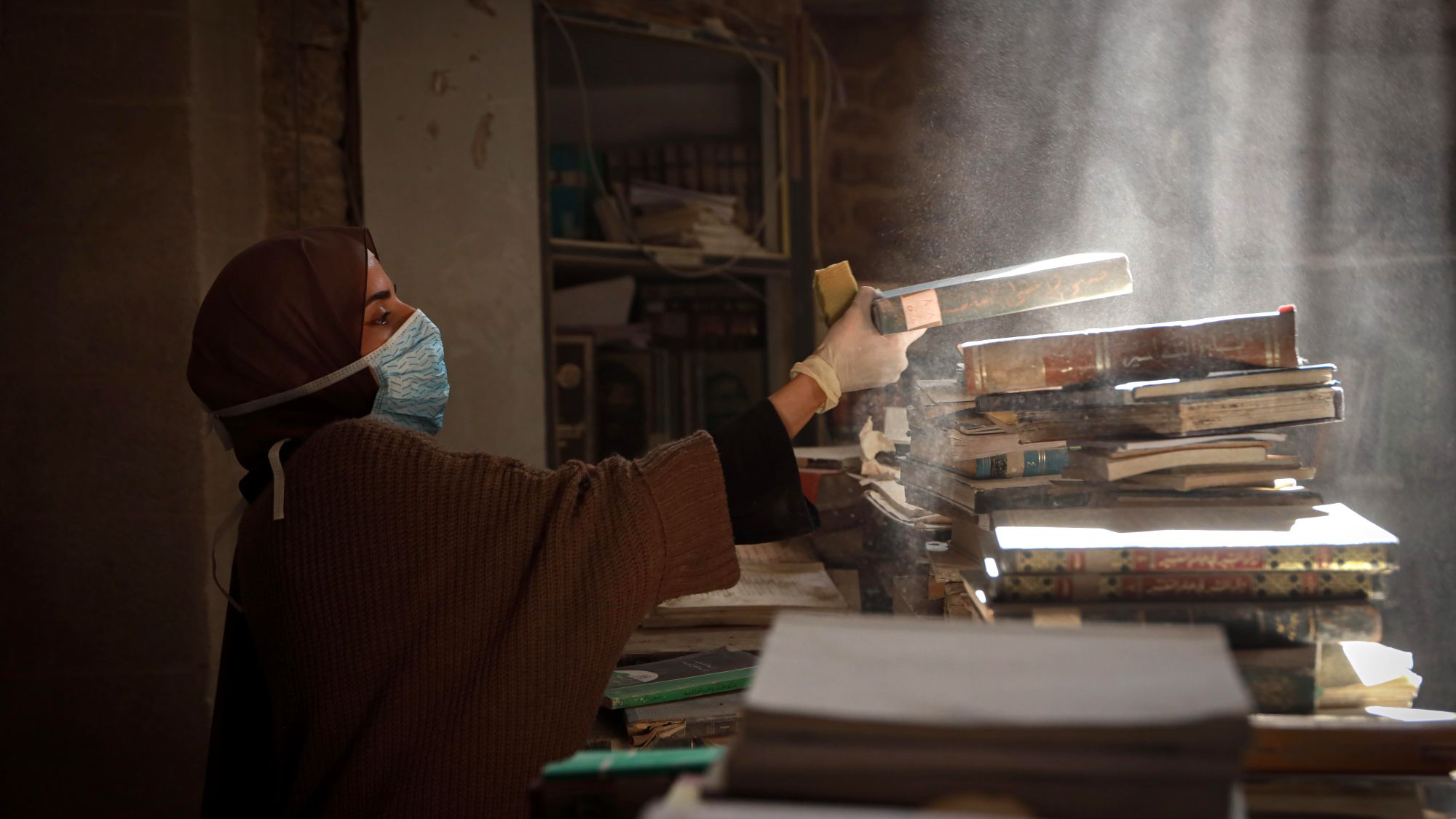
Now, a volunteer team from the Palestinian foundation "Eyes on Heritage" is trying to rescue several thousand of the approximately 20,000 books, manuscripts and documents that were most recently kept there.
The foundation was established a decade ago by the historian and book collector Abd al-Latif Abu Hashem from Rafah. As book collections in the Gaza Strip were repeatedly targeted by Israeli air strikes, he began digitising the library’s most valuable items in 2022 with the help of the British Council.
As a result, 147 works were digitised and made available online before the war as part of the British Library’s 'Endangered Archives' programme – several of the original works are now believed to have been lost. Among them are unique religious works by local legal scholars, which Abu Hashem had digitised because he wanted to preserve them as important testimonies to a long tradition of scholarship in Gaza.
The digitised works also include issues of the local legal journal "Al-Huquq" (The Law) from the British Mandate period, which are not preserved anywhere else worldwide and offer rare insights into the legal history of the Gaza Strip.
A library guest book from the same period demonstrates just how important the institution was to the cultural and political elite of the time. A historical lending register has also been digitised, allowing researchers to draw conclusions about the reading habits of the population.
Searching through the ashes
Abu Hashem himself was forced to leave the city of Rafah last year; shortly afterwards, it was almost completely destroyed by the Israeli army. He is currently continuing his research into the Omari book collection at the Institute of Research and Study on the Arab and Islamic Worlds in Aix-en-Provence, France.
In a recent radio interview, he reported that he had owned a personal library of around 20,000 books, the fate of which remains unknown to him. With the rescued books from the Omari Mosque, he hopes to at least gradually rebuild that collection.
In the Gaza Strip, there also seems to be a general determination to revive the largely lost world of books. One example of this is the 'Phoenix Library' initiative by two young writers Omar Hamad and Ibrahim Masri.
Hamad always travelled with his personal book collection packed in several suitcases on his long journey as an internally displaced person. Now, together with his friend, he has made it his mission to rescue the remnants of bombed-out libraries before they are lost forever.
In Gaza City, the pair ran a crowdfunding campaign to set up several rooms filled with the books they have salvaged. As Hamad’s popularity on Instagram grows, he has begun promoting the collection, which is becoming Gaza’s first functioning library after the city’s public library was destroyed by Israeli air strikes.
This text is an edited translation of the German original. Translation by Jess Smee.
© Qantara.de