The Virgin Mary on the streets of Tunis
Topics
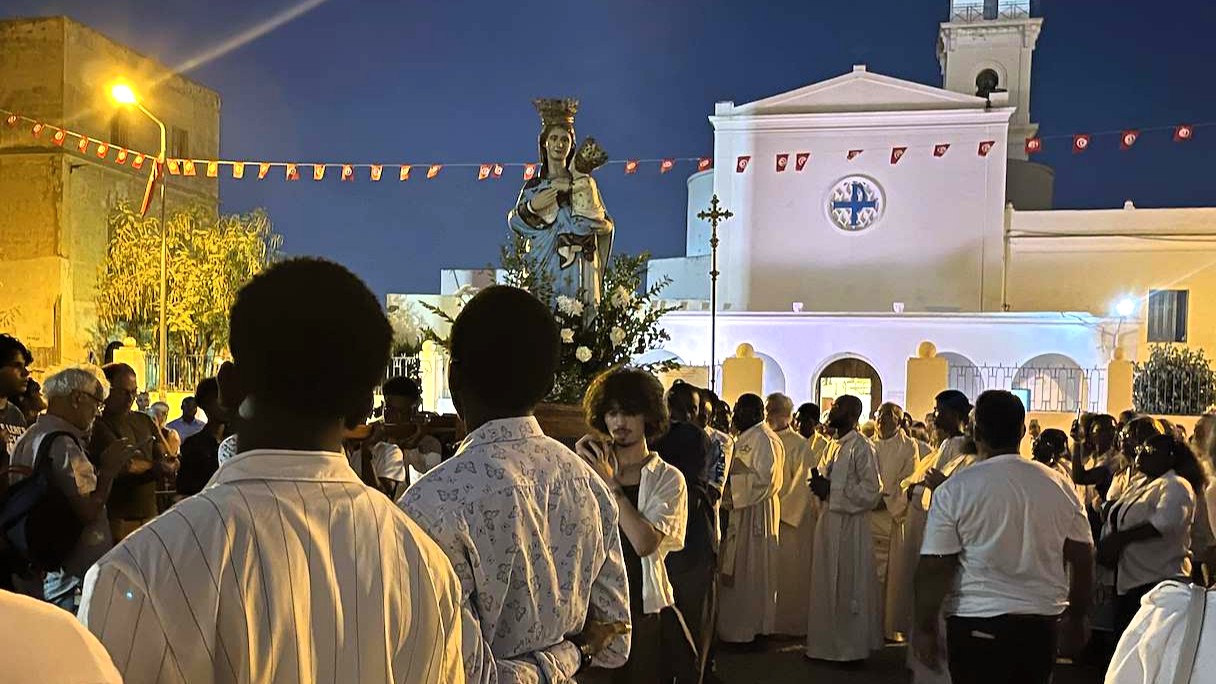
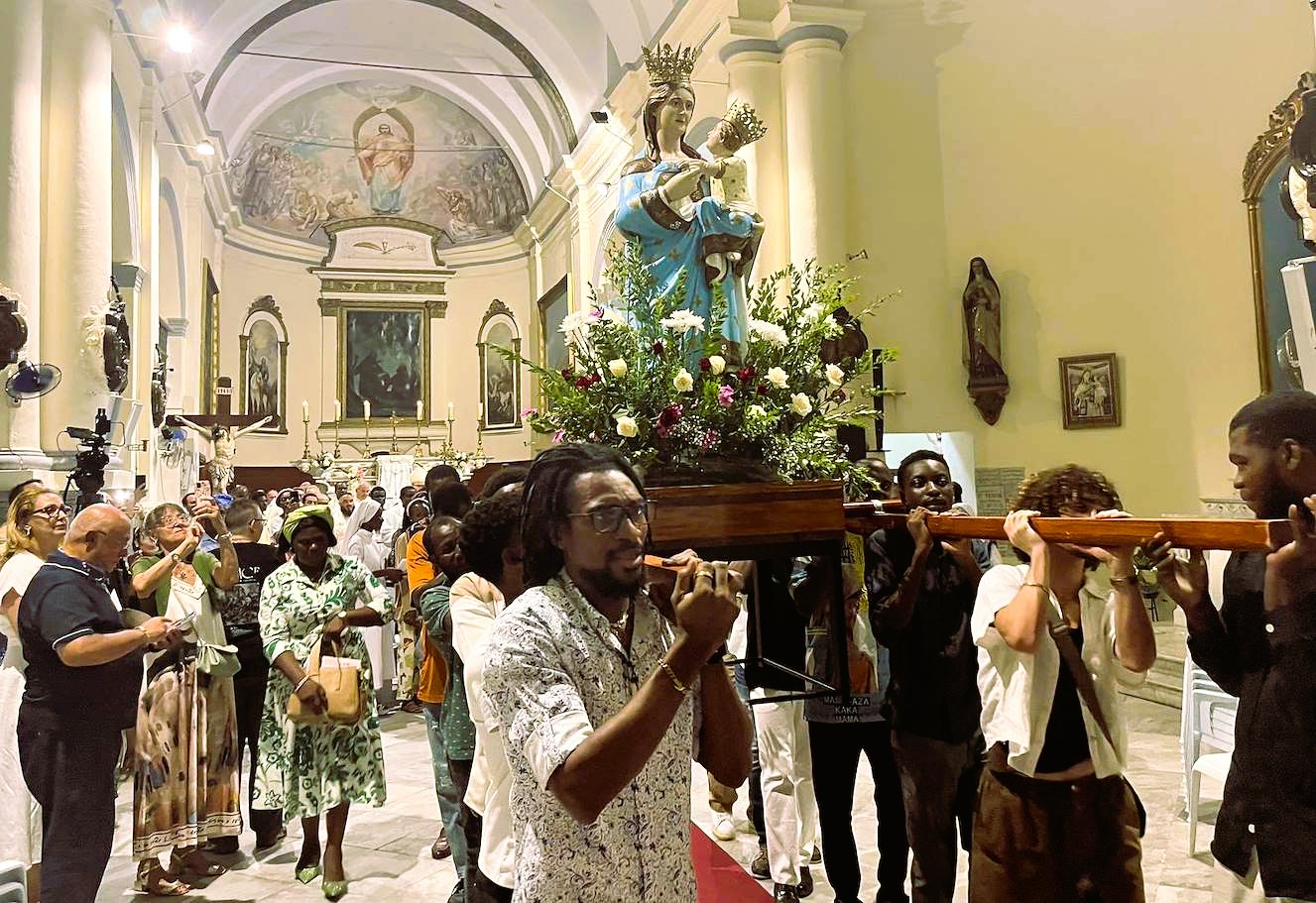
In the flickering candlelight and surrounded by the soft murmur of prayers, a statue of Mary holding the infant Jesus stands beneath the vaulted ceiling of the church. After Mass, twelve men will hoist the statue onto their shoulders and carry it through the warm summer night in La Goulette.
This August, the Catholic community of this suburb of the Tunisian capital celebrated the Feast of the Assumption of Mary once again. At the parish's request, people of different faiths were once again invited to take part this year.
"This festival brings us all together, us Catholics as well as our Jewish and Muslim friends and brothers," Father Narcisse Djerambete tells Qantara. Originally from Chad, he has led the parish in La Goulette for 13 years.
A wide variety of traditions shape the celebrations: women from the parish wear light blue skirts printed with images of the Virgin Mary and dance down the central aisle of the church towards the altar, baskets of offerings in their hands.
"It is a good sign that today I can publicly show something from my culture," says Nadia from Burkina Faso, one of the dancers. For security reasons, she does not want to give her surname. For her, being able to publicly express her faith and culture in Tunisia is unusual.
Since Tunisia signed a migration agreement with the EU in 2023, the Tunisian authorities have been clamping down on undocumented migrants as well as carrying out unlawful deportations to desert areas. There have also been lynch mobs and online hate campaigns against migrants.
Against this backdrop, the procession of the Virgin Mary, a tradition dating back to the 1880s, is seen as a symbol of the peaceful coexistence that still exists in Tunisia. The procession has only been taking place again since 2017, after the Madonna had been forced to remain inside the church for decades.
A tradition with European roots
People who had migrated to Tunisia in search of a better life have long been part of the procession. Its origins, however, lie not in other African countries but in Europe, in the Sicilian port city of Trapani.
From there, fishermen brought a replica of the famous statue of the Madonna of Trapani to La Goulette. They donated it to the local parish of St Augustine et St Fidèle, which was mainly made up of migrants from Sicily and Malta. They settled in Tunisia from the beginning of the 19th century.
"In Sicily, people were dying of hunger in droves at that time," explains linguist and author Alfonso Campisi, whose ancestors also emigrated to Tunisia. Expropriations by the Mafia also played a role in people's decision to leave, he says.
In Tunisia, the newcomers arrived at a time of high demand for labour to build infrastructure under the French protectorate. Workers found they could earn three to four times as much as they could in Sicily.
For Campisi, the procession was just one example of the peaceful coexistence of different religions in La Goulette, which continued into the 1960s.
"Christians invited their Muslim neighbours over for Christmas, Muslims prepared food for everyone to break the fast, and people helped their Jewish neighbours light candles on Shabbat," Campisi said, describing the scene around the fishermen's houses on the sandy beach, with their blue doors and lively courtyards. His comments were informed by conversations with former residents.
He added that this was possible in La Goulette because of social class: the Sicilians of La Goulette had little to do with the wealthier Italians in Tunisia, who were well connected to the French protectorate authorities and therefore associated with the colonial regime. The Sicilians lived in the same neighbourhoods as Tunisians and did similar jobs.
A post-independence shift
The Sicilian residents of La Goulette were also affected by the political changes following Tunisia's independence in 1956. Tunisians were to be given priority in the labour market, and Sicilian taxi drivers, for example, lost their licences.
In 1964, the land ownership of non-Tunisians also came under scrutiny. They had to hand over half of their property to a Tunisian or take Tunisian nationality themselves. Most were unwilling to do so, as it would have meant giving up their European citizenship. The Sicilian community was also unsettled by the nationalist mood in independent Tunisia, which is why a large proportion of Sicilians left the country during the 1950s and 1960s.
Yet whether they moved to Milan, Marseille or New York, many families still felt connected to their former Tunisian home today, Campisi said. The community keeps in touch through Facebook groups, for example, and organises trips to Tunisia together.
The year 1964 was also decisive for the Catholic Church. The Vatican struck an agreement with Tunisian President Habib Bourguiba, which led to numerous churches being closed. Although the church in La Goulette remained open, the Madonna of Trapani was no longer allowed to be carried to the beach, explains journalist and author Hatem Bourial.
President Bourguiba's critical view of the role of the Catholic Church in independent Tunisia was linked to the French religious order Les Pères Blancs, which had collaborated with the protectorate authorities. The order's schools and orphanages, as well as its Islam-critical discourse, were intended to convert the whole of North Africa to Christianity–for nationalists such as Bourguiba, this represented an attack on Tunisian identity.
A revival after the 2011 revolution
More than half a century later, in 2017, the statue of the Madonna once again passed beneath the starry sky in La Goulette. The 2011 Tunisian Revolution had created new spaces for freedom that also made it possible to revive the traditional procession.
But something else had changed alongside the political context: while the community used to be made up of many people of European descent, the majority today come from African countries. Their traditions also shape the celebrations. The dance towards the altar, for example, is a tradition from Ivory Coast.
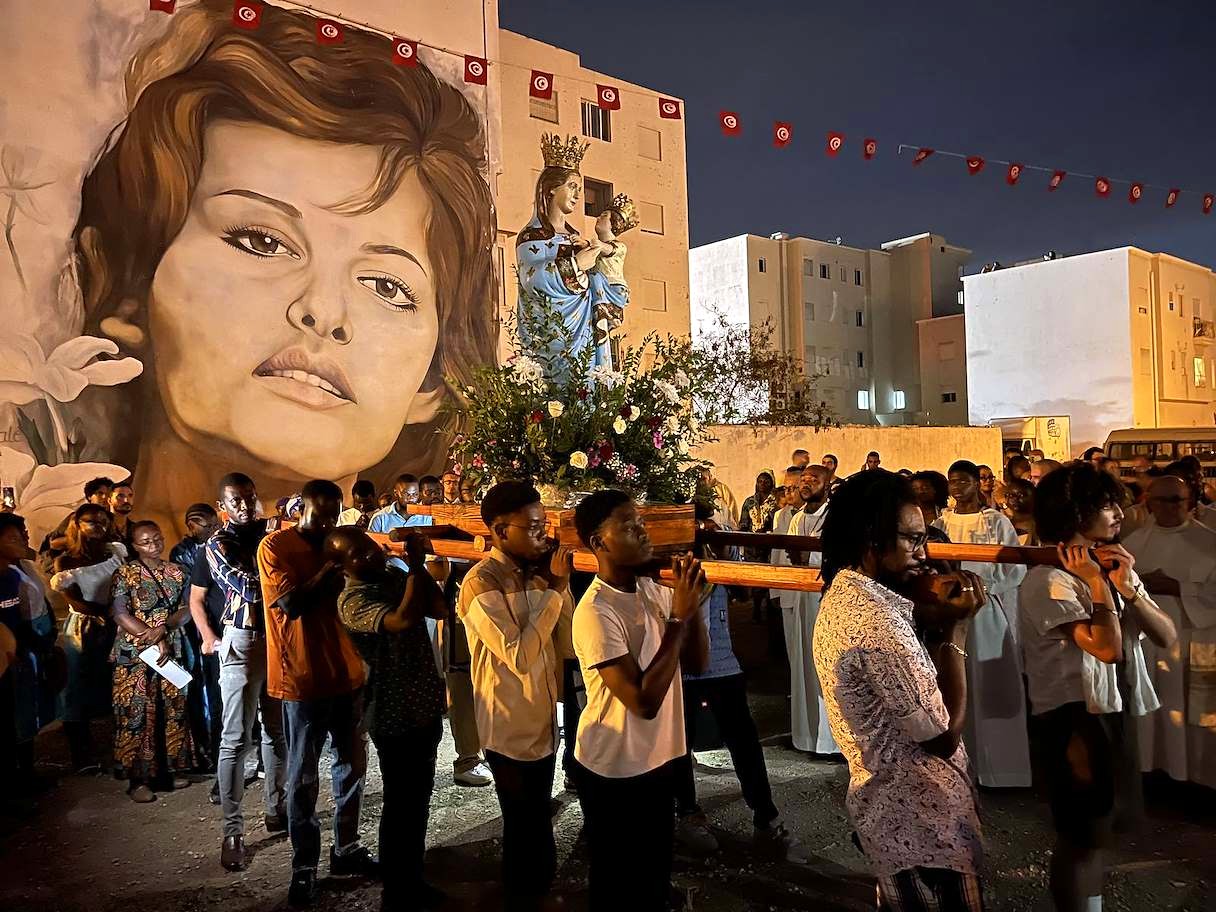
At the end of the service, the statue of Mary is carried out on a wooden frame, where more people await the procession. This year, fewer people turned up than before, because the police have cordoned off the square and control admission. They ask some people for an invitation and send them away, while others are allowed through. Some journalists are prevented from taking photographs. Admission is controlled even though the parish expressly invited everyone to join the celebrations.
As the procession carrying the statue of Mary with the infant Jesus slowly makes its way around the square, the choir recites a rosary, switching between Arabic, French, Swahili and Italian. In between, members of the parish urge tolerance and peaceful coexistence in several languages, which perhaps alludes to the increasingly precarious situation of migrants.
Hélène B. from France thinks of Israel and Palestine when she hears the intercessions: "The message of fraternity between peoples, religions and cultures touches me deeply, especially in view of the genocide in Palestine." She has travelled to the procession for the second time, after her Tunisian grandmother, who was Jewish, had enthused about the summers she spent in La Goulette.
After the rosary, the procession returns to the church. Some people queue for a selfie with the Madonna of Trapani, while the choir's final notes echo off the high beams of the church.
This is an edited translation of the German original. Translated by Jess Smee with the with the support of AI-assisted translation tools.
© Qantara.de