More than a strait
Topics
Saeid Shanbehzadeh is one of the best-known musicians from the Gulf region. The virtuoso, originally from Bushehr province in southwestern Iran, won first prize at Tehran's Fajr Music Festival at an early age, followed by international success; he now lives in France.
Shanbehzadeh—accomplished in dance, percussion and singing—is a master of the double flute ney jofti, which, combined with the bellows of the ney anban, forms the Persian bagpipe. His heavily rhythmic concerts, characterised by solos and improvisation, sound nothing like classical Persian music with its melancholic harmonic patterns.
That some of Shanbehzadeh's music evokes a Caribbean feel, and that much of it resonates with jazz musicians, is due to the particular geography and history of his homeland. Since antiquity, trade routes have linked southern Iran with the Arabian Peninsula, East Africa and India. By the late 16th century, under Portuguese rule, the city of Hormuz was among the richest trading centres in the world.
A wide range of cultural influences flowed into the region. Some local musicians even claim that jazz, rap, hip-hop and reggae were "invented" here.
Black Iranians
Trade did not only involve goods such as spices and commodities, but also people. Many Iranians living along the Persian Gulf are descendants of enslaved Africans who were brought to the region.
"For around a decade now, a younger generation of Black Iranians has been redefining itself," says Sara Zavaree, an Africanist based in Cologne. "They are searching for and finding new terms, and are marking Blackness with a new sense of self-confidence."
The global dynamics of identity politics and renewed Black consciousness have also reached the Iranian diaspora, leading in 2019 to the creation of the globally active online platform Collective for Black Iranians in Los Angeles.
Saeid Shanbehzadeh himself has African ancestors, in his case from Zanzibar. As a "cultural ambassador", he has spoken about how knowledge of such family histories is not officially passed down in Iran:
"It is a system that was already instilled in my great-great-grandparents: forget your origins, your identities, and then you will be accepted in Iranian society. That's when I began to research why I am the way I am, why I play the way I play, why I dance the way I dance."
Domestic tourism in southern Iran
Overall, perceptions of Iran's Gulf provinces have shifted. They were once considered backward and of interest mainly for ethnographic study. Later—until the current war—the south offered opportunities for domestic tourism for Iranians, who often require visas for travel abroad.
The island of Kish is a free trade zone and, in addition to its cultural and historical riches, offers attractions for shopping and active holidays: quad biking, parasailing and diving. Qeshm, meanwhile, the largest island in the Persian Gulf, with its vast mangrove forests, sparkling beaches and surreal landscapes, provides the perfect setting for off-the-beaten-track hiking and spiritual exploration.
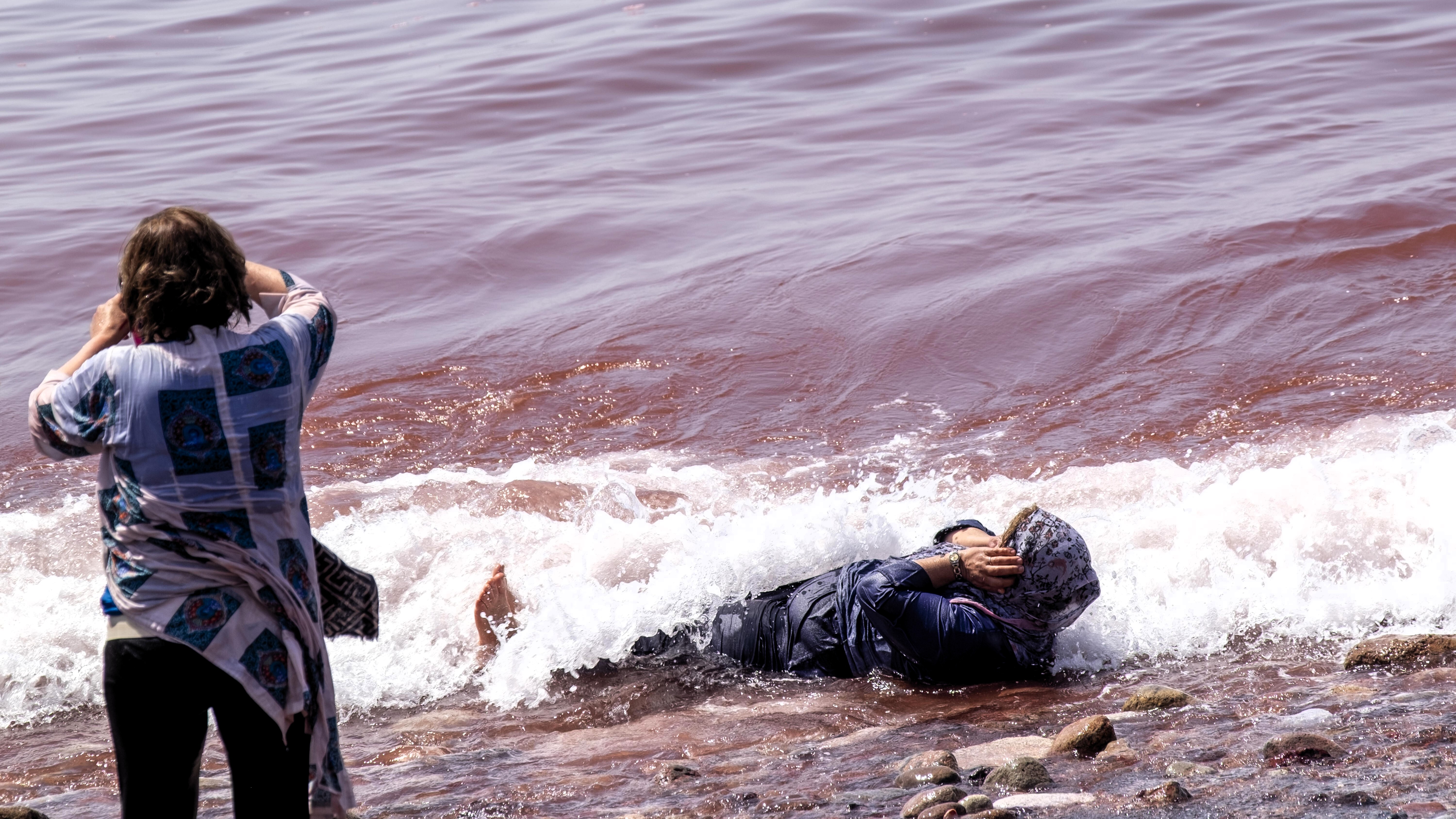
The small island of Hormuz, after which the now highly volatile strait is named, has also gained renewed attention. Here, the turquoise sea blends with shades of red and ochre, creating a spectacular sight, especially after rainfall.
This is due to the blood-red iron oxide dust (gelak), used as healing clay, spice and pigment. Since 2007, the Environmental Art Festival, curated by eco-artist Ahmad Nadalian, has taken place here, featuring enormous mandalas with mythological motifs arranged on the beach.
Southern Iran in cinema
Iranian cinema has likewise drawn inspiration from the visual richness, historical depth and atmosphere of the Gulf provinces. Filmmakers from the region, such as Amir Naderi and Nasser Taghvai, have long focused on the culture and people of their homeland.
Naderi's film "Davandeh" ("The Runner", 1984), in which he depicts his childhood in the shadow of oil rigs and refineries in the Gulf city of Abadan, is a visually powerful classic of Iranian cinema.
Hassan Bani-Hashemi, from Bandar Abbas, also made several short films with the cult singer-songwriter Ebrahim Monsefi (1945–1997), sometimes dubbed the "Bob Dylan of southern Iran". Monsefi blended influences from Western folk ballads and hippie culture with the rhythms of the Indian Ocean coast. Today, this early singer-songwriter is being rediscovered as an independent free spirit.
The rediscovery of the South has also led to films such as Mani Haghighi's "A Dragon Arrives!" (2016). In this psychedelic mystery road movie, a detective from Tehran quickly loses his bearings while investigating a puzzling murder—and takes part in trance-inducing rituals that point him towards hidden truths.
Spiritualism rather than Islamic doctrine
The new interest in popular culture in Iran also encompasses the widespread belief in spirits found in the southern provinces, the roots of which extend as far as Sudan and Ethiopia. As trade and travel between the seas depended on the winds, these play a central role in the region's mythology.
Known by names such as Zar or Dingomaro, these spirits are personified forces that speak different languages. When they take possession of a person, a collective trance ritual, often lasting several days, is required. The aim of this ritual is not expulsion, i.e. exorcism, but first to name the spirit and then to achieve reconciliation: the integration of the wind or spirit into the person who is its bearer.
In Iran, this complex Zar culture, which spans several continents, was long marginalised. It was already partially banned under the Shah. After the 1979 revolution, it was deemed un-Islamic, meaning that practitioners had to hold their rituals, which also involved drinking blood, in secret within old cisterns.
Sara Zavaree, an African studies scholar whose doctoral thesis focuses in depth on the region's spirit rituals, also sees a change here: "We are seeing a new, spiritualised interest among urban, well-educated young people. Particularly amongst those who have grown weary of Islamic doctrine and are fed up with the government, Zar offers a space for people to find new spiritual inspiration and to experiment."
The musician Saied Shanbehzadeh, too, cultivates and explores Zar traditions with his ensemble. As a result, Iran’s diverse and fascinating Gulf region is gaining greater visibility, along with a new sense of self-confidence.
The reimagining of the region as a hub of alternative counterculture may well involve a certain degree of romanticisation. Yet it is undoubtedly more diverse, compelling and forward-looking than the current perspectives of the warring parties around the Strait of Hormuz.
© Qantara.de