News for and by exiled communities
Topics
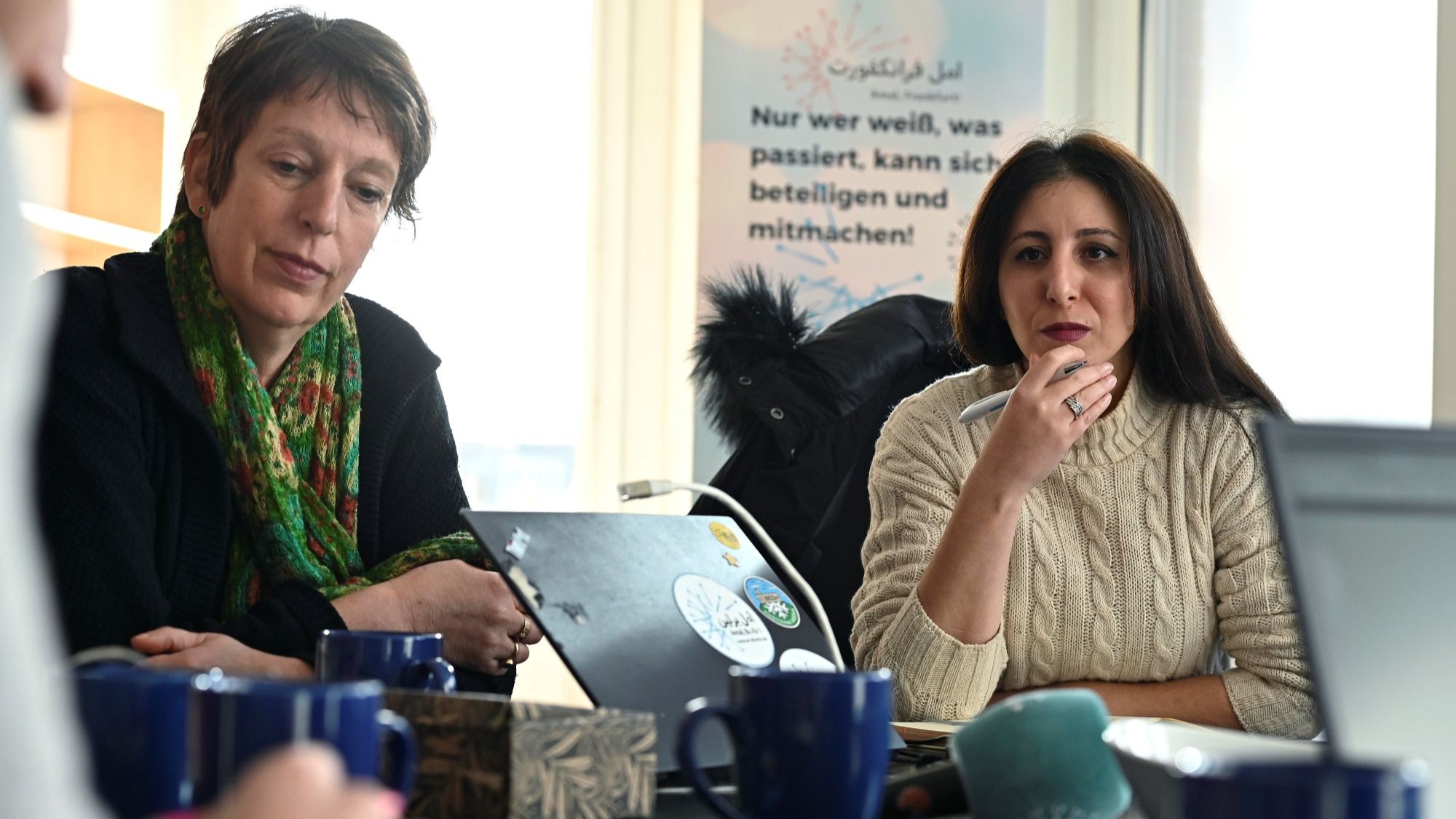
"This is how it all started," said Julia Gerlach, co-founder of Amal News, gesturing with a cup of tea towards her sister Cornelia. The two were sitting together at their platform's 10th anniversary celebration in Berlin in October, surrounded by guests from the Syrian, Afghan, Iranian, Ukrainian and other diaspora communities.
Gerlach was recalling a conversation they had in their kitchen in 2015, when large numbers of refugees were arriving in Germany. "So many people were coming from Syria and from Afghanistan, among them so many journalists. We asked ourselves: what can we do as journalists?"
Their idea was to create a media platform that would offer job opportunities to journalists arriving in Berlin and provide reliable information to newcomers at a time when misinformation was widespread.
That idea became Amal News (amal means "hope" in Arabic). Today, the outlet publishes in Arabic, Dari/Farsi, Ukrainian and German, with teams in three German cities: Berlin, Hamburg and Frankfurt. Local news is central to its mission.
In 2016, the Gerlach sisters held workshops for ten journalists with refugee backgrounds from Syria, Egypt, Afghanistan and Iran, with support from the Protestant School of Journalism. Amal launched its first Arabic and Farsi websites in Berlin in March 2017, expanded to Hamburg in 2019 and Frankfurt in 2022, and added a Ukrainian edition following the arrival of Ukrainian refugees after Russia's 2022 invasion.
A platform for exiled journalists
For Afghan journalist Zahra Nazari, who joined the Farsi/Dari team ten months ago, the outlet fills a gap for exiled journalists who struggle to continue working in their profession. "It's a challenge to find work in your field in Germany, as you need to reach a level of German that you can write in," Nazari, who worked in Kabul until the Taliban seized power in 2021, told Qantara.
Power consolidated, society reshaped
In the five years since regaining power, the Taliban have cemented their rule in Afghanistan, bringing armed conflict in the country to a relative lull. Their ambitions go beyond maintaining control: they are seeking to transform the country from the bottom up.
Nazari spent a year without work before finding a job with the United Nations in the Afghan capital. She moved to Berlin in 2024 through the Federal Admission Programme for Afghanistan (Bundesaufnahmeprogramm Afghanistan).
Amal employs 26 exiled journalists in three German cities to produce news for newcomers to Germany. Gerlach said Amal's mission is to help people understand what is happening around them so they can form their own opinions and participate in society.
For Amloud Al-Amir, a Syrian editor in the Arabic section and one of the platform's founding journalists, helping people feel they belong is essential. She covers Arab communities in Berlin, particularly Syrians. "The role of media is to make people feel that this place is truly their home – their new home," she said.
Alongside news coverage, Amal offers practical advice on how to meet people, find weekend activities and join a Verein (club or association). It also profiles people who have established themselves in Germany. "It's important to give people this kind of hope that they can reach this level, even if not right now," Gerlach said.
Changing the narrative
Amal News aims to challenge stereotypes by telling diverse stories by and about migrants, exploring their lives and experiences rather than defining them solely through deportation and debates over refugees.
Nazari, for example, reports on Afghans in Germany, particularly women who have built new lives in exile and become singers, athletes and football players. "These stories can be powerful," she said. "It is about changing stereotypes."
Amal aims to fill a gap in the German media landscape by bringing the perspectives of migrant communities to German audiences through partnerships with established outlets.
Gerlach noted that Amal has regularly partnered with the German newspaper Der Tagesspiegel and other local media outlets. Amal also began publishing German-language content on its own platform in September, while continuing these partnerships. "Amal is a bridge – to connect German media with our communities … it's important to hear the other side too," she said.
Fighting disinformation
Disinformation targeting migrant communities remains a major challenge for Amal's team. "It is a very big problem at the moment, especially affecting the Ukrainian community," Gerlach said. Alongside far-right campaigns targeting mainstream German society, Gerlach points to efforts to influence migrant communities. She says some disinformation originates abroad, including in Russia.
On Arabic-language social media, disinformation also feeds mistrust, fear and anxiety. One example was a campaign against Germany's Jugendamt, the local youth welfare office, which made migrant families afraid of the institution. Amal responded by providing context and explaining the Jugendamt's role, helping readers access reliable information.
Meanwhile, the Alternative for Germany (AfD) gains in recent elections have also encouraged Amal's team to expand its political coverage. "We do not tell them what to vote for, but they should think about it", she said.
Migrants face a shifting political reality
The far-right AfD made historic gains in September's state elections, while the Left Party came out on top in Berlin for the first time. Migrants across the country are now considering what the results could mean for their everyday lives and futures.
Al-Amir sees AfD policy as a direct threat to the communities Amal serves. "It's related to all of us because they really want to send people back to their countries. They don't really respect what migrants bring to Germany or to Berlin," she said. "They want to create a rift among migrants by accepting only those with higher degrees."
Taking the experience to Syria
After the fall of Bashar al-Assad in December 2024, Amal News expanded its work to Syria where it organised a journalism summer school in Damascus.
For Gerlach, the project reflects the importance of strong media for the new Syria. It also brings together journalists from different parts of Syrian society, including Sunnis, Alawites, Christians and Druze, who work together during the training, which she says is the project's most important effect.
A decade after its founding, Amal faces changing reader needs and the challenge of securing sustainable funding. The organisation relies on project-based support from a range of sources, including EU funds, local state funding and NGOs, while continuing to explore new ways to adapt.
© Qantara.de