Fear and rebellion in the lives of Druze women
Topics
Lebanese writer Haneen Al-Sayegh began her creative journey in poetry, publishing three collections: "Let It Be" (2016), "An Old Soul" (2018) and "Beacons to Mislead Time" (2021). She later began writing fiction, turning to the novel with measured steps and a poetic sensibility that remains firmly in service of meaning.
Her debut novel, "The Women's Charter" (Dar Al-Adab, 2023), drew wide attention across the Arab world and in its German translation (as Das Unsichtbare Band), eventually reaching the shortlist for the 2025 International Prize for Arabic Fiction. Her second novel, "The Fruit of Fire", was published at the end of 2025 as a companion novel. In it, she continues to portray the conditions and struggles of Druze women in the Lebanese countryside, giving voice to women in a community enclosed by poverty, ideological and geographic isolation, and religious and patriarchal authority.
"The Fruit of Fire" is a novel of patience, deliberation and contemplation. The narrative moves back and forth across four generations of women, from the 1940s to the present day. It reflects their worries, anxieties, restlessness and how they manage them.
Through these characters, the author interweaves life and death, love and pain—not pain in its physical or physiological sense, but a more elusive, hidden pain, concealed within unspoken emotions and struggles. In other words: fear. A fear instilled in childhood; fear of family and of one's surroundings; fear of the community when creativity calls one to break free from its confines; fear of losing oneself if one does not; and ultimately, the fear of losing one's family to death.
The "mutated germ" of fear
Al-Sayegh likens this fear to "a mutated germ that can only be eliminated by killing everything it feeds on", a task that may take a lifetime, with no guarantee of survival. Even when the sons and daughters of the Lebanese countryside migrate to cities like Beirut, Dubai, Berlin, Florida and Melbourne—where much of the novel unfolds—they carry their fears with them.
"Mahiba", the representative of the first generation, is a woman consumed by fear who has silenced any feelings of love and mercy. She denies her eldest daughter marriage and the experience of motherhood, and she ruins her middle daughter's life by relentlessly rebuking her.
Nabila, the youngest, and the central figure of "The Fruit of Fire", largely escapes her mother's control. She does not complete her primary education and never leaves her village. She falls into an (impossible) love with a young man from outside her sect and begins to record her feelings in a notebook. Forced to marry a man she does not know, she bears him daughters. She finds healing in making bread—supporting her family while creating a private world of her own.
Through the ritual of making bread, Nabila slowly comes to understand that "resisting bad feelings is the best way to strengthen them." She trains herself to bury her first love, just as her lover, Muhannad, takes up charcoal-making to silently and completely bury his emotions.
The stereotype of the suffering woman
Nabila endures this slow, deep burial, which masks the cracks in her life—like her self-absorbed husband, whose behaviour is quietly sanctioned by the clergy.
She refuses to surrender. Aware that she cannot engineer radical solutions on her own, she instead works to widen the boundaries of her inner world, refusing the logic of the defeated woman. She devises subtle strategies to keep her life moving with minimal damage. She enters into dialogue with religious authority. She hosts a radio cooking show under a pseudonym. She reaches out to her husband on Facebook under the guise of a hidden lover. And finally, Al-Sayegh writes, "she became capable of forgiveness when she no longer wanted anything from him."
Al-Sayegh's portrayal of Nabila moves beyond the stereotype of the silently suffering woman. Nabila witnesses other women around her break under the weight of fear and tyranny. She clings fiercely to her humanity: to give without pretense, to forgive without contrived heroism. Yet the portrait is not idealised. It bears the marks of exhaustion and resists the myth of motherhood as a spotless epic, free of doubt and scars.
Nabila's youngest daughter, Amal Bou Nemer, goes beyond her mother's careful tactics. She defies the traditions of her community, staging her own "soft revolution" by completing her education and graduating in English Literature from the American University of Beirut. She pays a price: divorce from her husband who attempts to confine her to the marriage.
Alongside her work as a teaching assistant at the same university, she launches a project of her own, producing a TV documentary. The documentary highlights creative Druze figures, men and women ostracised for breaking the mould: the visual artist Makram, criticised for his colourful T-shirts, his love of dance and his expression of different sexual identities; and Uncle Zoukan, a successful businessman, shunned for marrying outside the Druze community.
Religion and lust for power
In the novel, Al-Sayegh approaches the Druze faith not through doctrine or ritual, but through the conduct of certain religious figures. She presents two models: Sheikh Al-Ruhani Abu Taher, an ascetic who renounces money and power; and his successor, Sheikh Ridan, who instrumentalises religion to control every detail of village life.
Through these two contrasting characters, Al-Sayegh suggests that the problem lies less in the sacred texts than in the lust for power, which leads to the isolation and suffering of believers. The masses follow these powerful men, eager to brand every dissenter a traitor, rejecting them in life and denying them mercy in death.
Amal does not appear to side unequivocally with either camp. Instead, she is driven by questions: why must a person submit to a false binary, either preserving self-respect or surrendering it for society's approval? If conservatives claim the right to secure their peace of mind by conforming and looking away, then shouldn't rebels, too, have the right to speak their truth without fear?
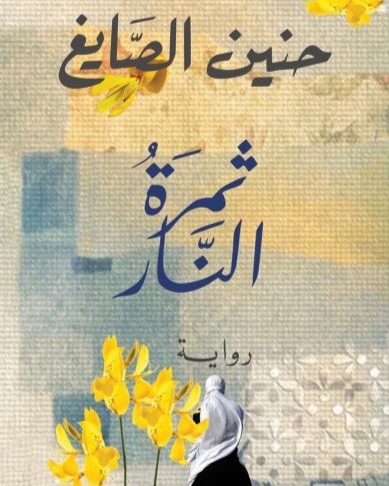
"The Fruit of Fire" by Haneen Al-Sayegh
Dar Al-Adab, 2025
This is an edited translation of the Arabic original. Translated by M. Taylor.
© Qantara.de