The paradox of Colette Khoury
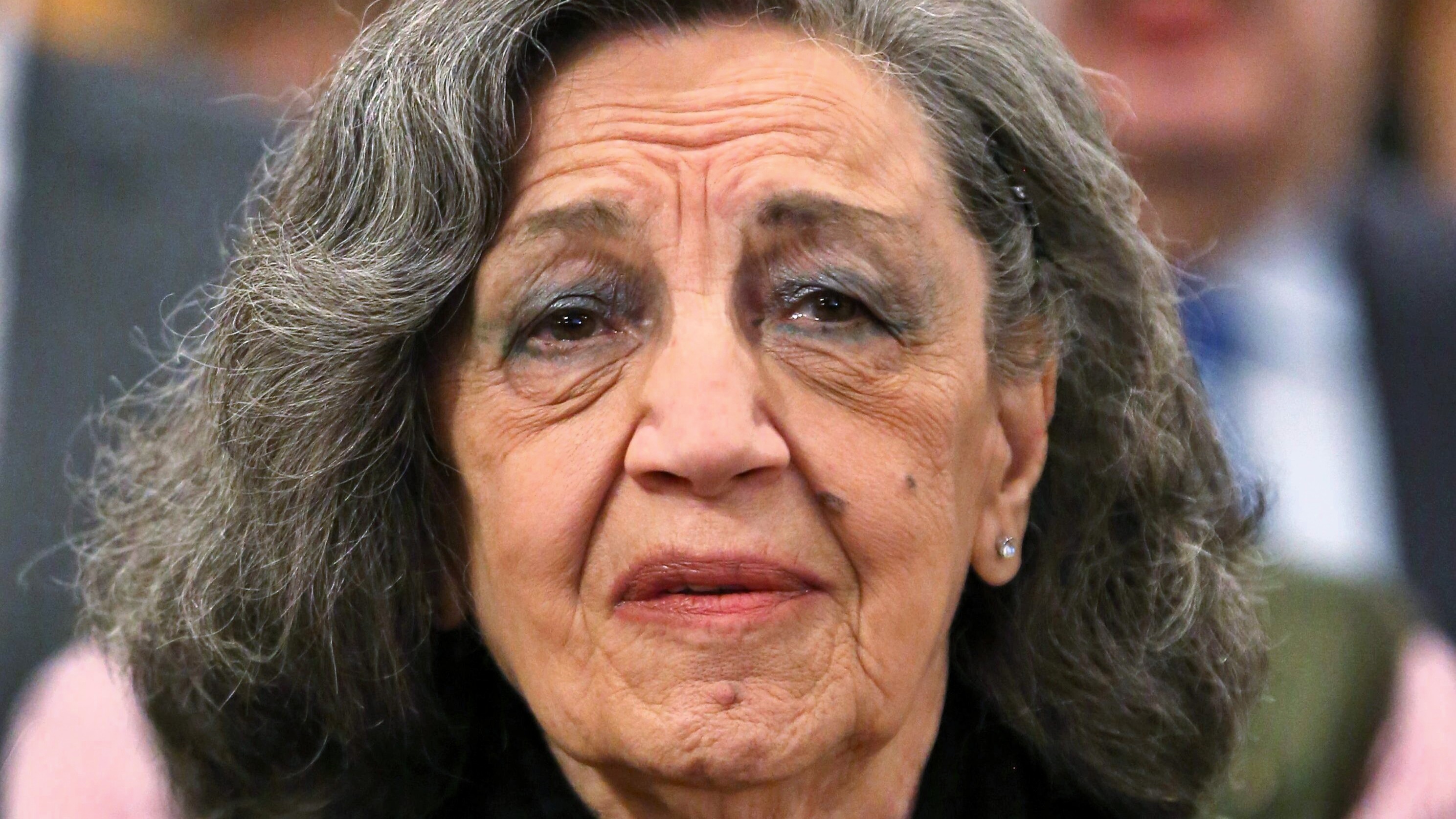
When "Days with Him" (أيام معه), the novel that brought Colette Khoury to prominence in Arabic literary circles, appeared in late-1950s Damascus, it stirred a quiet controversy. The book traced the relationship between a woman and a poet but framed it less as romance than as a psychological struggle, an attempt by a woman to understand desire, identity, and the elusive meaning of freedom.
Arabic fiction had seldom offered a female protagonist quite like this: neither victim nor heroine, but a consciousness navigating unresolved interior conflict. The whisper circulating was that the novel’s brooding male protagonist, Ziad, was drawn from life, and more specifically, was based on Khoury’s relationship with Nizar Qabbani, the Damascus-born poet who would become one of the Arab world’s most celebrated writers of love and desire.
For many years, Khoury neither confirmed nor denied the speculation and when she finally spoke, she did so with a novelist's precision. "I was living a love story with Nizar, a marriage project that we had planned two years before I wrote this novel. And that story has since come to an end." Of Ziad, she said, "The character is a composite of many individuals … an amalgam of men: Nizar, my husband, and others—about four men in all."
It was a characteristically intelligent answer, offering just enough information to satisfy curiosity while insisting, correctly, that fiction is not transcription. "Days with Him" was not a roman à clef but an act of transformation, shaping personal experience into something capable of offering meaning beyond itself. That distinction mattered to Khoury and it is key to any honest reading of her work.
Colette Khoury: a writer of consequence
Khoury, who died on April 10 at the age of 95, was born into one of Damascus' most prominent families in 1931. Her grandfather, Faris al-Khoury, was a towering figure in Syrian political history and a former prime minister; her father was a jurist and government minister, and her maternal uncle was a journalist and man of letters. She grew up speaking French and English alongside Arabic, and published her first poetry collection, "Twenty Years" (عشرون عامًا), in French in 1957.
But it was in Arabic fiction that Khoury found an enduring voice. "Days with Him" established her as a writer of real consequence, and its central concerns—freedom, selfhood, and the emotional cost of being a woman in a society that liked its women decorative and compliant—would run through much of her later work.
"One Night" (ليلة واحدة), which was published in 1961, unfolds over the course of a single evening, portraying marriage as a cold and emotionally unbalanced arrangement, a space from which real feeling has long since drained. Rasha, a married woman entangled in an extramarital affair, demands of her husband Salim, who has long treated her as an object, "Did it ever occur to you, even for a day, that this woman you brought to supplement the furniture of your house was a human being?"
In "Kayan" (كيان ;1968)—a title which can be loosely translated as individual existence or being—Khoury ventured into philosophical territory. Using the romantic relationship as its vehicle, the novel interrogates what it means for a woman to possess a self in the first place, an existence that is genuinely, irreducibly her own, and not just a social role or a function within a family.
Alongside the novels, Khoury wrote short stories, and attempts were made, ultimately unsuccessfully, to adapt her work for the cinema. Some poems and essays were published in translation. But the novels were the work that mattered, their message consistent and unmistakable: women possess an interior reality that society is determined to ignore.
As Rim, narrator of "Days with Him" says of marriage: "No! I was not born only to learn cooking and then to marry, bear children, and die! If this is the rule in my country, I will be the exception. I do not want to marry!"
Khoury articulated this conviction most directly in a 1972 essay published in Al-Ma'rifa, the journal of the Syrian Ministry of Culture. It's an essay which in retrospect reads as both a manifesto and an unintentional epitaph for the writer she might have remained.
"Since my very first book," she wrote, "I have advocated for women’s economic liberation—a prerequisite for their moral and spiritual liberation. I desire for women to work and earn their own livelihood; once that is achieved, their moral liberation becomes a far more attainable goal."
"The issue is no longer a 'woman's issue' alone," she continues, her lens widening. "The problem is far greater; it is a fundamental crisis regarding the very essence of the Arab human being—both within the homeland and beyond its borders."
These were words of genuine moral seriousness. They were also, as it turned out, the high-water mark of her public independence.
Accommodation to the Assad regime
Syria under Ba’athist rule was not a state that rewarded independence. The country in which Khoury lived from the 1960s onward was shaped by a nationalist and socialist ideology which existed primarily to serve the party’s grip on power, and after 1970, to serve Hafez al-Assad’s grip on the party. Writers of a liberal orientation faced a choice which was never quite spelled out: accommodation or marginalisation. Khoury accommodated, gradually at first, then thoroughly.
She became a regular contributor to the official press and served as an adviser to Mustafa Tlass, Assad’s long-serving Defence Minister, who was at once a man of genuine cultural interests and a pillar of a regime responsible for extraordinary brutality. She was elected to the People’s Assembly for two consecutive terms (in Ba’athist Syria, election results usually tallied with the needs of the Party). She continued to publish works of both fiction and memoir.
In 2006, Bashar al-Assad, who had inherited the state from his father six years previously and was in the process of proving himself a worthy heir to his methods, appointed Khoury his personal literary adviser.
When the Syrian Revolution erupted in 2011, the Assad government responded with a campaign of violence that would eventually kill hundreds of thousands and drive millions from their homes. Khoury issued no statement. She signed no letter. She made no public gesture, however small, of distance or dissent. In 2024, weeks before the regime collapsed under rebel assault, the Ministry of Culture awarded her the State Appreciation Prize.
The contrast between the writer who had argued so eloquently for liberation—of women, of Arab humanity, of the self—and the public figure who spent her later decades adorning one of the Arab world’s most repressive states, is one not easily resolved.
Khoury's is a legacy consisting of two irreconcilable parts. There is the novelist of the 1950s, 1960s and 1970s who brought to Arabic fiction a quality of female interiority previously lacking, one who understood that the liberation of women and the liberation of the Arab self were, finally, the same project. Then there is the public figure of the later decades, who lent her name and her reputation to a state that crushed the very freedoms her fiction had championed.
Each part is real; neither cancels the other out.
© Qantara.de