Landmark trafficking trial nears verdict
Topics
"Walid found me and started hitting me with a water hose until my back was completely open. When I asked him what I had done wrong, he grabbed a gun and said 'I'm gonna shoot you dead,' while holding the gun to my head."
This testimony was given by one of four survivors—identified only by an initial for security reasons—who spoke on 17 November in Zwolle, Netherlands, during the trial of Amanuel Walid, also known as Tewelde Goitom. The Eritrean national is accused of leading an international criminal network that trafficked human beings, took hostages and committed torture, sexual violence and extortion between 2014 and 2018.
On 27 January, judges could deliver their verdict in Walid's trial in a livestreamed hearing from 12:15, although developments in the case mean a verdict could be delayed. The trial stands out for its focus on the entire migration route, from Eritrea through Sudan and Libya to Europe, shedding light on how transnational trafficking networks operate.
Walid's network allegedly ran detention camps, mainly in Bani Walid in Libya, where people were held and tortured until their families' paid ransoms of thousands of dollars. The case is being heard in the Netherlands because many Eritreans living there reported being extorted by Walid's network.
The first "big fish"
"This is the first case against an alleged leader of a criminal group", says Luigi Prosperi, assistant professor of law at Utrecht University. According to him, all other European trials connected to migrant smuggling in Libya "were against small fish".
The 30,000-page case file was discussed in seven hearings, from 3-26 November 2025. Eritreans travelled from across the Netherlands to attend the first day at court. "We don't have any experience of such trials in our country, so everybody is happy to be here," said Tadese Teklebrhan, chair of the Dutch NGO Eritrean Human Rights Defenders.
Walid entered the packed courtroom escorted by police, his face seemingly emotionless. Short in stature, he wore jeans, trainers and a blue puffer jacket zipped up to his neck. "I am not the person you are looking for, I am not Walid," he said through an interpreter. For the rest of the trial, the defendant invoked his right to remain silent.
Since the fall of Muammar Gaddafi in 2011, it has been very difficult for migrants to remain in Libya. The country has become a key link on the route for those fleeing conflict and poverty to Europe. Armed factions have financially thrived from trafficking people.
During the first hearing, Judge René Melaard said he would read the survivors' stories one by one: "They deserve to be shared in public". Around 200 statements from survivors and witnesses were heard by the prosecution, and 30 were included in the indictment.
The first testimony the judge read was of an Eritrean girl who arrived in Messina, Sicily, on 4 February 2018, aged 15. She said that no food, water or phone was allowed on the boat crossing from Libya. "I can't swim, and we did not have lifejackets", she told investigators. Like many other survivors, she was rescued by the Italian authorities.
Of the 157 people rescued, 128 were Eritrean. According to their testimonies, the vast majority had scabies, and they had all been detained in warehouses near the Libyan town of Bani Walid. Only after their families paid the ransom, often between $3,000 and $6,000, were they allowed to leave the detention camps for the coast. Many families struggled to raise the sum, some could not.
"The solution requires political courage"
Tensions between Morocco and Algeria are fuelling a frantic arms race. Moroccan researcher Hicham Mouatadid traces the roots of the rivalry and calls for a solution that goes beyond the Western Sahara conflict to address regional security as a whole.
Witnesses recounted fleeing the Eritrean dictatorship, through Ethiopia, Sudan and Libya, where they were sold to Walid and held hostage in warehouses. More than a thousand people were crammed together there, often waiting from three to seven months.
Walid controlled several dozen "kapos", refugees mostly from Eritrea who could not pay for the journey and were forced to work for him, beating and torturing people with plastic sticks, or pouring molten plastic onto their bare skin. Walid is also accused of beating people himself.
According to testimony, every day, prisoners had to queue to call their relatives and ask them to pay the ransom. During the calls, they report being beaten. "They want you to be crying or screaming", said T, a woman in her 30s who travelled with her two small children, so that relatives would pay sooner.
Conditions in the warehouses were appalling, witnesses said, with a severe lack of toilets and food. A single plate of pasta, often distributed only once a day, was shared among eight people. Sixteen-year-old E recalled weighing just 30 kg despite being 1.70 m tall when he arrived in Sicily. Witnesses described people dying from starvation, torture, disease and childbirth. Many reported sexual abuse at the hands of Walid, who allegedly forced women to live with him; some said they became pregnant.
Prosecutors demand 20 years
During the closing statement on 19 November, Dutch prosecutors demanded the maximum sentence of 20 years. Prosecutor Petra Hoekstra spoke of crimes "beyond all humanity" that had "an impact on thousands of people". She estimates that Walid may have earned nearly $2 million.
The trial received widespread international attention. According to Melaard, over a thousand people followed the livestream organised by the court in Dutch, English and Tigrinya. The trial is the result of an investigation that started in 2018, which saw the Dutch prosecution collaborating with Italy, Europol, the International Criminal Court and others.
"All these people want is a chance"
The feisty Catholic priest Mussie Zerai is a staunch advocate of the rights of refugees in Italy and has already saved countless lives. A candidate for the Nobel Peace Prize, he is known as the "refugees' guardian angel". Many refugees simply call him "Father Moses". By Andrea Backhaus
Besides Walid, the case involved five people located in the Netherlands, suspected of extortion and money transfer via the untraceable and informal hawala system, which operates outside of traditional banking systems and relies on trusted transfer agents.
In addition, Kidane Zekarias Habtemariam was included in the investigation, a man Dutch police have described as "one of the most notorious and cruel human smugglers in the world". Arrested in Ethiopia in 2020 with Walid, Kidane escaped a year later, only to be recaptured in Sudan in 2023. The 41-year-old was convicted of financial offences in the United Arab Emirates and, after serving his sentence, was extradited to the Netherlands on 24 December 2025. Proceedings against him will begin later this year.
Transnational Eritrean repression
Since gaining independence from Ethiopia three decades ago, Eritrea has been ruled by dictator Isaias Afwerki. Civil liberties are extremely limited, and citizens are forced into a long and brutal national service. Even abroad, Eritreans often remain under threat. VluchtelingenWerk, a Dutch organisation supportingrefugees, estimates that 28,000 people of Eritrean background live in the Netherlands.
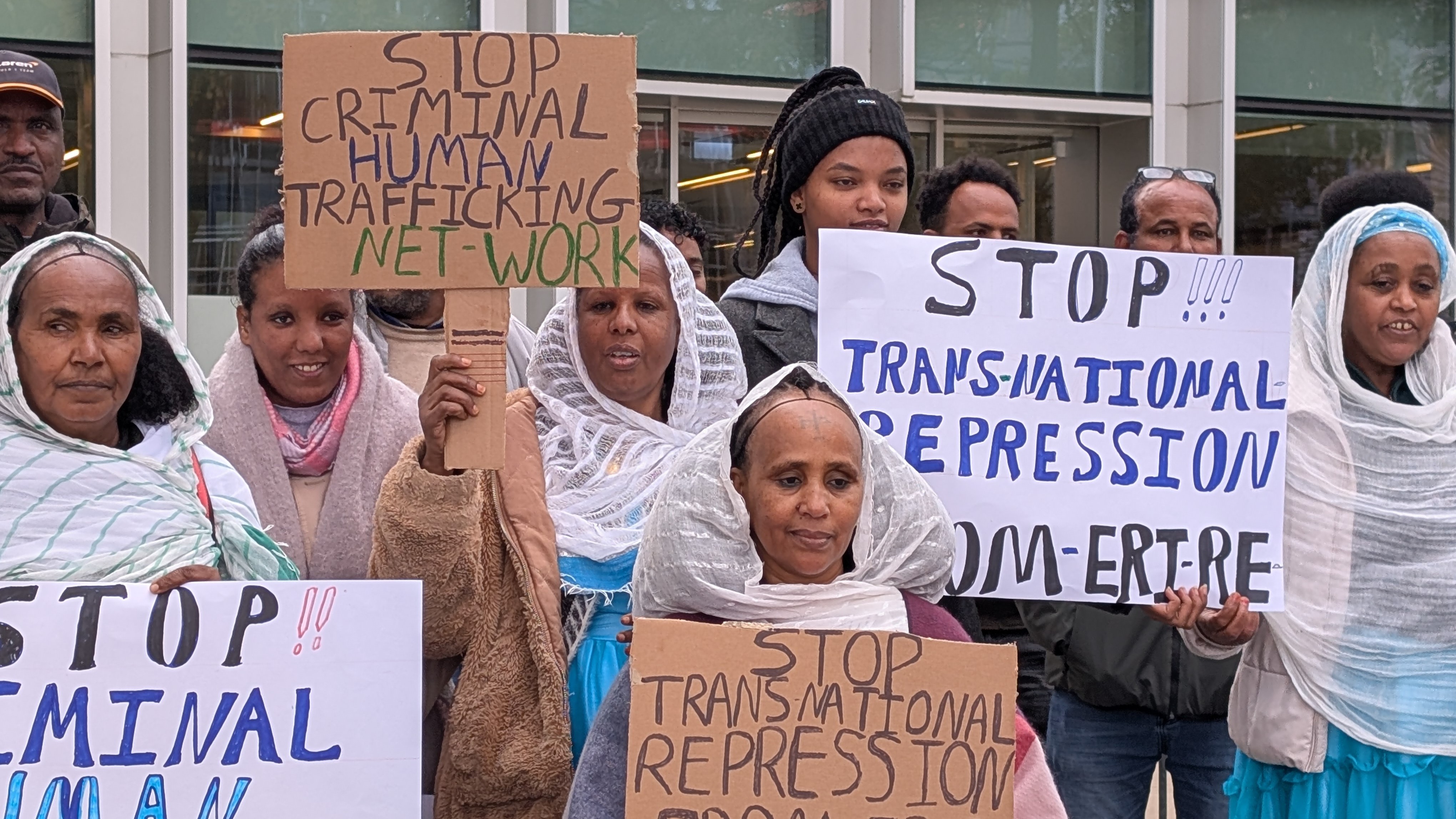
Despite the risks, Eritreans who attended the trial organised a demonstration in front of the court in Zwolle on 3 November. Around 30 people demonstrated, demanding an investigation into the link between the criminal network that perpetrated human trafficking and the Eritrean authorities.
According to Mirjam van Reisen, a Professor at Tilburg University who researches human trafficking in the Horn of Africa, the Eritrean trafficking networks active in Libya, Sudan and other countries operate under the protection of the Eritrean state. These networks are much bigger than Walid and Kidane, warns Van Reisen.
But trials of this kind have an impact. According to Van Reisen, in the past, traffickers operated with "total impunity". During the trial, the judges showed evidence from Walid's Facebook profile, including records of conversations discussing ransoms and videos from the warehouses that were posted publicly.
Van Reisen says that previously, those committing abuses against migrants in Libya were not "scared of anything. That has absolutely changed. It's very clear that prosecutors take this seriously and are able to investigate these crimes and to bring them to court."
© Qantara.de