"Arab culture's flexibility distinguishes it from others"
Topics
Qantara: You are among the first gender studies specialists in Tunisia and the Arab region. Why is the topic often viewed with some skepticism in this part of the world?
Amel Grami: Historically, gender issues were only taught in foreign language departments, such as French and English literature. They relied on foreign sources, without addressing the realities of local societies. Gradually, however, the concept of gender, as a tool for analysing power relations and the distribution of social roles, began expanding across most of the social sciences, humanities and even scientific disciplines.
Alongside this academic shift, state policies of many countries in the region began to change under international pressure. They started to integrate gender issues into their public policies.
But this top-down adoption of gender mainstreaming policies revealed the lack of a specialised academic framework. Non-specialist researchers entered the field, contributing to widespread misunderstanding and conceptual confusion. In many cases, gender studies have been conflated with women’s studies and feminist studies.
There have also been hostile campaigns against gender studies. Rights-based and feminist discourses that seek to deconstruct patriarchal structures, male dominance and forms of social injustice are often portrayed as narratives that "undermine society and the family" and are seen as being "linked to the West," and therefore as eroding local culture and values.
Such accusations—often promoted by certain preachers, imams and conservative academics—have fuelled the collective perception that gender studies "promote homosexuality and moral decay."
What sparked your interest in gender studies?
I taught comparative religion and Qur’anic studies in Beirut, Milan and elsewhere. I explored how books of Qur’anic exegesis, jurisprudence, hadith, philosophy and other sources represented differences between the sexes. I felt the study of gender from within Arab and Islamic culture itself was lacking, and I began to ask: how have different sources—historical, medical, religious and others—addressed this? How did scholars understand masculinity and femininity, and on what basis did they establish the rules of socialisation, assign roles, structure relationships?
And what did you find?
Islamic culture did not address masculinity/femininity or man/woman in isolation from non-normative identities such as the mukhannath (effeminate man), the khuntha mushkil (intersex person of indeterminate sex), eunuchs and the amrad (beardless youth). Throughout history, Islamic societies were not hostile toward people with non-normative identities. Rather, they integrated them into society and considered their legal status and rights.
For example, books of Islamic jurisprudence contain explicit references to inheritance rights for khuntha mushkil individuals, as well as rulings concerning the leadership of prayers and marriage involving the mukhannath. This reflects jurists’ recognition of cases that fell beyond the traditional male-female binary view of gender.
The same applies to writers, poets, and other creative figures who expressed such ideas in their texts. Arab culture’s flexibility distinguishes it from other cultures that sought to marginalise such individuals and deny their right to exist.
What then led to the social exclusion we witness today?
When Arab civiliszation declined, countries fragmented, and colonialism arrived to exploit their resources, culture closed in upon itself. There was a rise in hatred, intolerance, and fear of otherness. In most colonised countries, changes in legal systems and the imposition of Western laws—French, British, and others—required populations to adopt legal frameworks that specifically targeted groups that did not conform to dominant social norms.
Colonialism targets land but also shapes patterns of thought, influencing how the colonised perceive themselves. It altered Arab societies’ perceptions of people with non-normative identities.
Awareness of the impact left by the colonial experience now encourages us to analyse this legacy and reconsider our relationship with European and Western centrality, as well as our own epistemological choices.
As a result, teaching methodologies are no longer limited to works produced in Francophone contexts. Greater attention is paid to knowledge production in gender studies within Arab societies, alongside the contributions of women scholars living in exile.
Translating gender-related terminology has long posed a challenge for researchers. How have you addressed this issue?
There is considerable terminological confusion surrounding the lexicon of feminist studies and gender studies. The term “gender”, for example, has been rendered into Arabic in different ways: junūsah (used in Lebanon and Sudan), al-nawʿ al-ijtimāʿī (social gender, used in Tunisia, Morocco, Libya, and elsewhere), al-nawʿ (type/gender, used in Egypt), and nawʿ al-jins (gender/sex category) in other countries.
This diversity of terms has not made it easy for digital libraries to classify scholarly production. However, current developments have gradually led to a degree of consensus around using social gender (al-nawʿ al-ijtimāʿī) or simply gender (al-nawʿ).
In addition, there are many mistranslations, even in UN documents. For instance, al-jinsāniyya, which actually corresponds to “sexuality”, has sometimes been used interchangeably with “sex” to refer to gender.
I encountered this problem while preparing my dissertation. For that reason, I worked on simplifying concepts and making them more accessible to Arab readers through the use of the concept "the gendering of knowledge". This refers to the classification of fields of knowledge according to socially assigned roles for women and men.
In my lectures, I worked to create Arabic alternatives for the term LGBTQ+, using expressions such as "people with non-normative identities" or "people with non-standard identities". In doing so, I drew on Islamic cultural references, including our own terms for effeminate man, intersex person of indeterminate sex, eunuch, and beardless youth, while, at the same time, clarifying the distinctions between them. We also no longer use the singular concept of "sexuality", but rather "sexualities", in recognition of the diversity of identities, orientations, practices, and expressions.
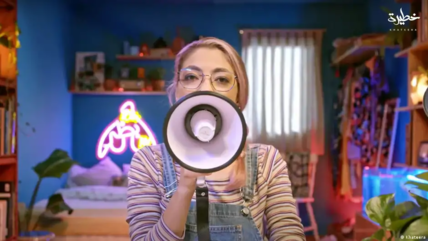
Lebanon's 'dangerous' Khateera feminists
A popular Beirut-based media platform is tackling some of Arab society's most sensitive subjects – such as sex, love, desire and gender roles – with distinctive humour. Diana Hodali reports
How do you approach gender-inclusive language?
I use inclusive or gender-inclusive language in my spoken and written teaching. Rather than allowing the masculine form to dominate the feminine, I deliberately place the feminine first, using expressions such as "female/male activists" instead of "male/female activists". Sometimes, I also use feminine forms only, because we usually assume the existence of a male reader, translator or critic by default.
I was also among those who advocated for drafting the Tunisian Constitution in 2014 using inclusive language, through the explicit use of feminine markers, such as “Tunisian women and Tunisian men.” In responding to critics, I based my argument on Qur'anic verse 35 of Surah Al-Ahzab: “Indeed, Muslim men and Muslim women, believing men and believing women, devout men and devout women (...).”
To what extent have approaches to gender issues changed in Arab societies today?
Countries that have integrated gender into their public policies have contributed significantly to increasing awareness of gender issues, for example, understanding the relationship between climate change and women, as well as recognising the digital gender gap.
In addition, academic and journalistic analysis of our reality as viewed from a gender perspective, alongside cinematic works, have played an important role in reshaping attitudes. They underscore the injustices faced by women, exploring their causes and posing alternatives. This effort should be praised, even though it continues to lag the changes in perspective gender scholars and researchers truly want to see.
This article is an edited translation from the Arabic original by Maram Taylor.
© Qantara.de