Made for Western critics?

The concept of "festival cinema" has been debated in Iranian media and cinema circles since the 1980s. The term was first coined by supporters of the new regime that emerged from the 1979 Islamic Revolution to criticise films that won acclaim at international festivals. Over time, the term was adopted by a wider range of critics, including those who oppose the regime.
For decades, the director most closely associated with the term was Abbas Kiarostami, whose work played a central role in bringing Iranian cinema to international prominence after the Revolution. His first major international success came with "Where Is the Friend's Home?" (1987), which received the Bronze Leopard at the Locarno Film Festival. He later won the Palme d'Or at the Cannes Film Festival for "Taste of Cherry" (1997).
In Iran, however, reception of Kiarostami's films was more complicated. From the 1990s onwards, his films received only very limited public screenings in Iranian cinemas, where strict censorship has shaped both the production and circulation of films.
Those Iranian critics who did have access to his work also debated Kiarostami's place within Iranian cinema. In the Farsi-language book "Paris-Tehran: Abbas Kiarostami's Cinema", film critic Maziar Eslami and essayist Morad Farhadpour argued that Kiarostami's rise was determined in part by chance and by the historical moment in which it occurred.
Eslami and Farhadpour argued that during the expansion of globalisation in the 1980s and 1990s, Western cultural institutions sought new figures from the Global South to broaden the cultural "showcase" in the Global North. Kiarostami's emergence, they wrote, coincided with a period in the 1980s when art cinema lacked major international figures. Western festivals and critics were looking for new names, and they "discovered" Kiarostami.
Other directors closely linked to the term festival cinema include Bahman Ghobadi, Mohammad Rasoulof, Majid Majidi, Mohsen Makhmalbaf (at one point), and Kiarostami's former assistant Jafar Panahi. Emerging as a leading figure of the phenomenon, Panahi won the top prize at Cannes, which has emerged as a key platform for Iranian festival cinema, for his 2025 film "It Was Just an Accident".
Humanism and humour
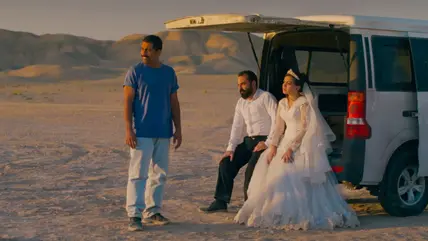
In the Iranian director's most critical film yet, Jafar Panahi presents a cross-section of society, takes aim at the practice of torture and shows fearless women claiming space. But there's still room for comedy.
Orientalist depictions
Festival cinema is not a genre in its own right. Rather, it describes a broad range of films that critics believe are made primarily to appeal to international audiences and win awards abroad, regardless of how they are received inside Iran.
Critics of the movement argue that these films win awards mainly because they deal with the preferred subjects of festival juries. They say that there is a formula behind what is recognised as festival cinema in Iran, and that filmmakers who follow certain patterns are more likely to gain international screenings and awards.
Kaveh Jalali, a prominent Iranian film critic based in Montreal, argues that this phenomenon reflects Orientalist power dynamics, through which the West selectively highlights certain cultural works, generalises them, and presents them as exotic and magical.
Jalali situates festival cinema within an international supply-and-demand system shaped largely by political relations between the Global North and Global South. "Like a customer who goes to a store and buys what they need, Western audiences also approach Iranian cinema based on their own interests and select films for their festivals," Jalali told Qantara. "Festival cinema has developed inside the country to meet that demand. As the interests of Western critics and audiences change, the kinds of films being produced change as well."
Shifting trends
Trends within festival cinema are shaped by political developments and social conditions inside Iran, which influence how audiences, critics and filmmakers in the Global North view Iran and how they expect it to be represented on screen.
Hamed Sarafizadeh, an Iranian film critic and podcaster based in London, explains that in the 1980s and 1990s, when both Iran's domestic and international images were still heavily influenced by the 1979 Revolution, films that portrayed simplicity, sacrifice and respect for poverty attracted international attention. These themes echoed the revolution’s emphasis on austerity, self-sacrifice and solidarity with the poor, offering Western audiences a distinctive image of post-revolutionary Iran.
They also offered a rare glimpse into a society that had become a subject of Western curiosity, while standing in contrast to the materialism of consumer culture. Even the French philosopher Michel Foucault, in his articles on the 1979 revolution, drew attention to its challenge to Westernized modernity and the role of ordinary and marginalised people.
Kiarostami's films were the most famous examples based on those themes. Films focusing on children and rural communities, such as Panahi's "The White Balloon" (1995) and Majid Majidi's Oscar-nominated "Children of Heaven" (1997), also gained traction during the period.
That trend, however, changed in the 2000s, as the focus shifted towards domestic politics and social issues in Iran. Women's rights became a major theme, with films such as Marzieh Meshkini's "The Day I Became a Woman" (2000) or Panahi's "Offside" (2006) widely shown at international festivals.
More recently, "films portraying marginalised people with the potential for violence and angry outbursts have become increasingly popular," Sarafizadeh says, pointing in particular to Panahi's latest, "It Was Just an Accident" (2025). "In recent festival cinema, expressions of rebellion and revolt have become attractive to international audiences."
For Sarafizadeh, many festival cinema films are neither well-written nor well-acted, "but non-Iranian audiences like to believe them."
The future of festival cinema
Other Iranian directors, meanwhile, are sidelined, Sarafizadeh says, pointing to the recent negative reception of Asghar Farhadi's latest film, "Parallel Tales" (2026), which was based on Polish director Krzysztof Kieślowski's "Dekalog: Six".
Some critics accused Farhadi of failing to fully understand the moral and philosophical questions embedded in Kieślowski's cinema. Farhadi, who is widely regarded in Iran as a filmmaker who has generally kept his distance from festival cinema, focused in his earlier films on issues within Iranian society, particularly family, societal tensions and interpersonal relationships.
In "Parallel Tales" he shifted his focus away from Iran and included no Iranian characters. For Sarafizadeh, the reaction to this film demonstrates how non-Iranian critics respond when Iranian directors do not deliver the themes they expect.
Sarafizadeh foresees that the themes major festivals look for in films about Iran could soon change in response to the US-Israeli war on the country, particularly as many artists and intellectuals in Europe and North America have voiced their opposition to the war.
"The latest wave of these films, represented by the work of Panahi and Rasoulof, which focuses on society's anger and resistance to repression, is reaching the end of its cycle," he says.
He argues that the impact of the war will prompt Western audiences to look for movies that reflect the conflict and its effects on Iranian society. "It is likely that, under the impact of this war, non-Iranian critics and audiences will begin looking for a different image of Iran. As a result, a new trend in Iranian festival cinema may emerge."
© Qantara.de