"I want audiences to see me first as an artist, not a refugee"
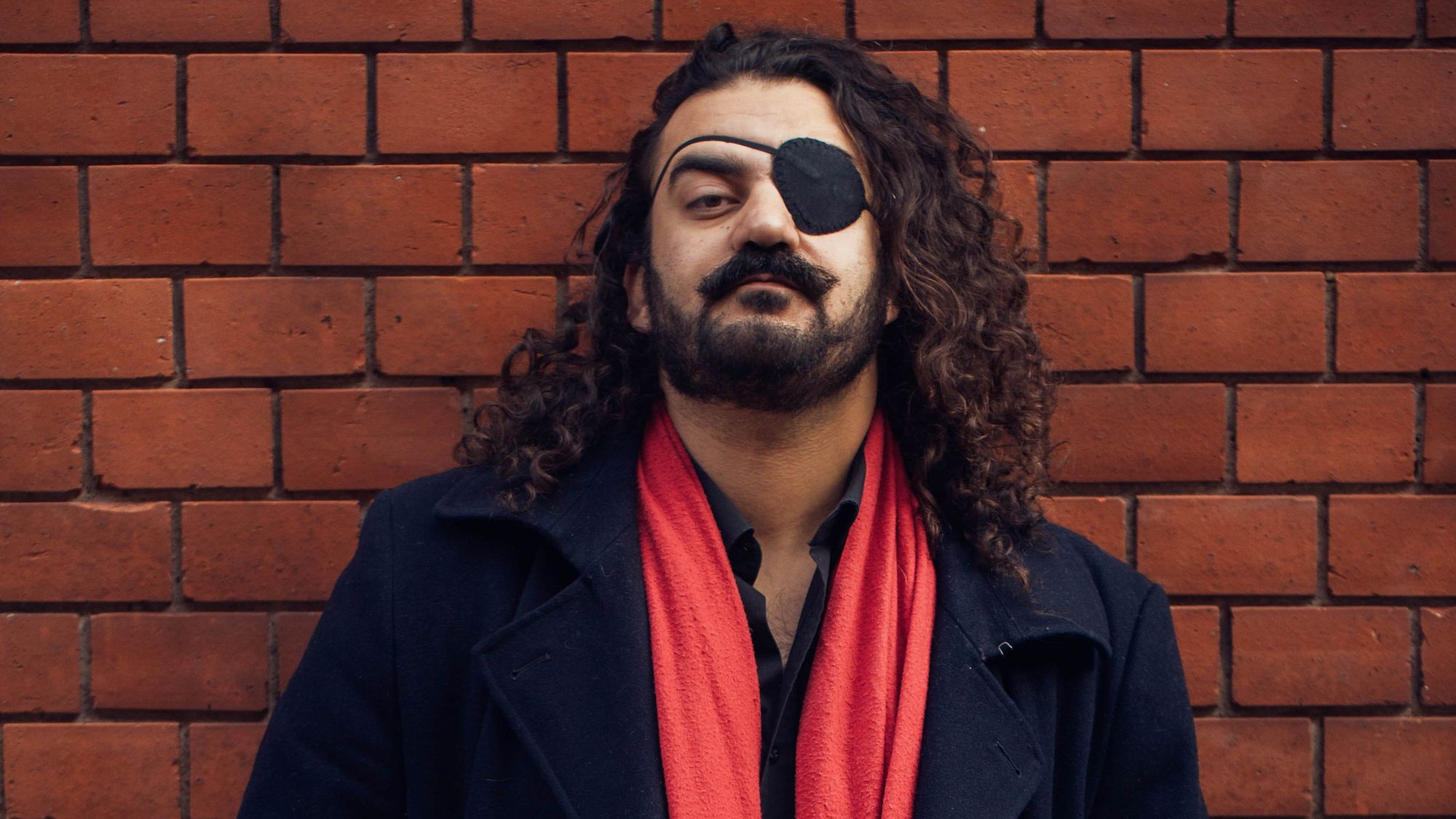
You come from a family deeply rooted in Syrian theatre. How did your this shape your artistic identity? How did these influences carry over to the theatre scene in Germany?
Theatre was the air I breathed. I was, quite literally, born into it. My mother (actress Suad Bulbul) attended rehearsals while she was still pregnant with me. My grandfather, Farhan Bulbul, was one of the leading figures of Syrian theatre, and my uncle, Nawar, was an actor. My earliest memories are filled with the smell of the stage, the bustle of rehearsals and the laughter of actors backstage. I learned to read through plays before I ever read school textbooks.
My grandfather was my first teacher. He never gave me formal lessons, but immersed me in the craft itself. He taught me that theatre is a collective endeavor where every element has its place. He taught me diction—how to make words sit naturally in an actor's mouth and carry to the back row. I watched him design sets, adjust lighting and fine-tune the sound system. He taught me how to direct a script, work with actors and take a production from initial concept to the opening night.
I learned that art is not only about inspiration but also discipline, hard work and patience. The theatre was a living organism that demanded constant care.
This is the what I carried with me to Germany as a refugee. I knew how to build a production from the ground up because I had watched my grandfather do it countless times. No one knew who Farhan Bulbul was or understood my family's place in Homs theatre. It was both liberating, because I was no longer defined by my family's name, and lonely, because there was no one to guide or protect me.
What were the most significant challenges in moving from the Syrian theatre scene to the German one?
The first challenge was language. I arrived in Germany without speaking German and felt as though I had lost my voice. But I soon discovered that the language of the body is universal. I joined an English-speaking theatre company, because my English was stronger, and after my first performance, I was surprised by the audience's response. That experience taught me that emotions can transcend language.
The second challenge was adapting to a different theatrical culture. German theatre operates within traditions that are generally more structured and less spontaneous than those I was used to. At first, I felt constrained, but I gradually came to appreciate the strengths of that system. It taught me precision, organisation and long-term planning. At the same time, I was able to contribute some of the spontaneity and flexibility I had brought with me from Syrian theatre.
The greatest challenge, however, was a subtle form of racism rooted in preconceived expectations. Introducing myself as a Syrian director often meant that people assumed my work would revolve around war, displacement or suffering. They expected me to embody the role of the victim. I rejected that. I wanted audiences to see me first as an artist, not simply as a refugee.
Your play "The Trip" combines autobiographical and collective experiences. How did you translate a deeply personal story into art without turning it into a direct political statement?
When I started writing "The Trip", my goal was never to tell the story of Syrian suffering. I wanted to tell the story of my friends and of the city I love. I wanted to reconstruct Homs on stage—not the city reduced to ruins, but the Homs preserved in memory.
I adopted a fragmented structure, the narrative unfolding through scattered memories, like photographs in an old family album: a scene in a café, another at a university, another on a street. Then war arrives suddenly, disrupting those memories without erasing them.
Abstraction also played an important role. Instead of giving the characters individual names, I identified them by roles—"The Student", "The Friend", "The Mother". In doing so, my personal story became a shared one. Syrian audiences could recognise themselves in it.
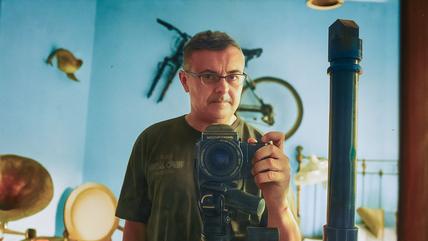
An obsessive archivist
Ahmed Hasan sold his house to pursue a passion for historical photographs. His collection traces Syria's history through everyday life.
How do you navigate Syrian-German identity in your work?
I don't see my identity as divided; I see it as integrated. Although I left Syria physically, I carry it with me in my memory, my accent and the way I think. Germany provides the framework in which I now work; the language, the audience and the institutions.
I try to combine the Syrian spirit with German theatrical form. "The Trip" is deeply Syrian in its emotional landscape; its nostalgia, dark humour and intense human relationships. At the same time, its structure reflects German theatre, with its systematic direction, attention to detail and contemporary stage techniques.
How can art serve as a tool to resist discrimination?
Racism in Europe is not always explicit. More often, it takes the form of assumptions and stereotypes that reduce Arabs to refugees or terrorists.
I have challenged these assumptions in several ways. First, I refused to accept stereotypical roles. Even when I needed the income, I turned down parts that portrayed Arabs as terrorists or street vendors because accepting them would only reinforce those stereotypes.
Second, I developed artistic projects that question these narratives. My production "The Unknown City", for example, explored the lives of immigrants from different backgrounds living in Berlin, presenting them as ordinary people with hopes and fears rather than as stereotypes.
Third, I address these issues through teaching. In my workshops, I encourage students with migrant backgrounds to tell their own stories instead of reproducing the stories that society expects.
How do you assess the current state of theatre and cinema in Syria? What are the challenges?
The reality is complex. On the one hand, there is renewed artistic energy, with young people staging performances in Damascus and Aleppo despite extremely difficult circumstances.
The first challenge is infrastructure. Many theatres have been destroyed, technical equipment is scarce and funding is almost non-existent. Artists often depend solely on their own determination, and that is rarely enough. The second challenge is censorship. Although the political landscape has changed, the culture of censorship continues to shape artistic expression. Many artists still censor themselves, which limits creativity. The third challenge is social division. Creating theatre that can speak to Syrians from different backgrounds after years of war requires exceptional courage and sensitivity.
There are also significant opportunities. One is the emergence of a younger generation that did not experience the old regime in the same way and approaches artistic expression with greater boldness.
Another opportunity lies in the Syrian diaspora. Artists working across Europe and North America have gained valuable experience that can be shared with colleagues inside Syria.
Your film "Chekhov" explores torture through a surreal and unconventional style. Why did you choose that approach?
Because realism has reached its limits. After years of witnessing horrific images on television, audiences have become desensitised. When the same visual shock is repeated over and over again, it loses its power. I wanted to find a different artistic language capable of breaking that cycle.
“Chekhov” is not a film about torture itself; it is about the memory of torture. It asks how the body continues to carry the memory of pain long after the immediate violence has ended. That is why I turned to surrealism—dreams, nightmares and fragmented images that distort reality while remaining emotionally recognisable.
What role does art play within refugee and diaspora communities?
Internally, it can be therapeutic. Many refugees carry deep trauma, and artistic expression offers a way to communicate experiences that words alone cannot. In my workshops, I have seen theatre help participants regain a sense of dignity. On stage, they become the authors of their own stories rather than victims.
Externally, art serves as a bridge between refugees and wider society. It enables audiences to understand the refugee experience not through statistics or news headlines, but through human stories. When a German audience watches a play about a Syrian refugee, they encounter an individual rather than a number.
What is your greatest artistic dream?
My dream is to contribute to the creation of a new, free and independent Syrian theatre scene. I hope to see an arts centre established in Syria that brings together artists from inside the country and across the diaspora; a place dedicated to training, creativity, dialogue and experimentation.
I dream of a theatre scene that represents all Syrians in their diversity—theatre unafraid to confront difficult questions about war, responsibility and reconciliation.
Above all, I want to tell young Syrians that their history did not begin with war. They inherit a rich artistic tradition, from Farhan Bulbul to Saadallah Wannous. They should learn from that legacy without becoming confined by it. They must build on it and create an artistic language of their own.
This interview was first published by Al-Thawra,16 July 2026.
© Qantara.de