Striking deals with the old elites
Since 8 December 2024, the Islamist-led Hay'at Tahrir al-Sham (HTS) has controlled large parts of Syria. Following the fall of the Assad regime, its seizure of power was a watershed, bringing with it questions about legitimacy, reconciliation with the past and transitional justice.
The HTS-led government distances itself from the crimes of the Assad regime. It presents itself as an alternative to dictatorship, repression and systematic violence, and claims to embody a new political beginning. Yet the group itself emerged from a Salafist-jihadist milieu characterised by violence; its members are accused of serious human rights violations and repression.

Promises of the revolution remain unfulfilled
Since December 2024, Syria has been oscillating between euphoria and disappointment. The British-Syrian analyst Robin Yassin-Kassab sees optimism as a resource, but the new government’s focus on stability as a potential pitfall.
The policy of selective remembrance stands in the way of genuine transitional justice. The process of coming to terms with the past focuses primarily on the crimes of the Assad regime, whilst the history of violence perpetrated by other actors—in particular that of HTS—is downplayed. This gives rise to an asymmetrical understanding of the process of coming to terms with Syria's past. Justice does not appear to be regarded as a guiding principle, but rather as a political instrument of the new rulers.
Even this selective process of historical reckoning is stalling. The public is exerting pressure and demanding that past crimes be properly addressed. In response, the HTS regime stepped up its efforts to portray itself as a force for law and order. A prime example of this is the arrest in April 2026 of Amjad Youssef, the main suspect in the 2013 massacre in the al-Tadamon district of Damascus. In this way, the new leadership demonstrates its capacity to act and its commitment to breaking with the crimes of the Assad regime.
But the political reality stands in stark contrast to this self-portrayal. Instead of a consistent break with the power structures of the Assad regime, the new leadership is integrating parts of the former Assad elite into its own structures of governance and administration. The much-touted "new beginning" thus appears less as a fundamental transformation and more as a selective reorganisation of existing power, economic and security networks.
Economy: deals before accountability
This logic is particularly evident in the economic sphere. One example is the HTS regime's decision to strike a deal with one of the most notorious profiteers of the Assad era: Mohammad Hamsho.
Whilst public attention was focused on HTS's attacks on Kurdish areas in Rojava, Hamsho announced in January 2026 that he had signed a comprehensive agreement with the new government. The aim, he said, was to resolve his situation legally. The plan was to make a fresh start without reopening issues from the past.
Mohammad Hamsho is regarded as an influential businessman from the Assad family's inner circle. Syrians gave him the nickname "King of Scrap" because he is said to have collected scrap and metal in neighbourhoods destroyed by barrel bombs, recycled it and sold it at a profit.
In doing so, he collaborated with the Fourth Division, a key elite unit of the Syrian army under the command of Maher al-Assad, the brother of the ousted Bashar. Due to his role in the Assad regime, Hamsho was already subject to sanctions imposed by the European Union and the United States in 2011.
Figures such as Hamsho were central to the economic stabilisation of the Assad regime's machinery of war and repression. This makes it all the more serious that he is apparently not being held to account by the current government, but is instead presumably to be rehabilitated by handing over a large portion of his assets to the Syrian state. Instead of facing trial, he can remain in the "new" Syria and once again operate at the heart of power.
To facilitate such financial arrangements, the HTS transitional government established a National Committee for Combating Illicit Enrichment in April 2025. It is specifically negotiating with influential businesspeople who already dominated the Syrian economy under Assad and who amassed their fortunes through smuggling, drug trafficking, the war economy, looting and the exploitation of destroyed cities.
The structures of the war economy have therefore not been dismantled, but rather given a new legal framework and reused for political ends. In the Hamsho case, which caused widespread outrage amongst the Syrian public, the committee felt compelled to issue a statement, claiming that the agreement was part of a voluntary disclosure programme designed to ensure transparency regarding assets and promote economic "justice". Viewed critically, however, this approach shifts the focus from criminal liability to administrative regularisation.
"Faces of peace" with blood on their hands
The agreements with former Assad loyalists are not limited to businesspeople, but also include well-known military figures. Among these is Fadi Saqr, one of the key leaders of the "National Defence Forces". These were founded in 2013 as an alliance of pro-government militias to relieve the Syrian army, which had been weakened by desertions and casualties. They played a central role in suppressing protests and fighting the opposition.
Saqr quickly rose from being a local commander to one known throughout the country. His supporters called him the "Falcon of the National Defence Forces"—his name, Saqr, is the Arabic word for Falcon.
In the collective memory of many Syrians, however, Saqr is primarily associated with his key role in the 2013 Tadamon massacre. According to consistent reports, hundreds of civilians were executed without charge or trial. His militias were involved in sieges, mass executions, looting and collective punishment. Because of his involvement in these crimes, Saqr is also known as the "Butcher of Syria".
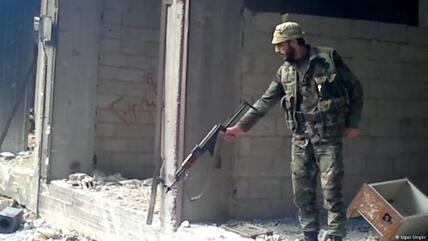
Bashar al Assad's killing machine exposed
A leaked video shows scenes of a grisly Damascus massacre by Assad forces. Six minutes of horror from the war in Syria that were never intended to be made public. By Luisa von Richthofen and Khaled Salameh
Instead of appearing in court, Fadi Saqr appeared in public in Damascus in June 2025, alongside the mayor and the chairman of the Committee for Civil Peace, Hassan Soufan. There, Saqr offered his condolences to the families of five young Alawite men who, according to the Syrian Observatory for Human Rights, were reportedly shot dead by security forces of the transitional government.
In the same month, the transitional government released hundreds of officers from the Assad army from prison. Saqr is said to have acted as a key mediator in this process. He appears to be increasingly functioning as a figure of de-escalation and a representative of Alawite interests in the post-Assad era. However, his public appearances and his role sparked widespread outrage.
The Islamist-influenced transitional government is attempting to contain this criticism by portraying figures such as Saqr as ‘stabilisers’ or ‘peace actors’ intended to prevent further bloodshed. In doing so, it treats perpetrators’ backgrounds not as a criterion for exclusion, but as a political resource. The following seems to apply to the transitional phase: anyone with contacts and experience within the security apparatus can be brought on board, regardless of what they stand for or what crimes they are accused of.
Old networks, new power
Hamsho and Saqr exemplify a pattern that extends beyond individual cases. Rather than making a clear break with the Assad regime, the transitional government is integrating parts of the old power, economic and security structures into its own system of governance. This undermines the narrative of "liberation" and a "new beginning".
Many Syrians expect transparent procedures, independent investigations and consistent enforcement of the law. This also includes the disclosure of all agreements and economic networks, so that Syria’s future is not once again built on impunity and the principles of a war economy.
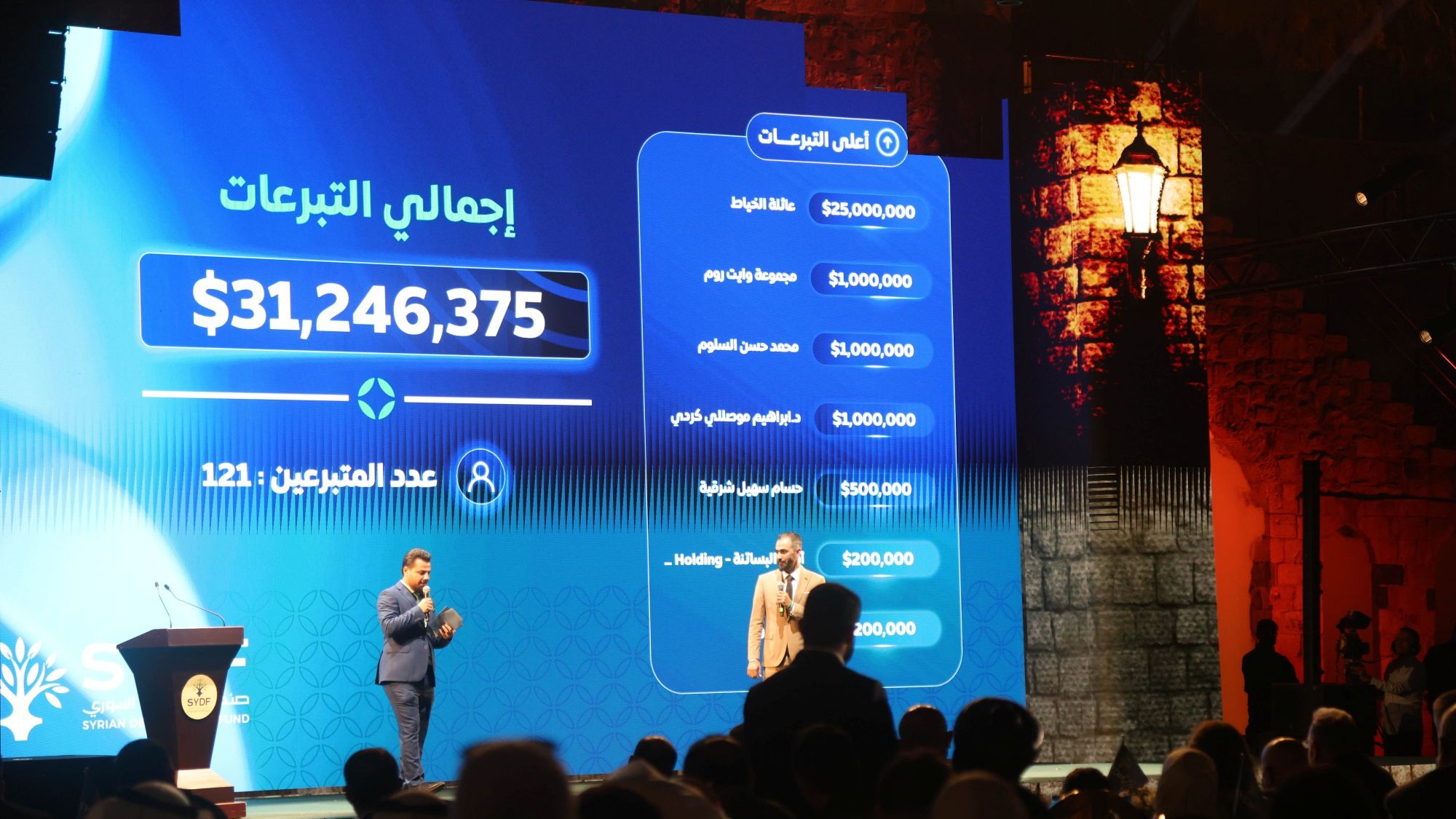
However, anyone calling for such disclosure can evidently expect to face repression. Hassan Akkad, a Syrian activist and filmmaker, launched a campaign under the slogan "Give Us the Money That You Owe!" in Damascus. In doing so, he addressed those who had pledged large sums for reconstruction at charity galas but had not yet paid them. At the same time, he criticised the rehabilitation of members of Assad's elite like Mohammad Hamsho.

In June, he was detained for several days by the Cybercrime Authority. Although the HTS regime cites existing complaints against Akkad as the reason, it seems likely that his public criticism was the real cause. The arrest is therefore directed not only against Akkad but potentially against anyone who calls for transparent transitional justice.
The government’s efforts to consolidate its power are giving rise to a key tension within the new Syrian order. On the one hand, the regime derives its moral and political legitimacy from Assad's crimes. On the other hand, it refuses to conduct a comprehensive legal reckoning with the past, creating a form of governance that speaks of "liberation" while perpetuating key mechanisms of the old order.
This text is an edited translation of the German original. Translated by Max Graef Lakin with the support of AI-assisted translation tools.
© Qantara.de