Promises of the revolution remain unfulfilled
Topics
When Syria’s Assad regime collapsed in December 2024, it was replaced at first by a wave of euphoria. The final rebel offensive had taken a mere 11 days to reach Damascus from Idlib. Assad’s army made no last stand in the capital, as many had feared it would, but simply dissolved. The final battles involved no sectarian massacres and almost no civilian casualties. The tyranny that had ruled by terror for over half a century ended with a whimper rather than a bang.
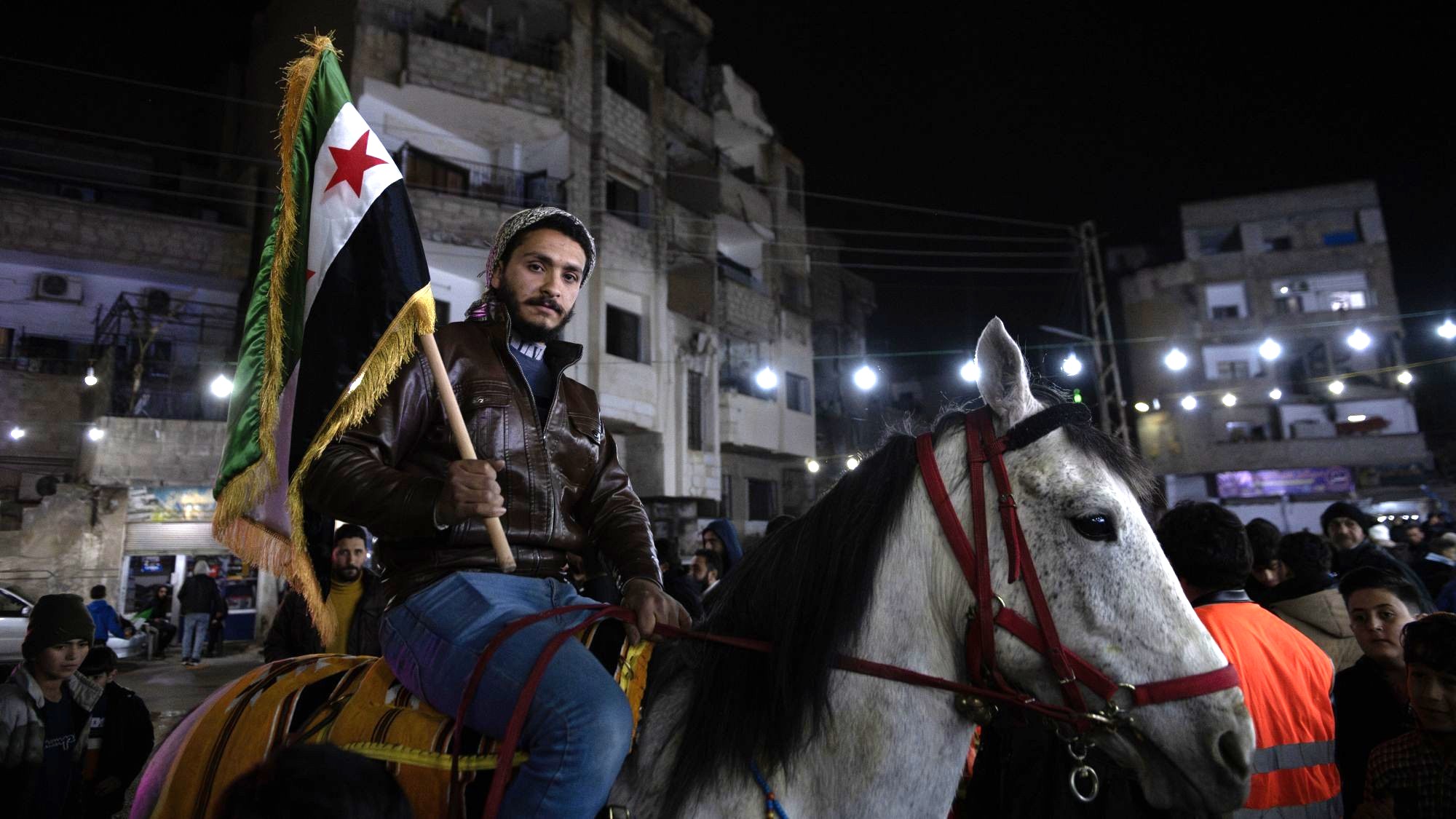
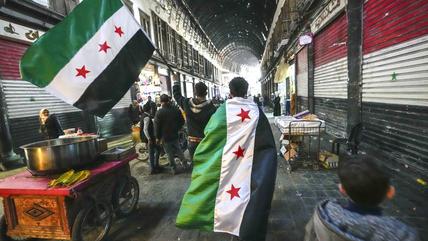
Syrians couldn’t believe their luck. After decades in which public gatherings had been banned, men and women, the secular and the religious, rushed to the streets to celebrate. The triumphant gunfire and ululations of the first days soon mellowed into bouts of communal dancing and flag-waving in city squares. The revolutionary song “Raise your head up high / You’re a free Syrian” was amplified everywhere.
Numerous smaller celebrations lit up the country’s destroyed cities and villages as displaced people returned home and were finally reunified with their relatives. More than 3 million Syrians, including both refugees and the internally displaced, have returned to their areas of origin. And the wild enthusiasm unleashed by the liberation has persisted. Even a year later, I saw people arriving in Damascus airport dressed in the revolutionary flag.
The uncertainty of freedom
An abandoned Assad-regime torture chamber, Kalashnikov-wielding rebels and a fearful archbishop. Karim El-Gawhary reports from the "new Syria"—a snapshot of history.
In reality, liberation took a lot longer than 11 days. It followed almost 14 years of revolution and war during which the regime was slowly hollowed out and the country splintered into militia fiefdoms. Over half the population was driven from their homes. any Syrians had to resort to sub-national identities - sectarian, regional or ethnic - for solidarity and protection. The civic and democratic revolution that produced hundreds of self-governing local councils was largely drowned in violence, crushed by local warlords and foreign states.
So, though the regime collapsed, it isn’t quite correct to say that the revolution won. What happened is that the strongest rebel militia—Hayat Tahrir al-Sham (HTS), with Ahmad al-Sharaa as leader—assumed power when Assad fled. Many of the original civil revolutionaries were disturbed by this. My colleague Amer Matar, director of the documentation project the Prisons Museum and the person who gave me the title for my book on the new Syria, put it bluntly: “Ten years ago [al-Sharaa's] group was cutting off the heads of revolutionaries. How can we trust these people? There is blood between us.”
HTS rules Syria by presidential decree
It was certainly problematic that an authoritarian Islamist militia had achieved power in multicultural Syria, but it could have been so much worse. HTS had been moderated by the exigencies of power while it ruled the Idlib pocket. It had moved away from Salafi-Jihadism towards the traditional Sunni mainstream. It allowed civil society to participate in service provision and learned to tolerate a certain level of dissent. This wasn’t an ISIS takeover, as some propagandists claimed, but the arrival in government of a militia that had fought ISIS and al-Qaeda and had already cooperated with powers like Turkey and the United States.
Most Syrians support their new government and praise its undoubted achievements. Without the discipline and military prowess of HTS, the liberation would not have happened. Since then, the HTS-led government has brought the formerly SDF-ruled northeast back under central control, securing the survival of the Syrian state. Its deft diplomacy has reconnected a long-isolated Syria to the world and helped lift US and EU sanctions. The economic improvements—like all-day electricity in some regions—are obvious, even if the economy is still in crisis.
Yet the government is “revolutionary” only in the narrow sense that it follows the collapse of the old order. Rather than establishing a transitional council representing the various currents of Syrian politics—leftist, liberal and nationalist as well as Islamist—it has kept real power within its own circle. It did organise a brief “National Dialogue”, but one that was neither truly national nor a real dialogue.

The false saviour
Ahmed al-Sharaa is celebrated for liberating Syria from the Assad regime. But the former militia leader has a dark past. Will the people, out of desperation, once again fall prey to a brutal dictator?
So far, there has been too much rule by presidential decree. One hopes this is temporary, given the necessity of rebuilding homes and returning and registering refugees before meaningful national elections can be held, but there are concerns about the slow pace of political reform. No law on political parties has been legislated, for instance, so Syrians still don’t have the opportunity to organise politically on a national level.
Between euphoria and trauma
Added to grinding economic realities, this uncertain progress means the initial euphoria of liberation is diminishing, and disappointment is mounting. Worse, some “minorities” who had been reassured initially have come to fear the government, or at least the new “Sunni” dispensation and the fierce identity politics associated with it. The fact that an Islamist militia dedicated to protecting and serving the country's Sunni majority had arrived in power gave them reason to fear exclusion.
Many Alawites feel they are being collectively punished for the crimes of the Alawite-dominated Assad regime. In March 2025, following an Assadist insurgency in Alawite areas, some pro-government militia engaged in sectarian massacres of Alawite civilians. Abductions and occasional killings continue.
Then in July 2025, pro-government forces committed massacres against Druze civilians in Suwayda—surely the lowest point of the transition. Today Suwayda remains traumatised and determined not to recognise the central state’s authority.
Trauma, and the resulting resentment and anger, is the negative counterweight to enthusiasm. Communities—families and villages as much as sects and ethnicities—have been divided by dictatorship and war and often seek vengeance against one another. There is blood between Syrians in this sense too.
How to put the country back together? How to stop the aggrieved from taking the law into their own hands and thereby triggering new cycles of resentment and revenge? A comprehensive and transparent transitional justice programme is essential, but the current process remains partial, slow and flawed.
The government calculates that economic growth will calm passions, but its laissez faire approach—cutting subsidies and allowing tariff-free imports—is provoking anger too. Exacerbated by the latest US-Iran war, a cost-of-living crisis rages in Syria. Protests have recently been held over electricity rates and the price at which the state buys wheat from farmers.
The government promises stability to war-weary Syrians. Nobody wants to return to violent chaos, but an overemphasis on stability risks enabling the transitional authorities to build a system that is once again hyper-centralised, authoritarian and so inflexible that when it fails it risks breaking entirely. In this way, the pursuit of stability could ultimately lead right back to chronic instability.
Freedom, dignity and social justice
It won’t be easy for Syria to steer between the opposing rocks of chaos or authoritarian control. Both outcomes seem more likely for a traumatised country emerging from war than a happier, more democratic alternative. But Syrians died in their hundreds of thousands for freedom, dignity and social justice—to quote a slogan from the 2011 protests—and these goals remain central for many.
One cause for optimism is the enthusiasm that still persists in most Syrian hearts, even if it’s now tempered by disappointment. Enthusiasm isn’t only a resource to be harnessed or lost by the people in power; it’s a positive force in its own right.
Syrians are overjoyed that Assad is gone and that the war is more-or-less over. They want their new state to work for them, and they are willing to work hard to make it happen. This means cooperating with their neighbours to find solutions to immediate problems. Local democracy is flourishing as a result.
The question is, will popular participation become standard at the national level too, or will this wave of enthusiasm pushing society forward be broken by the countervailing force of trauma?
Robin Yassin-Kassab’s latest book, “The Blood Between Us: Syria After the Fall of Assad”, is published on June 4 by Saqi Books.
© Qantara.de