"The Iraq War shattered the promise of a new world order"
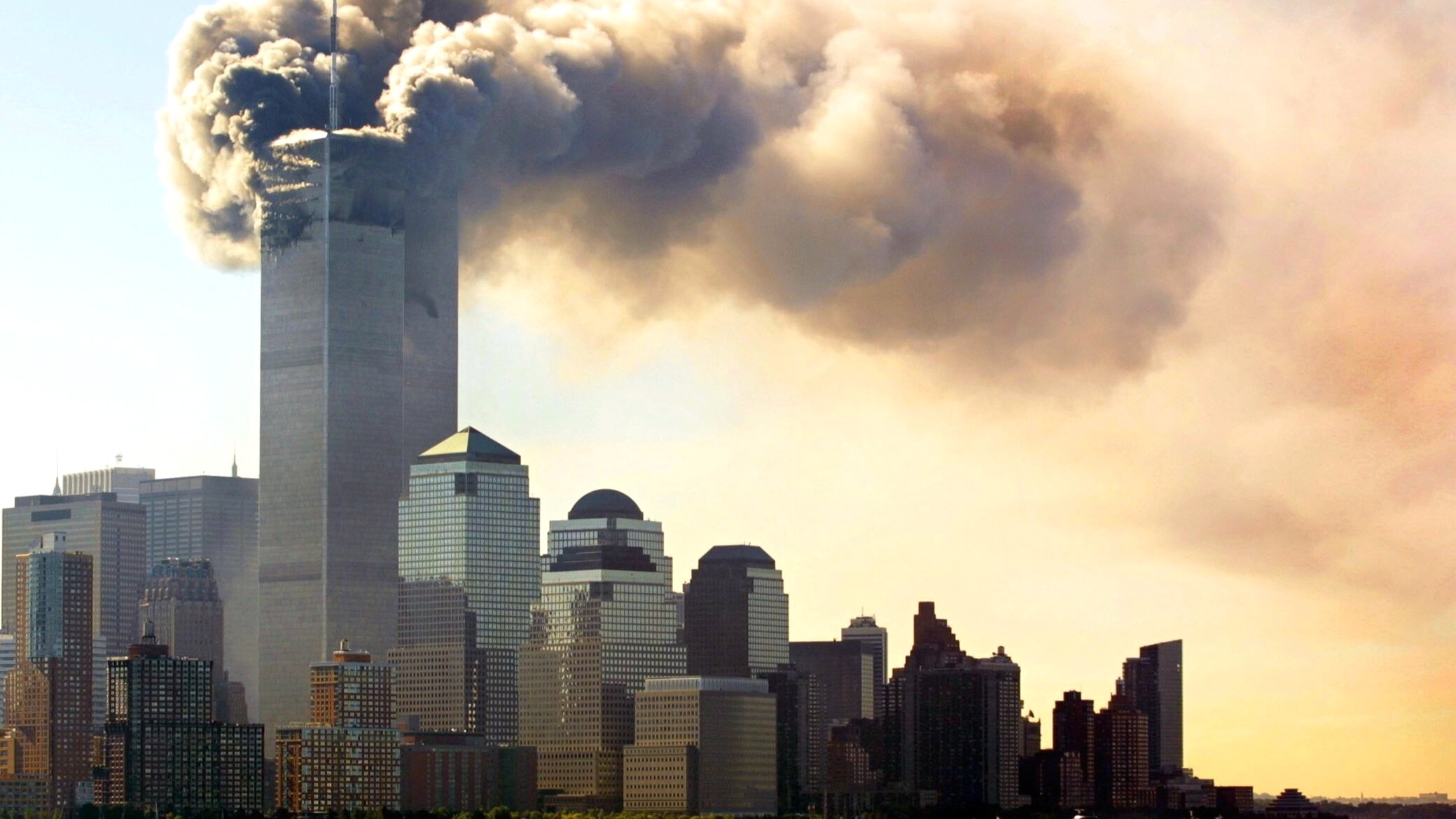
Qantara: There is this cliché about 9/11: that people remember exactly the moment the news broke. What was your reaction that day?
Gilbert Achcar: My first reaction was an “Oh my God!” At the time, the number of victims was estimated to be much higher even than the final count, which was about 3,000. Like most people, I was horrified to see those two skyscrapers collapse. It was a huge crime.
But then, my next reaction was fear of the consequences. It was clear to me that this would unleash a lot of violence on the part of the US. And that's exactly what happened with the wars in Afghanistan and in Iraq.
Were you aware that this was a turning point in history?
Oh, yes, of course. As all the comments at the time emphasised, this was the first time that the US had been attacked on its own continental territory. And it was a hugely spectacular attack that led to complete identification in Western countries with the Americans.
What stood out to me was the huge contrast with the lack of real empathy toward even bigger catastrophes in the Global South.

Such as what?
Take the war in Congo at the time or the AIDS epidemic which had been at its height in the 1990s. Millions were killed and hardly anyone cared about it.
Are these events comparable? The 3,000 people you mentioned were killed in coordinated attacks on a single day.
My point is that wars, attacks or epidemics in the Global North attract much more attention. I have called this “narcissistic compassion”: the fact of identifying with “people like us”, and much less with people seen as different. That's how the world still works today. Take 7 October and the Gaza genocide, for example.
We’ll talk about parallels between 7 October and 9/11 later. Let’s stick with the wars in Afghanistan and Iraq for now, which have shaped the region to this day. How do you view those developments from today’s perspective?
9/11 was seized upon as a pretext by George W. Bush’s administration, which was made up of people determined to invade Iraq anyway, even though Iraq had no connection to al-Qaida or 9/11.
We know now from the testimonies, including those of Condoleezza Rice (then National Security Advisor) and Colin Powell (Secretary of State), that immediately after the attacks, Bush and his team discussed what to do. Donald Rumsfeld (Secretary of Defense) and others wanted to invade Iraq immediately, but Powell argued that this would not be understood because al-Qaida was based in Afghanistan.
Finally, they compromised: Afghanistan first, Iraq second. Afghanistan was only invaded because they had to as retaliation against al-Qaida. What they wanted was Iraq because it’s oil-rich and holds a strategic location in the Gulf.
Since the invasion, Iraq has gone through years of instability, marked by civil war, the rise of the Islamic State and growing influence of Iran-backed militias. The US remained militarily involved for years. In Afghanistan, US troops only left in 2021, making way for the Taliban to return. Both wars turned out to be disasters, didn’t they?
These wars were waged in disregard of the key lesson of Vietnam: not to be drawn into long-term engagements. Quick blow and stop it there. Bush did the reverse. I toured the US for my book “The Clash of Barbarisms” in early 2003, a month before the invasion. Everywhere I went, I said that the invasion would create chaos in Iraq and turn into a quagmire for the US.
The book was subtitled "The Making of the New World Disorder". What was new about the post-9/11 international system?
The title was a response to Samuel Huntington’s famous book “The Clash of Civilizations – The Making of the New World Order”. I countered it with the thesis of a clash of barbarisms. The ongoing clashes were not opposing civilizations as such, but the barbaric tendencies inherent in each side’s civilization.
Concerning the new world order, we need to step back. In 1990, we saw the end of the Cold War and the claim to relaunch the world order that had emerged after World War II, an architecture of the international system whose cornerstone was the UN and the rule of international law. This was a major step forward for humanity, but it was stalled by the Cold War.
In 1990, George H. W. Bush, the father, promised a renewal of the rules-based order under the name of “new world order”. By an irony of history, this was in a famous speech that he delivered on 11 September 1990. But soon after, the same US that had promised to abide by international law was blatantly violating those very same rules.
Was that a new phenomenon after 9/11? Already in 1999, NATO intervened in Kosovo without a mandate from the UN Security Council.
Indeed, but the invasion of Iraq was a violation of larger magnitude. With it the promise of a renewal of the rules-based world order was shattered. This dynamic, in turn, led to Russia developing into an increasingly predatory state, starting with Georgia in 2008, Ukraine in 2014, Syria in 2015 and Ukraine again in 2022. And earlier this year, with the war against Iran, the US launched its most important war since the invasion of Iraq.
You have described Western ruling elites’ approach to Islam as Orientalist, in the idea that Muslim people are culturally addicted to despotism. That was part of this clash-of-civilizations paradigm, if you will. But then the Arab uprisings of 2011 happened. Did they change the US outlook on the region?
2011 smashed the Orientalist perspective on Islam and the Arabs. But the rise of the Muslim Brotherhood, followed by their replacement in Egypt with a regime even more despotic than what existed until 2011, renewed this reactionary perspective. The idea that Muslim populations are culturally incompatible with modern values, democracy and secularism surged back.
What’s your counterargument to the Orientalist perspective? Not a single democratic system has emerged in this least democratic region of the world, where freedoms are even continuing to decline.
The region’s so-called “despotic exception” is, to a large extent, the result of Western involvement. For decades, Western powers have fully supported the region’s most reactionary, most despotic regimes, starting with the very close alliance between the US and the Saudi Kingdom which propagated Islamic fundamentalism in fighting left-wing nationalism. Western governments claiming to embody human rights compete to win the favour of the rich Gulf despotic monarchies. And European governments cozy up to despots, like the present Tunisian president, to get them to help stemming migration.
Iraq's wounds are slow to heal
20 years after the U.S. invasion, the country between the Euphrates and Tigris rivers is only just beginning to recover from the aftermath. But the road is paved with obstacles. Birgit Svensson reports from Iraq
In 2011, it was mostly pro-US regimes that were challenged by popular uprisings. Was this a rejection of US involvement in the region?
The first regimes to be shaken in 2011 were indeed pro-Western: Tunisia and Egypt. But they were followed by Libya, Yemen, and then Syria, none of which could be accurately described as “pro-US”.
It is true, however, that the invasion of Iraq had contributed to radicalising people in the region. The spectacle of the US army invading an Arab country shocked people. But the root cause of the 2011 “Arab Spring” was socioeconomic. The region suffers from a deep structural crisis that was revealed in 2011 and has only worsened since then.
The regimes in the Arab world hamper economic development. That’s why this region is doomed to remain in crisis and destabilisation as long as the same type of regimes prevail. Any belief that the region can go back to the kind of despotic stability that prevailed in the latter part of the 20th century is illusory.
In countries like Egypt or Morocco, social anger is accumulating and will sooner or later explode again. The region has held the world’s highest rates of youth unemployment for several decades. Take Morocco for example: it witnessed a remarkable Gen Z movement, and recently, the world was shocked to see thousands of young people swimming to Ceuta. These are two different symptoms of youth resentment.
Earlier, you mentioned Gaza. One could argue that 7 October was a turning point similar to 9/11, with certain parallels between the two: large-scale terrorist attacks that generated strong identification in different parts of the world, increased polarisation, and amplified ideological currents that were already present.
The obvious parallel is that in both cases the governments had pre-existing intentions to do what they ultimately did. Like 9/11 for Bush, 7 October was an opportunity that Hamas provided to the most far-right government in Israel’s history. It needed an opportunity to reoccupy Gaza. Leaving aside moral considerations, from a purely strategic point of view, Hamas’s ill-advised, ill-conceived attacks were the most catastrophic miscalculation in the history of anti-colonial struggles.
For decades, Israeli governments had to live with the limitations imposed by the international context. This kept them within certain limits such as not annexing most of the Palestinian territories that Israel occupied in 1967. These inhibitions disappeared after 7 October: not only was Israel governed by the Zionist far right, whose agenda is one of ethnic cleansing, but the US itself, Israel’s “big brother”, was led by its most pro-Zionist administrations under Biden and Trump. This convergence made the Gaza catastrophe possible.
In your latest book on the lead-up to Gaza, you struck an optimistic note, writing, “May this relapse of international relations into barbarism be reversed.” How can the international disorder that you already diagnosed after 9/11 be reversed?
I’m not optimistic, I’m hopeful. Optimism is the belief that the best will happen. Hope is the belief that something better is possible. But it’ll be a tough struggle. With the rise of the far right globally – from Trump to Netanyahu, from Modi to Le Pen and the AfD – there are many reasons for pessimism.
But there are signs nurturing hope. The shift in public opinion around Gaza is comforting. The younger generation in particular is much more internationalist in its feelings. This is progress for humanity. People react increasingly to what they see as horrible, even when it is done to populations with which they don’t identify spontaneously. This shows that it is possible to supersede “narcissistic compassion.”
And the fact that in the US, of all places, an increasing number of people are embracing democratic socialism and achieving electoral victories is a huge historical shift. So we are witnessing a rise of progressive counterforces. My hope is that the present far-right wave will subside and that progressive forces will be able to effectively counter it and take over.
© Qantara.de