"Annexation is already a reality"
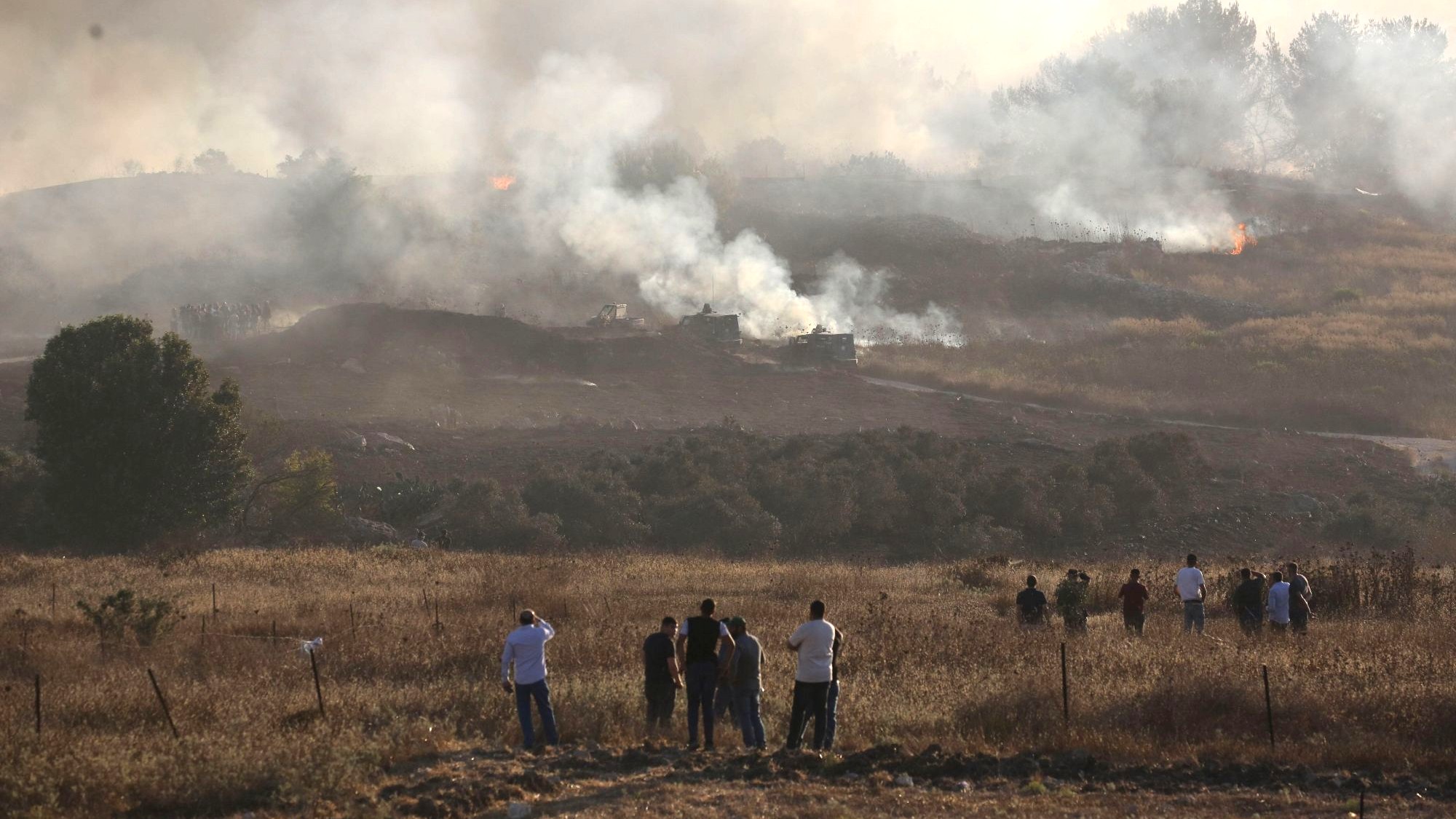
Qantara: Israeli settlers have besieged the West Bank village of Qusra since 9 August 2026. How would you describe the state of settlement expansion in the West Bank today?
Issa Amro: We must not fall into the usual traps of Western media by focusing on a single incident. Since the current Israeli government was formed at the end of 2022, a policy of organised violence has been adopted, aimed at pushing Palestinian communities out of their places of residence.
In Hebron alone, more than a thousand families live under siege and other restrictions because of settler attacks and the closure of checkpoints. They cannot move or receive visitors freely. The same scene keeps repeating in Masafer Yatta, Masafer Bani Naim, and around Nablus, which makes Qusra one case in a much wider pattern. The attacks in Huwara, near Nablus, in March 2023, which included assaults, arson and a siege, are a case in point, and they came with incitement from Israeli politicians, including Finance Minister Bezalel Smotrich.
Over the past three years, more than 118 Palestinian communities have been displaced. Since the beginning of the year, more than 1,600 attacks have been recorded. And this is merely what has been successfully documented, the actual scale of attacks is much greater. In my home in Hebron, we are subjected to an average of four attacks per day, and the number may exceed ten attacks on the weekend. We do not document all of them.
What is the most common pattern in these attacks?
Some people in Tal Rumeida in Hebron city told me that settlers spat on them while they were in the street, beat women, and closed roads. This is not to mention the thefts, destruction, gunfire, and burning of Palestinian homes.
We are talking here about truly shocking numbers. Since 7 October 2023, National Security Minister Itamar Ben-Gvir has granted 300,000 gun licenses to Israelis, under the eyes of the government and the Knesset. In the name of defense and security, he has technically established multiple militias. Before becoming a minister, Ben-Gvir was a suspect in more than 50 criminal cases with Israeli police, and has one terrorism-related conviction. He is an admirer of Baruch Goldstein, the perpetrator of the 1994 Hebron massacre.
When Shin Bet, the Israeli Security Agency, interrogated me the last time, I told them that what is happening is not legal. They replied: "We no longer have law, we act by the logic of force." So I told them that whoever does not respect his own law must either change it, or know that they are headed toward self-destruction.
What has allowed this level of escalation and violence in recent years?
First, Palestinian division and the weakness of the Palestinian National Authority, alongside the absence of a unified Palestinian program within the Palestine Liberation Organisation (PLO) to support families and actually represent Palestinians.
Second, the silence of the international community, especially given that many settlers hold French, British, American and German citizenship. When they attack us in Hebron, many of them speak to us only in English and some of them receive support from institutions based in these countries. The international community does not want to enforce laws against Israeli settlers or the Israeli state and its financial system. Rather, the system freely allows this support. Simultaneously, Palestinians face strict security screening procedures even when applying for a simple European visa.
But there are international sanctions: several European countries and Canada recently announced trade restrictions on goods coming from Israeli settlements. Some have imposed travel bans on Ministers Smotrich and Ben-Gvir. The EU imposed sanctions on individuals and organisations involved in settler violence, including freezing their assets.
The sanctions do not at all match the scale of violations on the ground. Despite global consciousness and the growth of the Palestine solidarity movement, there needs to be an increase in organised efforts. One example is Amnesty International's 2017 campaign to limit the entry of settlement goods into European markets.
Everything related to settlements, including trade, must be treated as illegal. European parliaments should move in this direction as well. Settlers must be deemed terrorists and punished systematically, not merely as individuals.
Do you believe that the genocide in Gaza has allowed settlers to intensify their crimes in the West Bank?
Of course! The genocide monopolised the attention of the world around what is happening in the Gaza Strip. The occupation exploited that to target the West Bank, fully evading scrutiny. Violations increased in quantity and with unprecedented, ferocious intensity and violence. Settlers began attacking homes and firing freely, and we are not allowed to defend ourselves.
We saw what happened with Farouk Ramadan, who defended himself and his land after a settler attacked him. Farouk seized the settler's weapon and shot towards him. Farouk was essentially killed by the Israeli army and accused of terrorism. His home was demolished and members of his family were arrested. If this had happened in any other law-abiding country, he would not have been punished in this way, for it was clearly self-defense.
Moreover, since 7 October 2023, about 185 settlement outposts have been established or expanded, as the Israeli government allocated 8.5 billion shekels, about $2.8 billion, for settlements, settlers and settlement infrastructure.
Israeli Defense Minister Israel Katz decided, in August, to transfer responsibility for dealing with settlers in the West Bank from the army to the police affiliated with Ben-Gvir. What implications does this have?
This discussion is inaccurate and full of worn-out media slogans. The civil police is the body authorised to deal with settlers and apply civil law to them, because they are originally subject to civil law, not military law. This arrangement has existed from the beginning, and is not a new matter as it is portrayed.
Personally, when I am attacked by settlers, I file a complaint with the Israeli police. The army does not intervene. Even Breaking the Silence, which includes former Israeli soldiers, says that the army's role in the West Bank is to protect settlers, not besiege them or hold them accountable.
„Zwischen Fluss und Meer ist Platz für alle“
Netalie Braun dreht antimilitaristische Filme in einem Land, in dem die Armee „in die DNA der Gesellschaft eingeschrieben ist", wie sie sagt. Hier spricht sie über Zensur in Israel, Boykotte im Ausland und die Schwierigkeit, sich Frieden überhaupt noch vorzustellen.
How do you explain the gap between the scale of attacks that Palestinians face and the small number of settlers who are held accountable?
There is no real accountability. There are several reasons for this: among them is the fact that the number and nature of Israeli police stations in the West Bank are inadequate for dealing with such crimes.
Alongside this is a local culture among some Palestinians, unfortunately, of not complaining, not trying and not exhausting oneself for nothing, because complaints in Israeli courts are not met by political will to hold settlers accountable.
Judging from all of the above, what does Palestinian life in the West Bank look like five or ten years from now?
The situation is dire, and could lead to further brain drain and immigration and investment abroad. We are heading toward a reality of cantons besieged by the army and settlers, with ever more land seized and controlled, often under full Israeli jurisdiction. The trajectory leads toward the displacement of Palestinians to Jordan and neighboring Arab countries.
There is no exaggeration in this description: there are about 925 obstacles to Palestinian mobility in the West Bank, including checkpoints, gates, and others.
So, are we facing a new model of controlling Palestinian land without the need to declare its formal annexation?
Annexation in the West Bank is already an existing reality. There is ever more control over land, water, and electricity sources, alongside major undermining of the powers of the Palestinian Authority. Therefore, I don't think the term "annexation" alone reflects what is happening, for the West Bank has now fully become part of the state of Israel.
Can what is happening today be reversed politically and geographically, or have we reached a point where retreat from settlement has become almost impossible?
International will is necessary if we are to end the occupation and settlement and implement the International Court of Justice ruling issued two years ago. The ruling considers the continuation of Israel's presence in the occupied Palestinian territories and settlement to be illegal, and calls for their termination within a year. The deadline has passed without implementation. Implementation of the ruling is thus a fundamental step toward ending the occupation and settlement. There needs to be a serious and effective international stance around this ruling.
To what extent has settlement changed the shape of the West Bank? And what is its impact on the future of the two-state solution?
Over the past three years, Hilltop Youth, a settlement group leading pastoral settlement outposts in the West Bank, has managed to dominate about 18% of the West Bank and more than 63% of Area C. It is now heading toward Areas B and A. The Palestinian National Authority is supposed to control 40% of the West Bank, represented by Areas B and A, but its actual control does not exceed 5 to 10%.
So there is no two-state solution?
There is no two-state solution. There is no solution at all in light of the international community's complicity and its refusal to hold Israel accountable for the war crimes it commits.
What is the solution, then?
First, we Palestinians must choose an alternative leadership and activate the PLO, involving all Palestinian political poweres within it. We must unite.
Second, we must adopt a program to strengthen steadfastness and popular, non-violent resistance in the West Bank and Gaza.
Third, a global campaign that isolates and holds Israel accountable for settlement and its crimes in the world must be established. Pressure must be put on Western governments to implement international law.
This is an edited translation of the Arabic original. Translated by Basyma Saad.
© Qantara.de